
Why You Should Get a Degree in Aviation Management?
July 21, 2026 2026-07-21 3:52
The future of aviation needs visionary leaders!
The aviation industry ranks high among the most dynamic industries worldwide. Aviation includes commercial airliners, international airports, cargo, aerospace operations, and the use of aviation technology to link persons, companies, and countries. With continued development and growth of aviation due to digitalization, sustainability efforts, and the ever-rising demand by consumers, there will be a need for leaders with expertise in handling complex operations.
As a result, pursuing an aviation management degree has emerged as the best education track for those hoping to take on positions of leadership in aviation operations. If your career objective is to be involved in airfield operation management, airline administration, coordination of aviation logistics, or strategic planning in the aerospace industry, a degree in aviation management might be suitable for you.
Aviation management graduates require not only knowledge but also a number of other abilities in order to operate in this fast-changing field. Hence, there is a need for a comprehensive aviation management program that can help the students develop the required competencies that can prepare them for diverse career opportunities in the future. Business strategy, organizational leadership, operations management, regulations, customer service, and technology are all essential parts of today’s aviation industry.
What Is an Aviation Management Degree?
An aviation management degree such as master in aviation management combines specialized knowledge of aviation with the fundamentals of business and management. The curriculum ensures that graduates develop a thorough understanding of the workings of aviation companies and acquire vital skills in leading, strategizing, and making decisions in order to effectively manage resources and systems.
Whereas conventional education in aviation concentrates mainly on flying or maintaining aircraft, a degree in aviation management provides a basis for careers at senior management levels within all aspects of aviation – from airlines to airports and regulators.
The main topics covered in an aviation management degree include:
- Aviation operations
- Airport administration
- Airline management
- Aviation finance
- Aviation law and regulations
- Strategic planning
- Human resources management
- Risk management
- Supply chain and logistics
- Customer service excellence
- Leadership development
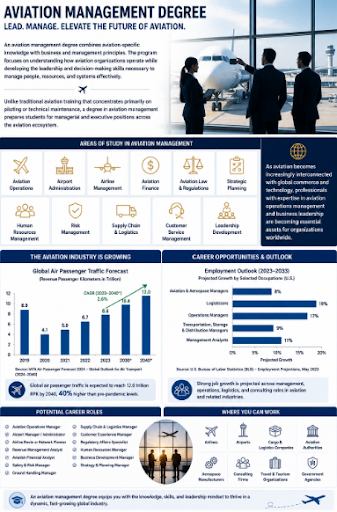
Here are few insights that will help to understand the infographic better:
- Aviation management encompasses knowledge on aviation operations and management, leadership, and decision making.
- It equips students with competencies not limited to the job of pilots or aircraft mechanics.
- Some of the key disciplines taught under the curriculum include airport management, airline management, aviation finance, regulation, logistics, risk management, and customer service.
- In the infographic, one of the facts revealed is that aviation will continue to develop due to the increasing numbers of projected global passengers.
- Career opportunities relate to management, logistics, operations, consultancy, and transportation.
- There are many places of employment available, including airlines, airports, cargo, aviation authority, aerospace, tourism-related organizations, and government bodies.
- Career opportunities available include aviation operations manager, airport manager, airline planning officer, revenue analyst, and safety manager.
- In general, aviation management assists graduates in developing necessary skills for management careers within a growing aviation sector.
With the continued development and integration of aviation in relation to global business and technology trends, there will always be a need for people who possess not only the technical expertise, but the skills and know-how needed in leading a business organization such as expertise in aviation operations management and related leadership skills.
Why the Aviation Industry Is Growing Faster Than Ever
The aviation industry has continued to experience remarkable growth thanks to a number of trends around the globe:
Growth in Global Movement
There is still more demand for air travel because of business travels, tourism, trade, and the interconnectedness of the world. The airports and airlines have to keep on adjusting their operations to cater to the ever-increasing passengers.
Technology Innovations
Use of artificial intelligence, automated systems, big data, security through biometrics, and digitalization are impacting the aviation industry to a great extent – changing the operation based on real-time data. Hence, it is important that leaders need knowledge of technology and management.
Growing Importance of Cargo Flights
Demand for better logistics operations has grown due to rising e-commerce activity. The management of the aviation companies is involved in logistics optimization.
Environmental Concerns
Efforts towards reducing carbon emissions, sustainable fuel usage, and environmental preservation are also playing a big part in changing the overall operation of the aviation industry. The present-day leaders will have to strike a balance between the two.
Leadership Change
With older generations of professionals retiring from work, there is a need for new leaders in the aviation industry.
These changes present numerous opportunities for students enrolled in an airport management degree or an airline management degree program.
Your Future in Aviation Starts with the Right Education
The Value of Aviation Management Education
A good aviation management education is not just about gaining knowledge of terminologies and processes. Instead, it involves building critical skills in thinking, leading, and strategic decision-making.
The best aviation managers are those who know how to:
- Analyze operational problems
- Enhance organizational effectiveness
- Maintain multidisciplinary teams
- Negotiate regulatory demands
- Satisfy customer needs
- Innovate new technologies
- Drive organizational change
With quality education, graduates can make meaningful contributions to aviation organizations immediately while preparing themselves for a career that can create success stories in the future.
Beyond Theory: The Importance of Real-World Learning
Here it is important to mention that traditional education programs come with challenges where there is disparity between theoretical ideas and practical knowledge. The aviation industry operates in a fast-paced environment where every decision happens in real-time which can affect safety, efficiency, customer satisfaction, and profitability of the company. Hence, employers in this industry prefer individuals with knowledge in practical applications more than just theoretical learning.
That is the reason modern aviation education is better off with a practice-oriented learning experience. Learning about real-world aviation problems can help students improve their critical thinking skills, gain more confidence and become more skilled leaders. It is more advantageous for individuals to be able to relate their learning process directly to contemporary problems within the aviation industry and workplace experiences.
Moreover, the future of aviation relies on individuals who have the capacity to manage uncertainty and foster innovation based on technical expertise and skills in management. These are the elements that determine the success of organizations. Individuals with technical skills in aviation who can manage strategically tend to be more successful.
Career Opportunities with an Aviation Management Degree
The type of job one will be employed in depends entirely on personal interest, specialization, and professional experiences.
The following is a list of possible career options:
Airport Manager
Airport managers are responsible for overseeing all aspects of airport operation including compliance, employee supervision, security coordination, and customer services.
Airline Operations Manager
These individuals coordinate schedules, resource allocation, and performance of services provided by the airlines.
Aviation Operations Manager
Individuals with expertise in operations management coordinate operations within the organization to make them efficient and harmonious.
Aviation Business Executive
Business administrators provide organizations with effective ways of growing through improved performance.
Aviation Safety Manager
These individuals formulate safety measures and procedures and monitor their implementation to ensure compliance.
Air Cargo Manager
Cargo managers supervise logistics, chain of distribution, and transportation networks.
Aviation Consultant
Consultants help organizations improve performance and adopt technology innovations.
Aviation Entrepreneur
Most graduates end up funding their own enterprises in the aviation industry.
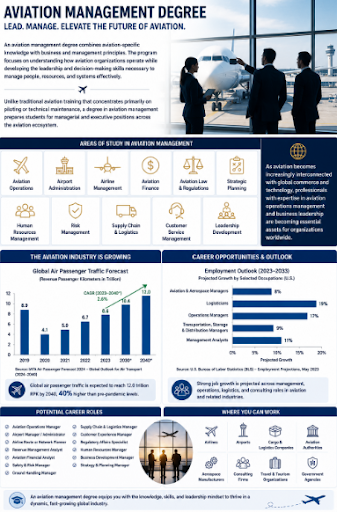
Below are the key insights:
- The airlines carried 853 million passengers, highlighting the magnitude of the industry.
- The airlines flew 948 billion RPM, indicating high passenger activity.
- There were 32 billion RTM of freight carried in the USA.
- Civil aviation was responsible for around 10 million employment in the USA by 2022.
- Contribution to GDP by the Aviation industry reached 4% in 2022.
- Projected growth rate is at 17% from 2024 to 2034; one of the promising careers for aviation.
- Growth rate is estimated at 9% for management analysts from 2024 to 2034; good for consulting and improving efficiency roles.
- Estimated growth rate is at 6% for project management specialists from 2024 to 2034; applicable for airport, airliners, and infrastructural projects.
- Expected growth rate is 6 percent for the following categories: Transportation, storage and distribution managers between 2024 and 2034.
- Some of the median salaries are – Transportations, storage and distribution managers ($102,010), management analysts ($101,190), project management specialists ($100,750) and logisticians ($80,880)
Why Personalized Learning Matters in Aviation Education
Every student enters higher education with different professional goals, experiences, and aspirations. Some may be experienced aviation professionals seeking leadership advancement. Others may be transitioning from military service, logistics, business, or related industries. Still others may be entering aviation for the first time.
Education systems taking account of these differences are likely to result in more productive educational experiences for their learners.
Personalization of the curriculum using curriculum builder tool enables each learner to relate his or her education to career goals, professional background, and personal interests, leading to increased motivation and relevance. Instead of adhering strictly to academic disciplines, students can pay more attention to subjects directly relevant to their future endeavors.
The Advantage of Academic Freedom at AIU
Sometimes innovation takes place in cases where people are stimulated to think outside the box. Freedom of academic choice allows students to explore aviation innovations and conduct interdisciplinary studies.
As an ever-changing field – having a unique point of view can be a great career asset and that is possible through academic freedom and open curriculum where an individual can add courses necessary for their own personal and professional goals. In fact, individuals who are given the freedom to choose their learning path usually have better problem-solving skills.
Learning Through Andragogy: Education Designed for Adults
Adult learners bring valuable experiences, insights, and professional knowledge into the educational process.
Andragogy recognizes that adults learn differently from traditional students hence, AIU offers andragogy-based learning modules to students. Instead of relying on instructor-centered structured teaching – this approach encourages self-directed learning, critical reflection, and practical application.
For aviation professionals and aspiring leaders – this learning model can be particularly effective because it connects academic concepts directly to real-world situations and professional experiences. Students become active participants in their learning journey rather than passive recipients of information.
Why Study Aviation Management Online?
With the increased demand for accessible and flexible education programs, one can observe the rising popularity of obtaining an aviation management online degree. An online education program allows balancing academics with work responsibilities and other personal needs, which makes it particularly convenient for working people. In addition, the global accessibility of such programs allows obtaining quality education regardless of geographical location.
One of the best features of obtaining a degree in an online manner is that a student will be able to apply new knowledge directly in a work environment, thus making academic work beneficial and useful at once. Furthermore, online degrees allow more personalization of the process due to increased self-management opportunities, as well as provide access to the course material from any computer. Combining education and work, the chosen program combines academic and practical aspects of learning, which makes it highly effective.
Why Now Is the Right Time to Earn a Degree in Aviation Management
The aviation industry is moving towards an era where technology plays a key role, along with issues such as sustainability, changing consumer preferences, and globalization. Therefore, there is a need for professionals who can take charge of managing the process of change, handle the complicated processes, apply new technologies, implement solutions, and create resilient organizations.
Aviation management education programs prepare the learners to succeed in this changing world and at the same time become future leaders in the field of aviation. From pursuing a course in airport management, airline management, aviation operations management, or even the broad field of aviation business administration while doing a doctorate in aviation management, the learner acquires skills beneficial in their career advancement.
Build a Career That Helps Shape the Future of Aviation
Aviation goes beyond transportation – as it is an industry that fuels commerce, tourism, innovations, and connections across the globe. With continuous evolution in the industry, the need for leaders will become even greater. By undergoing aviation management coursework, gaining firsthand experience, and receiving leadership training, as well as having a tailored curriculum, students can find their place in the future of aviation management.
A major in aviation management goes beyond attaining qualifications. It involves empowering oneself with the skills, knowledge, and leadership qualities that are required to affect change. For students in search of flexibility, relevancy, academic freedom, and growth opportunities – choosing to major in aviation management can be a step in the right direction.
Discover AIU’s Flexible Path to Professional Growth
FAQ:
Q. Is an aviation management degree useful?
Yes, an aviation management degree equips students with leadership, operations, and business skills needed for careers in airports, airlines, logistics, aviation consulting, and aerospace organizations, creating strong long-term growth opportunities.
Q. What is the salary of an aviation manager?
The salary of an aviation manager varies by location, experience, and employer. Many professionals earn competitive salaries, with senior managers, airport directors, and airline executives often earning significantly higher compensation.
Q. What’s the highest paid job in aviation?
Ans: Some of the highest-paid aviation roles include airline executives, airport directors, aerospace executives, chief operating officers, and commercial airline pilots, with compensation increasing alongside experience, responsibility, and expertise.
Q. What can I do with my aviation management degree?
An aviation management degree can lead to careers in airport management, airline operations, aviation logistics, aviation consulting, safety management, air cargo administration, business development, and aviation leadership positions.
Author Bio

Kathakali Basu is a dynamic Content Strategist and Brand Communication expert at Atlantic International University, with a knack for transforming ideas into compelling narratives. With a Masters in Sociology and certification in Content Marketing, Kathakali expertly crafts strategies that elevate brands and captivate audiences. Her extensive experience in content writing and strategy has helped numerous businesses articulate their vision and connect meaningfully with their target market. Passionate about blending creativity with data-driven insights, Kathakali thrives on creating impactful content for the last 16+ years that not only resonates but drives results.
An animal lover and believer in inclusivity, she actively participates in animal rescues and rehoming. When she’s not strategizing, you’ll find her exploring the latest trends in digital marketing or indulging in reading and her love for storytelling.