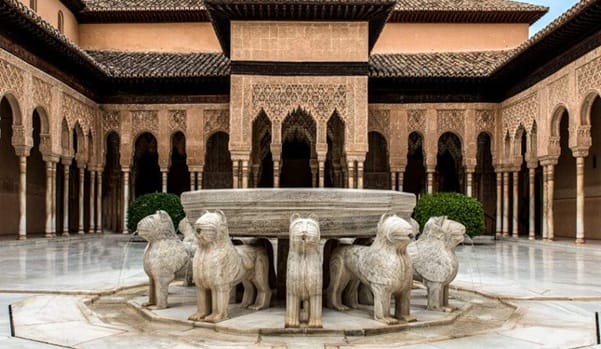
The year 1238 CE marks a significant milestone in the history of Granada — not merely a change of dynasty or political regime, but the beginning of an ambitious phase of engineering, architecture, urban planning, and hydraulic innovation that would leave an indelible legacy in southern Spain.
Context: Emergence of the Nasrid Domain
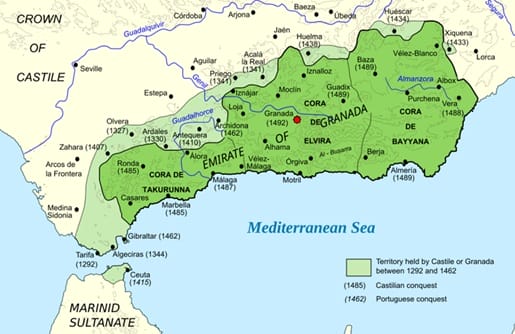
According to secondary research, in 1238, Muhammad I ibn al Ahmar (also called Ibn al-Ahmar) founded the Nasrid dynasty in Granada, establishing it as the last Muslim state (the Emirate of Granada) in the Iberian Peninsula. The city of Granada, strategically located at the foot of the Sierra Nevada mountains and overlooking a fertile plain, became the nucleus for a new phase of political resilience, cultural flowering and urban/engineering investment.
As part of its defensive layout, water infrastructure was incorporated with supply lines and channels that could run through the walls, tunnels, and towers. It is this sophisticated hydraulic engineering that is considered the most remarkable feature of the Nasrid-era works. It supplied water to the hilltop citadel and palace complex showcasing advanced hydraulic techniques for water supply. The main water source was the nearby Darro River and mountain streams that supplied water through these specially created channels and aqueducts that carried the water up to the plateau.
Careful planning with water-wheels, elevated channels, cisterns, fountains, baths and gardens represented the engineering marvel of the time. The fact that such systems were built on a hilltop fortress, rather than flat land, speaks volumes about the technical expertise of the people – the elevation differences, supply continuity, storage and distribution were measured and built with precision.
The stone known as “Santa Pudía calcarenite” was studied recently and was among the common materials in the historic buildings of Granada. Understanding its mechanical behaviour (compressive strength, elastic modulus, creep) helps to understand the engineering challenges of the time.
The design of arches, vaults and towers in the fortress kept horizontal thrust and opposing forces in mind — not unlike what earlier Roman or Mediterranean engineers had to account for.
Urban & Cultural Engineering
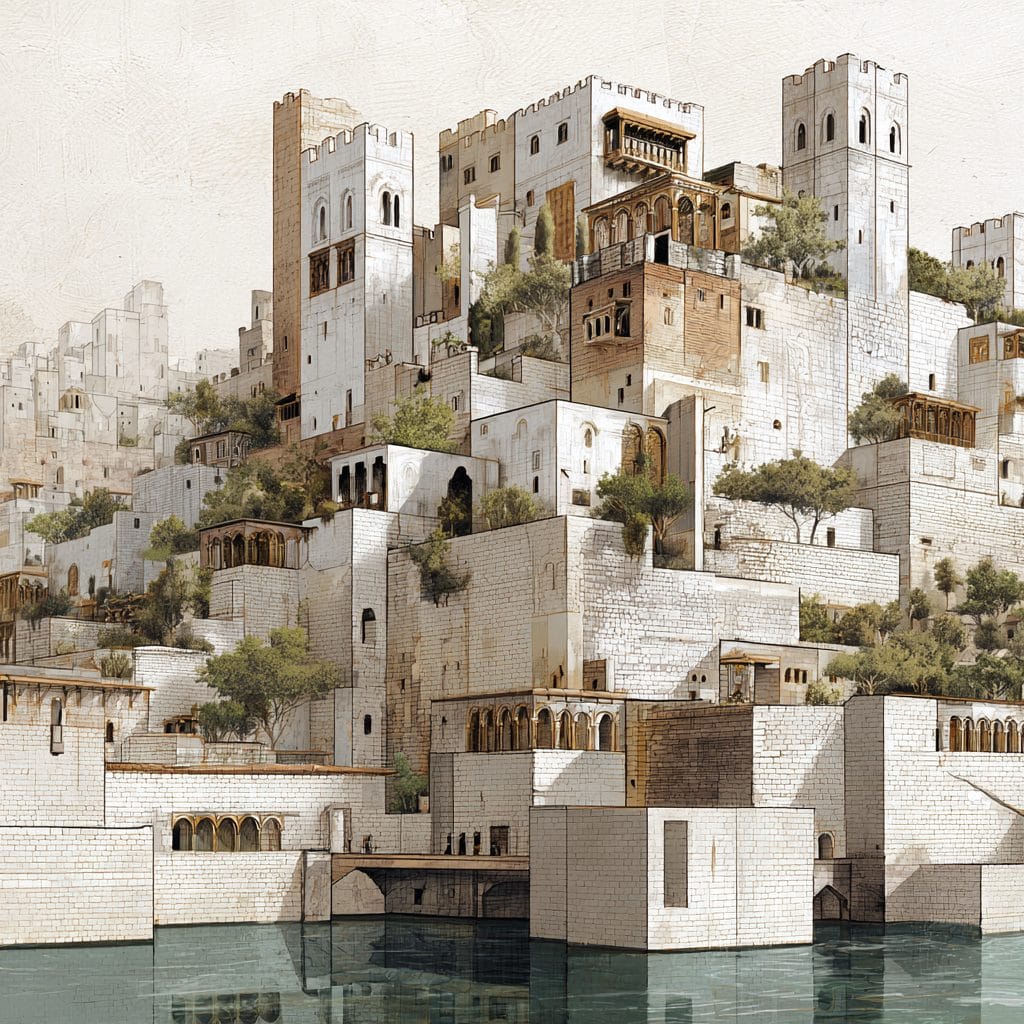
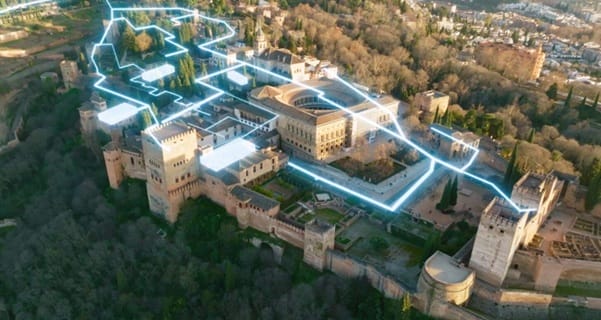
The Nasrids didn’t just build a fortress — they built a palace-city: administrative offices, mosques, workshops, luxurious palaces, gardens and baths, all integrated with the defensive urban fabric. The motto that there is no victor but God is emblazoned on the palaces. The very layout of Granada under Nasrid rule can be seen as engineered: narrow labyrinthine streets, vantage points for surveillance and defence, watercourses integrated into landscape, and the city adapted to its mountainous terrain.
Why 1238 Matters from an Engineering Perspective
1238 marks the starting point of a concentrated phase of construction and engineering in Granada under the Nasrids. It represents a moment where a fortress, palace, urban settlement and hydraulic systems were conceived as a unified engineering project, in a terrain that presented serious challenges. Moreover, the works initiated then were maintained, refined and expanded in later decades, but the engineering mindset founded in 1238 set the tone for the entire Nasrid period.
Legacy & Engineering Insights
The survival of much of the fortress/palace complex offers modern engineers and historians’ evidence of medieval engineering solutions: how to build on rock, how to manage water elevation, how to design for defence and habitation simultaneously. The integration of aesthetics with functional hydraulics is an early instance of “engineering meets luxury”. The engineering work also revealed cross-cultural transfer: elements of Roman/Visigothic water engineering, North African design, Islamic fortress architecture all blended together.
The primary level of challenges that they overcame were building on steep terrain. The construction had to account for rock bed, slope, stability of towers and walls. Then getting water up to the hill top is non-trivial; this requires channels, gravity, possibly mechanical devices. Again, its multi-functional aspect couldn’t be ignored. The site had to serve as a palace, fortress, residence, administrative centre — not just a military fort. Finally, using local stone like the calcarenite meant dealing with creep, weathering, and long-term durability issues.
Conclusion
Despite all the challenges, the efforts of the engineers mark a defining moment in Granada’s history—a convergence of vision, ingenuity, and engineering mastery. With the founding of the Nasrid dynasty – the city transformed from a regional stronghold into a living testament to human innovation. With the help of science, art, and necessity, creating a fortress that was as functional as it was beautiful.
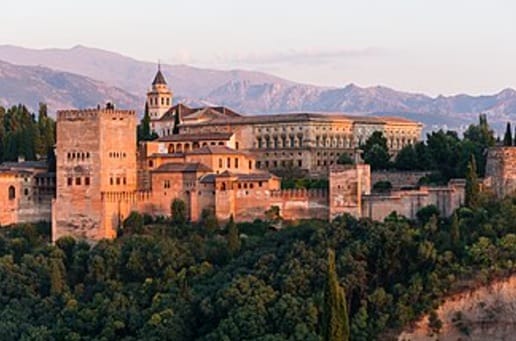
The works initiated in that year demonstrated a new understanding of how architecture, defense, and environment could operate as one cohesive system. The Alhambra, born from these early ambitions – stands as a symbol of this synthesis – a palace-fortress sustained by water channels, defended by design, and adorned with mathematical precision.
Hence, in 1238 – Granada became more than a city; it became a turning point in the evolution of medieval engineering and urban planning. Its builders anticipated principles that resonate even today – efficiency, sustainability, and the harmony of human creativity with the natural world. Through their innovations – the engineers of Nasrid Granada transformed a hilltop fortress into a masterpiece of enduring legacy.