The Three-Dimensional Reinforcement and Inclusion of Carpet Waste in Concrete: A Game Changing Breakthrough by Aussie Engineers
Concrete is the backbone of our infrastructure today. It is the most widely used man-made product on the planet and is found in almost every aspect of urban and rural property use, from tall buildings, bridges, and highway and road construction to crossings over rivers, earth embankments, and big dams. It is so prevalent, it exhibits amazing compressive strength, but despite its great strength, concrete has weaknesses; specifically, its most vulnerable point is when it has low tensile strength so the concrete will crack. The outcome of cracked concrete is very pervasive and almost all concrete crack during early age cracking mostly results from the effects of concrete curing and shrinkage—at times, months after it has been placed and finished.
This has ramifications not just a technical issue, per se but has economic implications (and environmental impacts) should not only ways to crush the concrete be explored but the issue of cracked concrete in terms of innovation be addressed, since in Australia alone, an estimated $8 billion a year is spent on rehabilitating cracked concrete in infrastructure, the USA spends approximately US$76 Billion a year.
It is important to differentiate that the financial cost of rehabilitating cracked concrete is not just a cost of repair, it is also indicative of structural deterioration throughout that same infrastructure along with deterioration in safety and aesthetics of the infrastructure and long-term durability and integrity of our buildings and public works infrastructure. We need to look at the problem in terms of the demand for resilient, durable, safe, sustainable, economic, and environmentally friendly building and construction materials required to expand and deal with urbanization everywhere on the globe, while attempting to meet the demand for creating climate resilient structures!
A Major Discovery: Waste carpets used to fortify concrete
RMIT University in Melbourne, Australia, is spearheading this exciting new research, led by civil engineer Dr. Chamila Gunasekara. The research team has designed a new and innovative concrete mix that contains scrap carpet fibres, a waste product formerly destined for landfill, and is now being repurposed and shown to make a significant difference to concrete performance.
The new concrete mix exhibited:
- A 40% increase in tensile strength, which means better resistance to pull and stretch forces.
- A 30% reduction in early-age cracking, a significant advancement as cracking is often one of the main points of failure in concrete.
These results are not simply academic. They could transform the nature of the construction industry globally, lower repair costs, extend the lifespan of infrastructure globally and put waste materials to useful and sustainable use in construction.
According to Dr. Gunasekara: “Scrap carpet fibres can be used to increase concrete’s strength by 40% in tension and prevent early cracking by substantially reducing shrinkage.”
How it Works: The Science of Fiber-Reinforced Concrete
Concrete cracks generally due to shrinkage during curing, loose moisture evaporates, and the concrete becomes dry. It shrinks, creating internal shrinkage stresses, thus resulting in micro-crack formations that are usually small and undetectable. Eventually, these micro-cracks propagate and lead to more serious damage to the structure, including corrosion of any embedded steel reinforcement that may be present.
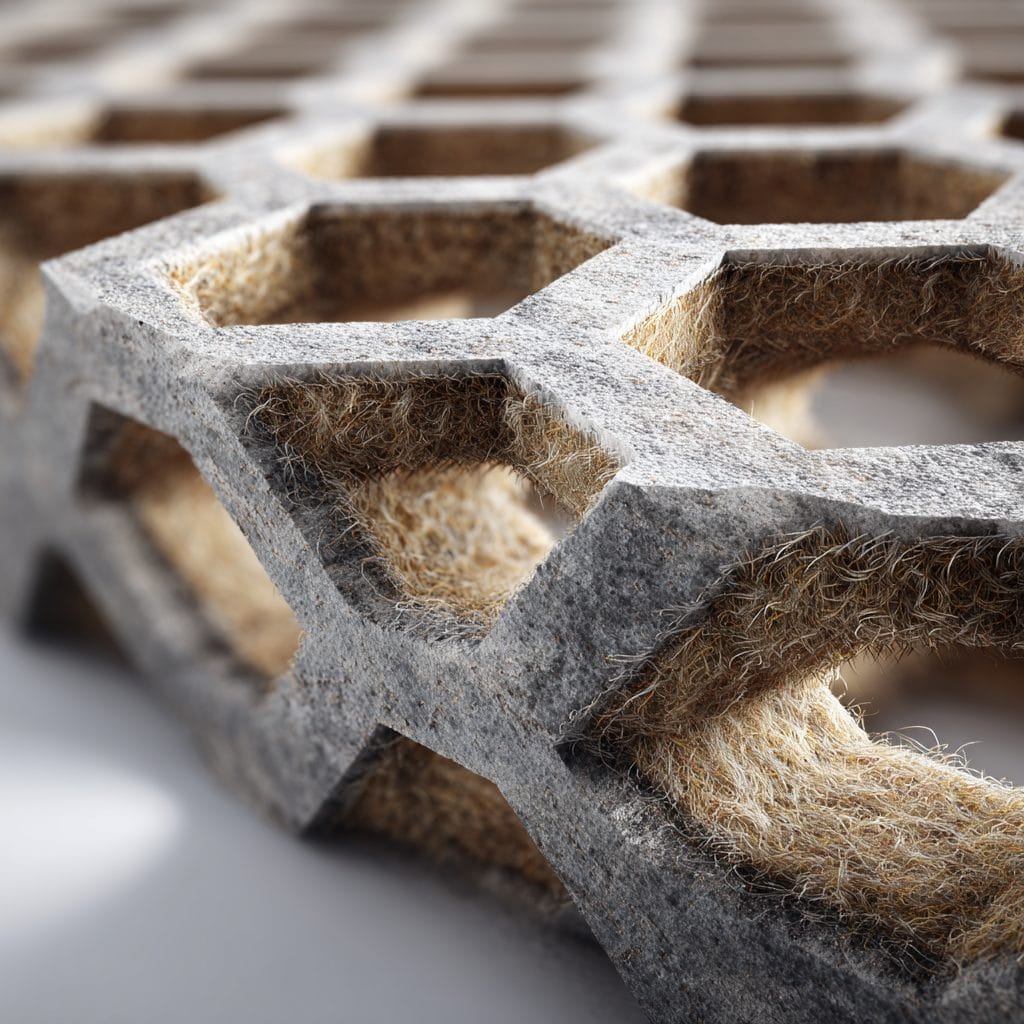
Carpet fibers–most commonly synthetic polymers including polymers like nylon, polyester, or polypropylene–are a constructing network of internal reinforcement for a specific purpose. They act to help bridge micro-cracks that help to:
- Distribute internal stresses better.
- Prevent micro-crack propagation.
- Increase flexibility and reduce external loads.
The fibers also help to reduce moisture loss and can inhibit the physical and chemical hydration process as well as control the overall shrinkage.
Environmental Catastrophe: Carpet Waste and Pollution
Textile waste and pollution release millions of tons, and landed or burned at the end of their useful life as carpets can be a significant environmental concern:
- They are composed of materials that will most likely be non-biodegradable.
- They can also have contaminants, such as flame retardants, dyes, adhesives and antimicrobials.
- Some of these chemicals may also be manufactured or emitted if burned, and may release hydrogen cyanide, dioxins, or heavy metals.
Open burning will produce ash and particulates that will contaminate the earth, and water.
Australia is ranked no. 2 in the world for textiles consumption in kilograms per capita, just behind the United States. The average Australian consumes annually 27 kilograms of new textiles, and throws away 23 kilograms, with most ending up in landfill. This alarming rate of consumption and lack of textile recycling will add to an escalating environmental concern. “This research is about more than concrete, it is about developing sustainable solutions for two huge problems simultaneously: durability of concrete and textile waste, as Dr Gunasekara stated.
Laboratory Success Meets Industrial Potential
The concrete infused with carpet fibers was put through rigorous testing in RMIT’s labs and was found to meet Australian Standards for engineering performance and environmental safety.
The next stage will be:
- Field tests in construction situations.
- Computational modelling to simulate long-term durability and stress.
- Collaborations with construction companies and municipal governments to trial and scale the technology.
- The challenge of moving technology from laboratory to field will be key in proving commercial viability and world impact.
Why This is Important: Sustainability and the Circular Economy
Concrete production is a significant global contributor to greenhouse gas emissions producing 8% of global CO₂ emissions. The concrete production process is also energy demanding, and requires the extraction of raw materials from quarries, heat, and chemical processes. By utilizing recycled materials from textile waste to replace part of the concrete mix, this new process:
- Reduces the reliance on virgin raw materials (gravel, sand and some other wider aggregates).
- Reduces carbon emissions from production and repair.
- Displaces harmful waste (periodic waste) from landfills and incineration.
- Creates a circular economy whereby waste becomes a resource.
“It’s a double win for the environment and for construction,” said Dr Gunasekara. “We’re not just making better concrete. We’re changing how we think about waste.”
A Call to Collaborate and Apply
In order to achieve the innovative potential, the researchers call on:
- Government agencies to enable regulatory approval and offer incentives.
- Construction companies to pilot the materials in government and private construction projects.
- Waste management industry to innovate and build a resourceful textile collection and processing streams.
With good collaborations, it is possible that carpet-fiber concrete will soon be useful in:
- Urban infrastructure
- Pavements and footpaths
- Precast building elements
- Disaster resilience housing
- Low cost sustainable housing developments
Conclusion: A Model for the Future of Green Building
As this research demonstrates, the technology represents a step change not only for construction, but also for waste management. In essence, RMIT researchers have developed a tangible and scalable solution to two of the biggest problems of this century: crumbling infrastructure and increasing levels of waste pollution, but turning rubbish into a resource.
As field trials continue and other sectors adopt this new technology, it’s possible that the use of this new technology may become routine in sustainable construction – both in Australia and worldwide. This new tech demonstrates that we are now moving toward smarter, greener options in engineering and environmental management.
The focus is not simply on constructing buildings that are stronger. It is really about creating a stronger planet.
Join Atlantic International University (AIU) and be a part of a world-wide community of sustainability, innovation and global impact. At AIU, you can design your own program, investigate new solutions, and help shape the future of sustainable construction, environmental science, and engineering – your way.
Empower your education. Change the world. Enroll at AIU today.
Reminder to our Dear Students,
Please ensure you are logged in as a student on the AIU platform and logged into the AIU Online
Library before accessing course links. This step is crucial for uninterrupted access to your learning
resources.