The Ancient Virus That May Have Sparked Vertebrate Intelligence
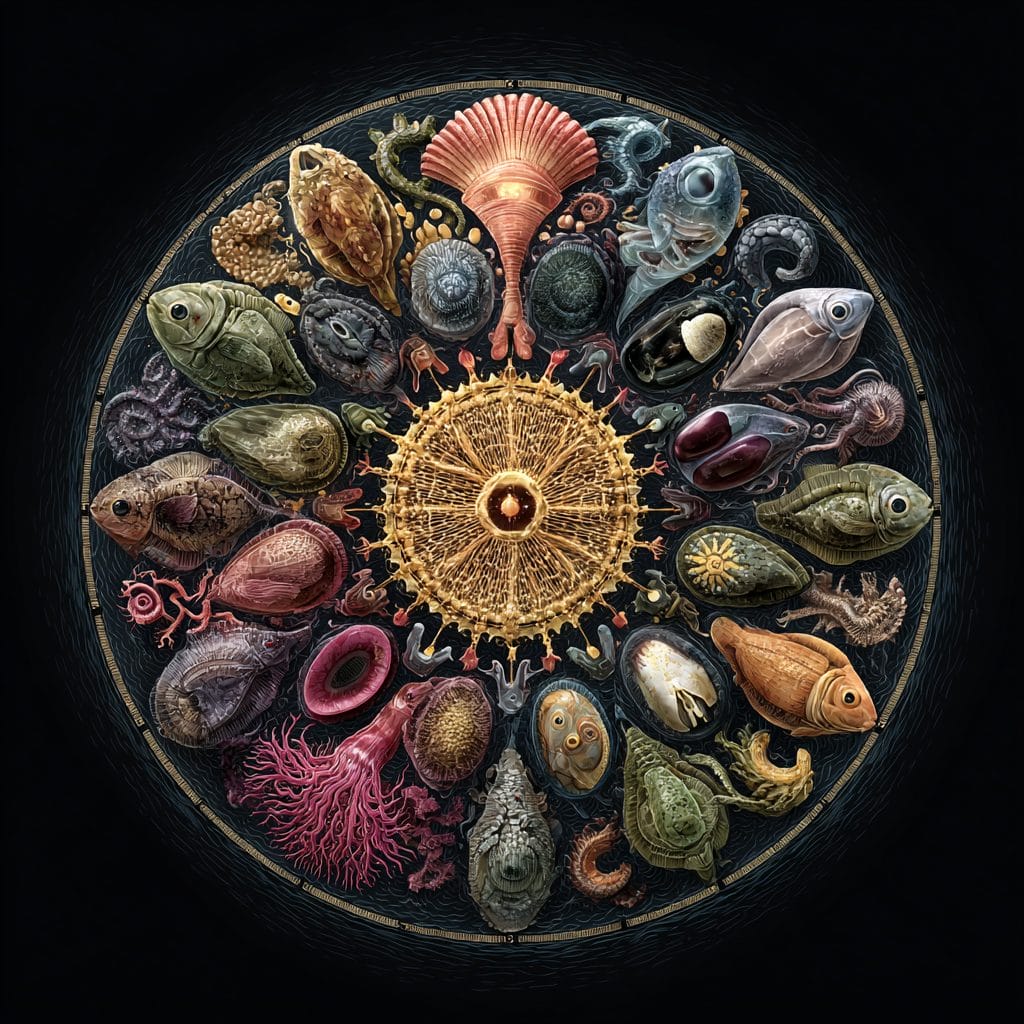
More than a half billion years ago, Earth was filled with strange, extraterrestrial-looking life. Seas swarmed with soft-bodied worms, jellyfish-like creatures, and primitive arthropods like trilobites. Land was vacant, devoid of green plants and terrestrial life. Then, and in what seems to be a blink of an evolutionary eye, the universe experienced a wholly new class of beings — vertebrates — endowed with backbones, centralized brains, and centralized nervous systems capable of processing information at unimagined levels of speed.
According to a new study, the catalyst for all of this activity may have been at least in part an ancient viral infection that, on some unknowable time scale, rewrote the DNA of our earliest vertebrate ancestor giving it the genetic instructions dermomyelin, the insulating sheath that allows nerve impulses to travel instantaneously.
Published in Cell, their research suggests that had the ancestral vertebrate’s encounter with a retrovirus several hundreds of millions of years ago never happened, all lines of vertebrates — fish and frogs to birds and mammals and us humans — would have never developed the cognitive complexity that distinguishes us all from all other forms of life.
A Dilemma that has Stumped Evolutionary Biologists
Charles Darwin characterized evolution as a latency to change: namely, beneficial small changes accumulate over generations to create variety. However, there are some traits that seem to arise as “punctuated equilibrium” – a term coined by paleontologist Stephen Jay Gould.
The sudden presence of myelin is another head-scratcher. Vertebrates began appearing about 500 million years ago, during the Cambrian explosion, and from their earliest fossils, they seem to be myelinated. However, there is no sign of myelin in their invertebrate ancestors. It would be like a complex, highly efficient neurological system popping into existence fully formed.
This creates a question: how could such a complex feature have evolved so suddenly and in two places at once in the nervous systems?
- Myelin originates in the peripheral nervous system from Schwann cells.
- In the central nervous system (brain and spinal cord), it is produced from oligodendrocytes.
If the two systems had independently evolved myelin, the benefits explored in the previous two examples could be a “bottleneck” in the experience in the initiation of myelination — like high-speed fiber-optic internet through a slow dial-up segment. Instead, it seems that myelin appeared in some sort of synchrony in both systems, suggesting one genetic change evolved simultaneously in both systems.
The only contemporary vertebrate that does not have myelin is the lamprey eel, a jawless fish that is the most primitive living representative of the lineage of the vertebrate. This makes lampreys a living time capsule — and a vital clue of when and how myelin first evolved.
The Viral Suspect Arrives
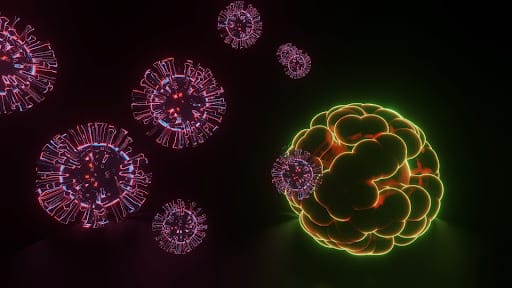
The group of researchers led by Robin Franklin from the Wellcome Genome Campus in the U.K. has tracked down a genetic sequence that is shared among all vertebrate groups with the exception of lampreys. This sequence, which has been called RetroMyelin, is the remnant of a retrovirus (a virus that directly inserts its genetic material into the DNA of the host).
Retroviruses are genetic free-loaders—they cannot reproduce independently, so they infect cells of the host, convert their RNA to DNA, and incorporate it into the host’s genome. Then the cellular machinery of the host produces viral proteins.
Across evolutionary time, many of the inserted viral sequences lose their ability to produce viruses, but they may still remain in the genome. These are called endogenous retroviruses, and in mammals they comprise an astonishing 40% of DNA. These sequences have often been described as “junk DNA,” but they ultimately serve crucial roles in regulation of genes.
In this case of RetroMyelin, it seems the sequence may serve to be a molecular switch for the production of myelin.
The Science of RetroMyelin Working
The main molecule in the structure of myelin is myelin basic protein (MBP), which zips the membranes of the myelin forming cell tight into electrically resistant layers.
This is how RetroMyelin is thought to act upon myelin formation:
- Retroviral Integration – Millions of years ago, a retrovirus infected an ancestor of all vertebrates (excluding lamprey), and inserted its genetics into the host DNA.
- Hijacking the SOX10 pathway – RetroMyelin binds to SOX10, a transcription factor that proteins the MBP gene.
- MBP Production – With the SOX10 transcription factor activated, the cells begin to produce large quantities of MBP.
- Wrapping the nerve fibers – The oligodendrocytes and Schwann cells extend long processes that act like tentacles around the axons (nerve fibers). The MBP molecules across from one another on either side of the membrane join together, squeezing out their cytoplasm, thus creating a tight sheath.
- Increased Signalling Speed – This insulation allows nerve impulses to ‘jump’ between the gaps in the myelin (nodes of Ranvier), and as a result can produce faster signalling speeds up to 100 times faster.
When scientists plugged the action of RetroMyelin in mice, tadpoles and zebrafish larvae, block myelin formation being made despite having supplied all other growth factors.
Myelin Changes Everything
With invertebrates, there are nerves in small bundles very close to the muscles or sensory organs they control. This makes sense with a simple body plan but creates chaos with coordination across the animal.
Myelin then allowed vertebrates to :
- Send signals long distances, with no delay
- Combine neural processing in a large brain
- Generate complex reflexes and behaviors
- Develop complex sensory systems (vision, hearing, balance)
All of these aspects equate to huge increases in mobility, agility, and brain-power culminating in vertebrates dominating the land, sea, and air.
Caution from the scientific community
Although the RetroMyelin hypothesis is fascinating, experts are cautious. Klaus-Armin Nave of the Max Planck Institute notes that myelination is an elaborate process involving many proteins and genetic regulators, and correlation is not causation.
Robert Gould, myelin researcher for the Marine Biological, also presents a mystery: if myelin depends on MBP, and MBP does not occur in pre-vertebrates, then where did MBP come from? Did RetroMyelin appear together with the MBP gene as a packaged deal? Or did RetroMyelin simply uncap the developmental potential of an established, but dormant pathway?
The final test according to scientists would be to put RetroMyelin into lampreys and see whether they develop myelin — a bold experiment to end the discussion altogether.
Viruses, Evolution’s Double-Edged Sword
Viruses are typically considered only virulent pathogens but the evolutionary trajectory of viruses is complex. While we know of their potential to cause disease and cancer, they are potential evolutionaries because they enable the generation of new genetic sequences. Examples include:
- Syncytin was fully formed from a retrovirus to be essential to the formation of the placenta in mammals.
- Viral sequences that can regulate immune responses and impacts on some immune-related responses of other organisms (e.g. SARS-CoV-2).
- Potential contributions to brain development and possibly other organ systems that are still unaccounted for.
RetroMyelin might be one of the most exceptional examples of using a viral genome – a gene not used for reproduction but to change the nervous system.
From Cambrian Seas to the Human Mind
If the argument stands, then every thought, every aspect of bodily movement, every flicker of human creativity owes its existence to a potentially ancient viral infection. Had it not been for an ancient viral infection on our ancestors, we would still be slow-moving phyla like other living organisms in developing life in the early Cambrian seas.
As Karen Carleton of the University of Maryland notes, “It does make sense that a retrovirus might be involved.” What is exciting is that the conjecture brings Darwin’s notion of gradual change together with the idea of evolutionary jumps — and possibly that our complexity comes from very unlikely partnerships with life.
Two whole centuries after Darwin’s famous voyage on board the Beagle, the story of myelin and RetroMyelin should remind us that evolution is not solely shaped by competition and natural selection but also by chance, happenstance, molecular accidents, and possibly a viral intrusion to our evolutionary ancestor.If evolution can be influenced by evolutionary forces like competition and adaptation, but also random events like an ancient viral intrusion, then the pursuit of knowledge is even more meaningful.
At Atlantic International University, we are part of that spirit of inquiry where science, history, and curiosity converge to yield life’s most extraordinary narratives. Our flexible, purpose-based programs will enable you to explore those profound questions, relate disciplines, and augment humanity’s knowledge of itself. Be part of AIU and be part of creating the next great discoveries that might, just like RetroMyelin, overhaul how we think about the world and our place within it.
Reminder to our Dear Students,
Please ensure you are logged in as a student on the AIU platform and logged into the AIU Online
Library before accessing course links. This step is crucial for uninterrupted access to your learning
resources.