Unveiling the Invisible: Scientists Portray the Shape of a Single Photon for the First Time
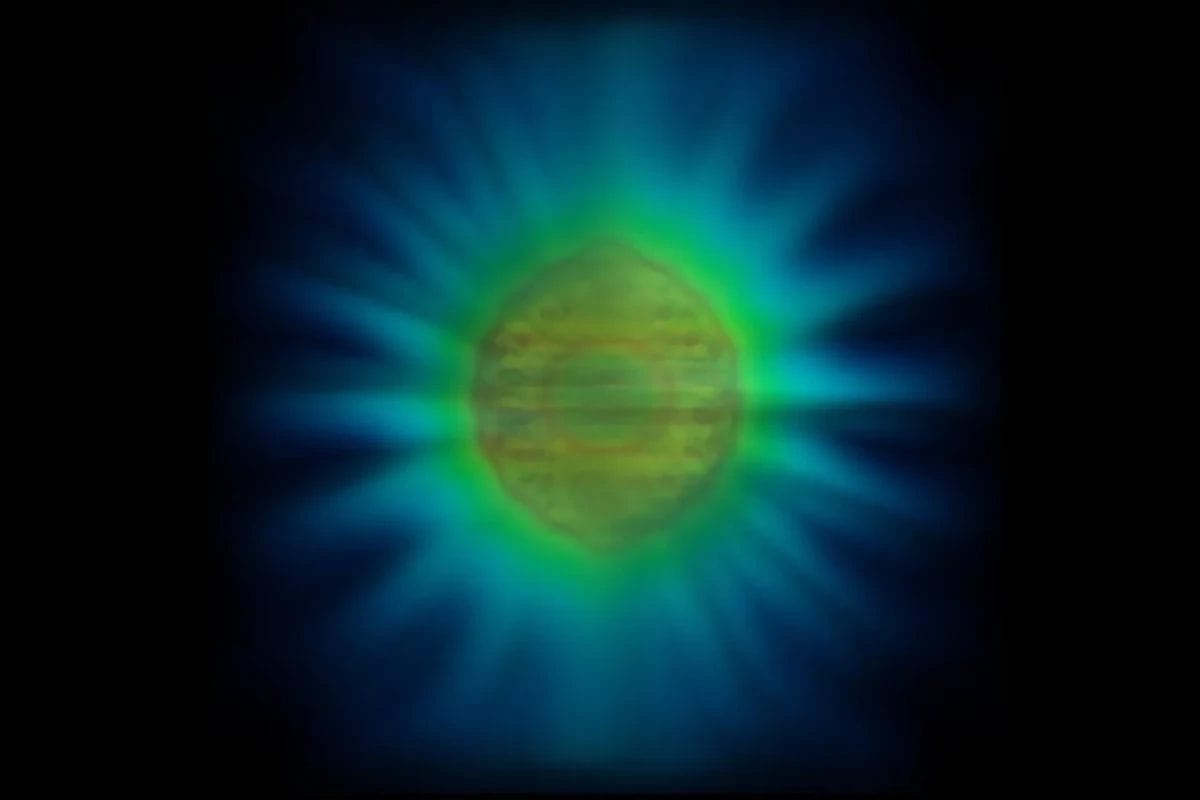
In a remarkable progress in optics and physics, researchers have achieved what was once thought impossible-the first portrait of the shape of a single photon, the most elementary unit of light. This was led by physicists of University of Birmingham, and while they did not take photographs of the light, it is a fundamental achievement using advanced mathematics and quantum field theory to replicate the intensity distribution from taking a measurement of light from an atom after emitting the photon.
The image they produced is not a simple interpretation; it is a scientifically accurate representation of an important feature of light, quantum mechanics and the fundamental workings of the universe.
What Is a Photon? The Elementary Building Blocks of Light
Photons are the quantum particles that incorporate electromagnetic radiation – visible light, X-rays, gamma rays, and radio waves to name a few. Quite unlike most other particles, even photons have no rest mass and they travel at the ultimate limit of all speeds – 299,792,458 meters/second; this universal speed limit is referred to as the speed of light. They act like carriers for energy, momentum, and information.
When photons hit our retinas or the sensors of a digital camera, they transmit a myriad of information about the objects they originated from or bounced off of that provide the utility we call seeing. Nonetheless, while photons are vital to the existence of perception, we cannot actually see photons. Photons do not interact with one another, do not interact with ourselves, nor can we observe individual photons without them being destroyed.
This has caused a quandary in optics for years: we literally use photons to see, but we cannot see a photon; until now.
Seeing the Unseen: What is the “Shape” of a Photon?
It can sound odd to suggest that a photon has a “shape.” Usually we think of photons as point particles, the smallest possible distinct, and non-divisible quantity. Which raises the question of whether there even is a shape, or if there is an internal structure to a photon, how that internal structure would manifest itself.
However, in quantum mechanics we describe particles using a wave function, which tells us how likely we are to find a particle in a specific location, or associated with a specific internal state.
The “shape” of a photon, in this way, does not refer to a physical outer outline, rather it is the three-dimensional intensity distribution, which we could call the photon intensity map. Conceptually, this represents the conceivable probabilities where you are likely to be able to find the photon at a given time following emission. Bright areas on this map represent higher probabilities you will detect a photon in this region, which has coherent spatial ordering of intensity distributions that represents the shape of the photon.
This “cloud” of quantum probabilities is ever changing, which is a product of environmental factors and the characteristics of the atom itself. This helps realize the genesis of quantum mechanics- uncertainty, superposition, and statistical behaviour.
How Did They Visualise the Shape of the Photon? THE QUANTUM PUZZLE IS SOLVED
You will first notice that it is pretty stunning. However, that is not what the researchers were intending to achieve with their study. The scientists wanted to examine a much larger question on how the local environment influences the way in which photons are emitted from an atom or a molecule.
Traditionally, the quantum mechanics of photon emission has placed a narrow emphasis on the extreme simplification of a perfect vacuum condition, where a single atom or molecule is assumed to emit light in absolute isolation from everything else. In contrast, in real life, atoms are not found in isolation, surrounded only by vacuum. Instead, they are surrounded by materials, surfaces, and particles that can greatly influence the behaviour of light.
As a way of understanding these interactions, the researchers built a new theoretical model based on quantum field theory, incorporating a silicon nanoparticle into the system. This nanoparticle had considerable effects:
- It significantly enhanced the probability of emission of a photon from the atom by many factors, up to thousands of times!
- It created the possibility of a photon being re-absorbed and emitted by the same atom many times, which is typically prevented in free space.
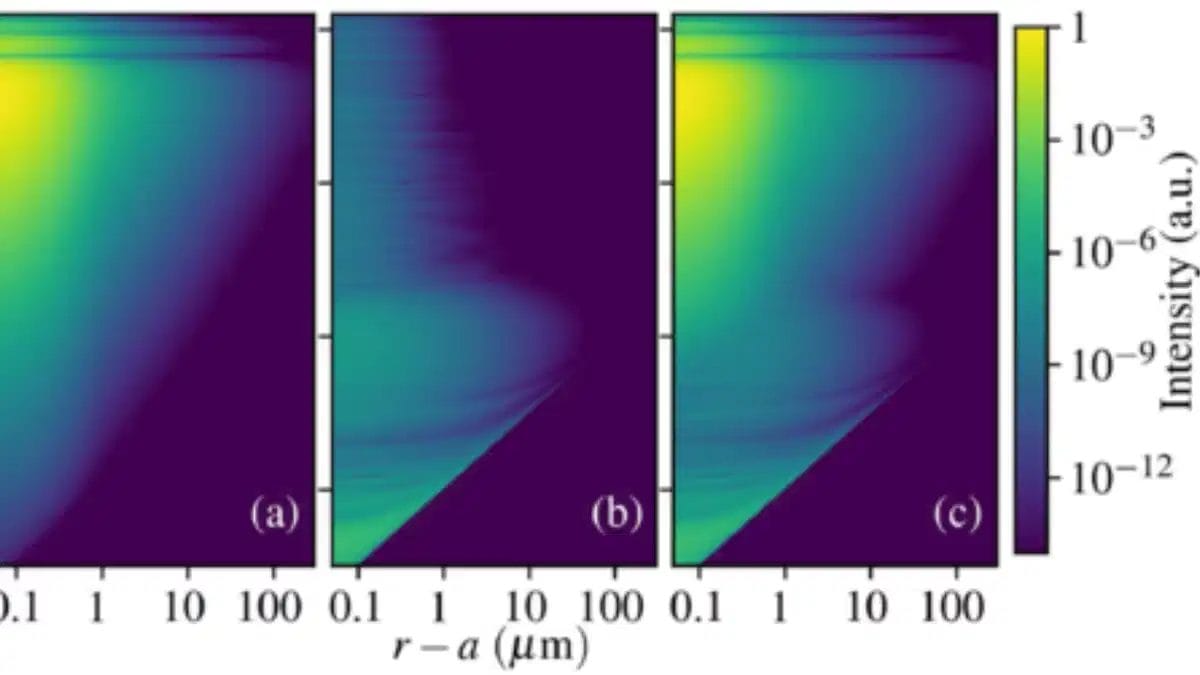
Using a powerful mathematical approach known as complex analysis, the researchers were able to practicalize these difficult infinite sets of interactions between the nanoparticle, and a continuous spectrum of light, and turn them into a discrete system. They offered many complex modes in place of an infinite set of possible light states – each one contributing to the behaviour of the emitted photon.
The outcome? A high-resolution quantum simulation of the photon’s intensity distribution just after it is emitted. What the researchers produced is essentially a ‘map’ of the quantum wavefunction of a single photon, providing a clear picture of the probabilistic “shape” of a photon.
The Physics of the Wave Function: Mechanics in Action
At the center of this research is one of the deepest and most mysterious ideas in physics, the notion of the wave function. The wave function contains everything that can be known about a quantum system and is not something that we can directly observe, although it helps provide a mathematical basis to predict all possible outcomes to an interaction or measurement.
For photons, the wave function will tell where we are likely to observe the particle, at least if we measure the particle flat out, it collapses the wave function giving a definitive answer, destroying the rest of the information.
The innovation of this work is in that not only did they observe the photon once and destroy all other information in the measurement process, they measured it many times theoretically, and simulated their work to then reconstruct the full intensity distribution—not the intensity distribution from one measurement, of just where you would see or detect the photon, they essentially reconstructed the full three-dimensional “terrain” of the photon wave function. Given that they have an accurate 3D view of the photon wave function, they have no precedent in viewing the quantum world so effectively.
Why This Discovery is Important: Applications and Implications
At this point, the visualization of the photon may seem somewhat abstract, but the potential implications of this work are incredibly practical and likely to impact a significant number of disciplines. Understanding the detailed behavior of photons, in particular, how they interact with materials, will enable great strides in many scientific and technological areas:
1. Quantum Computing and Quantum Communication
Precise knowledge of the shapes and wave functions of photons would improve quantum bit (qubit) fidelity and enable even more secure forms of quantum encryption. It may enable better control over photon-based quantum gates, optimizing the experiments of quantum information processing tasks.
2. Solar Energy and Photovoltaics
A deeper understanding of how photons interact with nanostructures would work towards designing more efficient solar cells, where we can optimize the capture of light and energy conversion at the most atomic level.
3. Optical Sensors and Imaging Devices
More advanced optical sensing systems, such as microscopes, or uses of light in medical diagnostics, could leverage phenomenally more sensitivity and resolution with the knowledge of how photons interact, especially in low light, and highly scattering environments.
4. Photonics and Nanoengineering
The project enabled a more advanced and detailed understanding of manipulating light. Knowledge for more intricate and elaborate photon based circuits, waveguides, and nanophotonic devices directly depends on the manipulation of light at such small scales. In all likelihood, this would facilitate advances in smarter, more precise designs.
A Paradigm Shift: Light Seen Differently
This visualization challenges traditional thinking on light and how we observe it. This perspective shifts our thinking on light from a steady stream of particles (a measure) to a much denser, sophisticated operational form – a quantum-probability structure dependent on context.
Moreover, the research supports the fact that the universe is more complex and structured at the level of quantum circumstance than we imagined. Each photon has energy and a spatial signature that are more complex, fine-tuned to the conditions of its context (the atom that it was born from) and electromagnetic signatures around it.
Conclusions: From Quantum Enigma to Science Fact
To visualize the shape of a single photon is a fundamental shift in physics. It gives insight into the world we live in and connects completely abstract equations of quantum mechanics with the universe we see. It verifies decades of theoretical work and provides the foundation for new science, and engineering of the future.
This is a better picture both literally, and abstractly of the oldest messengers of information in the universe. We are excited, and hopeful we are taking one more step towards demystifying a quantum universe, creating new opportunities for inventing and tinkering, and perhaps ultimately revealing deeper true knowledge about the universe.
If you are excited by discoveries like these and want to learn more about the forces at play from the quantum to the global level, Atlantic International University (AIU) provides a truly singular and transformative educational offering. At AIU, you will have the opportunity to create your own program, tap into over 8,000 learning components, and join the global academic community of AIU where curiosity, creativity, and lifelong learning thrive.
Reminder to our Dear Students,
Please ensure you are logged in as a student on the AIU platform and logged into the AIU Online
Library before accessing course links. This step is crucial for uninterrupted access to your learning
resources.