Revolutionary Titanium Metamaterials: A Breakthrough in Engineering and Biomedical Applications
In the field of materials engineering, scientists have long sought the ideal combination of strength, lightness, and resilience. Such properties are especially vital in sectors like aerospace, automotive, and biomedicine. However, creating materials that can simultaneously bear heavy loads, resist extreme temperatures, and maintain a lightweight form has remained a significant challenge.
Now, researchers from RMIT University in Australia have made a remarkable breakthrough. By drawing inspiration from biological structures like coral and plants and combining it with the precision of 3D printing technology, they have developed a new type of titanium metamaterial. This innovative design overcomes a decades-old limitation in metallic cellular structures—uneven stress distribution that leads to cracking under pressure.
The Challenge of Metamaterials: A Long-Standing Engineering Problem
Metamaterials are engineered materials with internal, repeating structures that give them unique mechanical properties not found in natural substances. These often take the form of lattice-like or cellular designs, making them ideal for applications that require lightweight yet strong components, such as bone implants, prosthetics, and spacecraft components.
Despite their promise, these structures have a fatal flaw: they crack under mechanical stress due to uneven weight distribution. The stress tends to concentrate at specific points (commonly known as “stress hot spots”), making the entire material susceptible to failure under load.
Over the years, engineers have tried various modifications to alleviate this issue, but no method had proven effective enough to fully unlock the potential of metamaterials—until now.
The Breakthrough Design: Combining Dual Lattices for Enhanced Strength
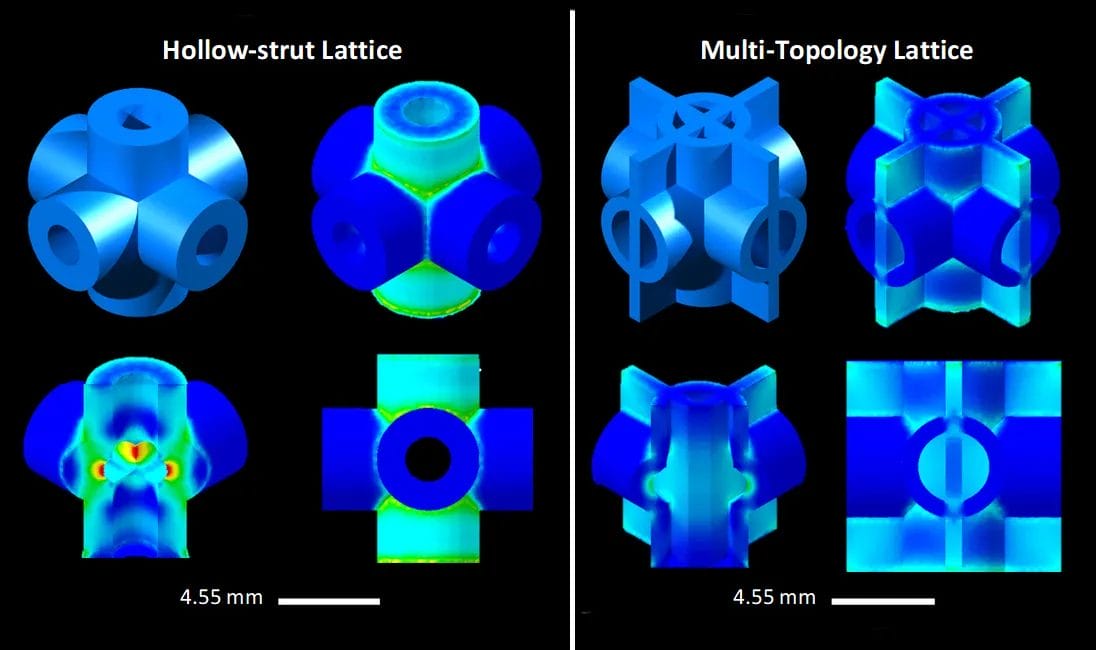
The RMIT research team, led by Distinguished Professor Ma Qian, addressed the cracking issue through a novel design approach. They developed a double-lattice titanium structure by combining two distinct types of lattices:
- Hollow Strut Lattices – These provide an internal cavity to reduce weight.
- Reinforced Bands Inside the Struts – These internal thin bands act like support beams inside each hollow strut, improving mechanical strength.
This dual-lattice architecture allows stress to be distributed evenly across the entire structure. By eliminating localized stress points, the material no longer suffers from weak zones that cause fractures.
As Prof. Qian explained, “By combining two complementary lattice structures to evenly distribute stress, we avoid the weak points where stress normally concentrates.”
The result? A metamaterial that merges unprecedented strength with lightness, mimicking and even surpassing what is found in nature.
Laser Powder Bed Fusion: Advanced 3D Printing Behind the Innovation
The creation of this advanced metamaterial wouldn’t be possible without a cutting-edge 3D printing technique called laser powder bed fusion (LPBF). In this process, a high-powered laser beam selectively melts layers of powdered metal, fusing them into a solid form with remarkable precision.
Here’s how it works:
- A thin layer of titanium alloy powder is spread across the build platform.
- The laser selectively melts areas of the powder based on a 3D digital model.
- Once a layer is complete, another layer of powder is added, and the process repeats until the entire object is formed.
This allows the production of highly complex, microscopic lattice structures that would be impossible to create using traditional manufacturing techniques.
The researchers used a common titanium alloy, known for its biocompatibility and corrosion resistance, making the material ideal for medical implants and aerospace components alike.
Performance Metrics: Stronger and More Heat-Resistant Than Ever
To test their innovation, the RMIT team created a cube made from their new metamaterial and subjected it to compression tests. The results were stunning:
- The cube withstood 50% more weight than an equivalent cast made from WE54, a magnesium alloy commonly used in aerospace engineering.
- The material currently withstands temperatures of up to 350°C (662°F).
- With more heat-resistant titanium alloys, the upper temperature limit could reach 600°C (1,112°F).
These performance characteristics make the metamaterial suitable for harsh environments, such as inside rocket engines, firefighting drones, or spacecraft structures that experience high stress and extreme temperatures.
Biomedical Applications: A New Era in Bone Implants
One of the most exciting prospects for this titanium metamaterial lies in biomedicine, particularly in orthopedic implants such as artificial hips, knees, and bone scaffolds.
Here’s why it’s promising:
- The hollow lattice structure allows for bone cell regrowth, facilitating natural integration with the patient’s bone.
- The lightweight design reduces stress on surrounding bone, which is crucial for long-term implant success.
- Titanium is already well-established as a biocompatible material, meaning it won’t trigger adverse immune responses.
This means the new material could lead to more durable, long-lasting implants that support tissue regeneration and reduce recovery times.
The Road Ahead: Overcoming Technological and Cost Barriers
Despite the promising results, widespread adoption of this metamaterial won’t happen overnight. As lead author and PhD candidate Jordan Noronha pointed out, “Not everyone has a laser powder bed fusion machine in their warehouse.”
Currently, LPBF machines are costly and specialized, limiting use to research institutions and high-tech manufacturers. However, as 3D printing technology becomes more affordable and accessible, the RMIT team believes it’s only a matter of time before their innovation becomes mainstream.
In fact, growing investment in additive manufacturing and metal 3D printing globally signals a future where such materials could be produced on-demand and customized for everything from implants to space exploration.
Conclusion: A New Frontier for Engineering and Medicine
The development of this nature-inspired, 3D-printed titanium metamaterial marks a transformative moment in material science. By resolving the long-standing issue of stress concentration, RMIT’s design sets the stage for a new generation of stronger, lighter, and more adaptive materials.
From rocket engines to human bones, the potential applications are both vast and life-changing. As technology evolves and access to advanced manufacturing tools expands, innovations like these will likely redefine the boundaries of what engineered materials can achieve.
This is more than a scientific achievement—it’s a step toward rethinking how we build, heal, and explore in the 21st century and beyond. Join AIU and be part of the future shaping these breakthroughs.
Reminder to our Dear Students,
Please ensure you are logged in as a student on the AIU platform and logged into the AIU Online
Library before accessing course links. This step is crucial for uninterrupted access to your learning
resources.