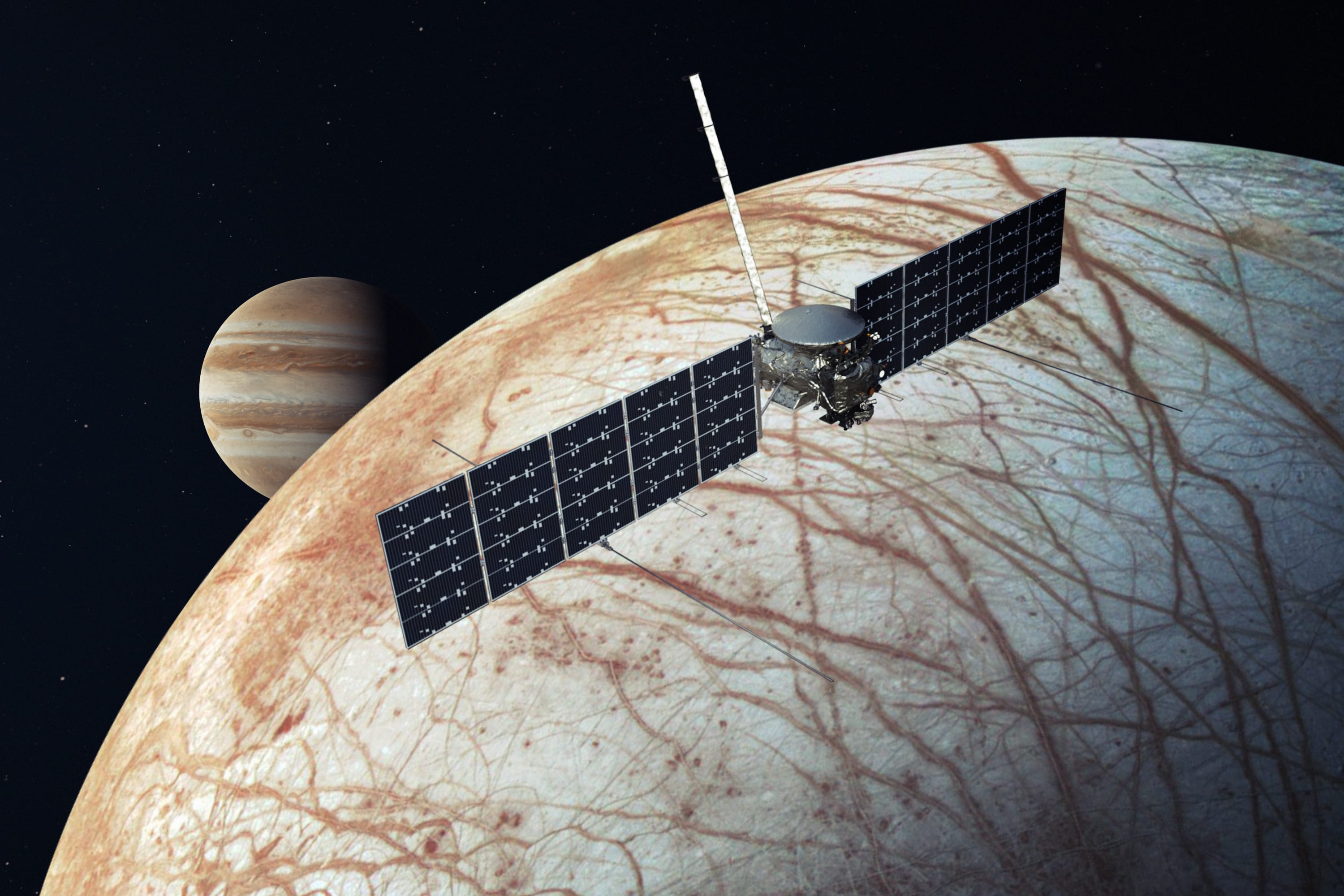
At long last, NASA is about to launch one of the most scientifically ambitious missions in its history — a mission to Europa, the icy moon of Jupiter, with its beautiful glimmering frozen surface and with the strong probability that a vast ocean might exist beneath. Europa has always been a huge temptation for scientists looking for life outside of Earth, especially considering it is among the most likely places to look for life.
The Europa Clipper mission is the result of decades of study and an enormous amount of technological infrastructure. NASA plans to launch the spacecraft in a launch window that opens on October 10, for a journey of hundreds of millions of miles, to determine if Europa could be habitable today — not billions of years ago but today.
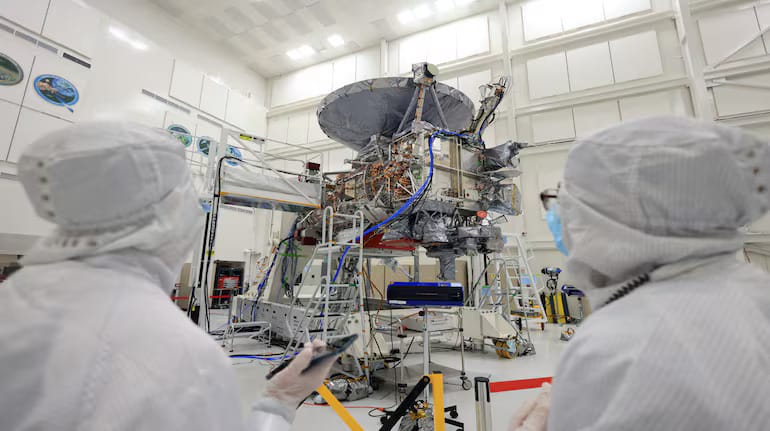
The Europa Clipper mission recently passed a major milestone – what NASA calls Key Decision Point E (KDP-E) – the final review of the mission’s systems, instruments, and readiness to begin the final preparations for launch. “This is really the last sort of big review before we really get into that launch fever,” said Nicola Fox, associate administrator for NASA’s Science Mission Directorate.
KDP-E simply means that Europa Clipper continues to be on track technically; but it is also on track financially and scientifically as well, triggering a move for NASA teams to move into the exciting final stages of integration, testing, and launch operations.
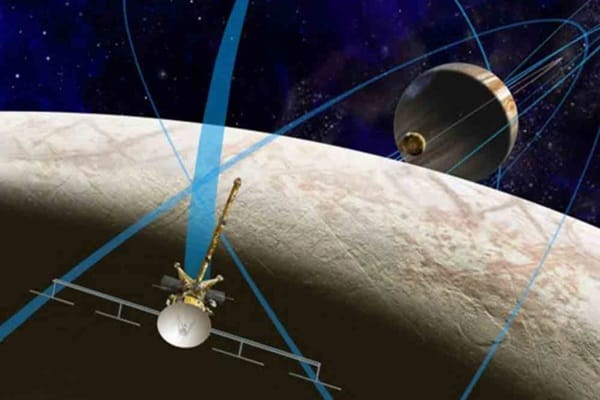
When it is successfully launched, Europa Clipper will set off on the 5.5 year trip to the outer solar system. It will take a meticulously designed path that takes advantage of gravity assists- which means close flybys of the Earth and Mars to both accelerate and conserve fuel. When it arrives, it will be captured and enter orbit around Jupiter, where it will conduct nearly 50 flybys of Europa over several years.
Similar to previous missions that have orbited Jupiter, the Europa Clipper will never orbit Jupiter directly; rather, it will utilize a novel tactic to reduce radiation exposure. It will orbit Jupiter in a broad ellipse, swooping in to examine Europa on a periodic basis and retreating further out to have a safe distance. Each time it comes close Europa will offer an opportunity to scan, measure, and map the icy surface and interior of this moon.
Carrying ten advanced science instruments, Europa Clipper is responsible for measuring and examining each aspect of the Europa environment. These include:
- Imaging systems to image the ice in high resolution to determine geological characteristics such as ridges, cracks, and any potential ice geysers.
- Radar instruments to aid in determining ice shell thickness and search for pockets of liquid water beneath the surface.
- Spectrometers to analyze the composition of the surface, searching for salts, organics, and chemical ingredients necessary for life.
- Magnetometers to determine how the magnetic field of Europa interacts with that of Jupiter, and therefore could show depth of the ocean and salinity.
- Dust and plasma detectors to analyze dust particles and gases escaping from the moon, potentially detected from plumes of water vapor venting into space.
While eternally the Clipper will not carry instruments designed to find life directly, the craft will be searching for conditions for habitability, meaning a stable source of energy, chemical nutrients, and liquid water. While the existence of those conditions would represent an incredible finding in itself, right?
Getting to Europa is only part of the battle. Working there is a whole other story.
Jupiter’s magnetic field is the strongest of any planet in the solar system — about 20,000 times stronger than the magnetic field of earth. Its incredible magnetosphere captures charged particles that rain down on everything in its region, creating intense radiation. Europa is located on the outer edge of this radiation belt, meaning that any spacecraft visiting it will also be subjected to high energy particles constantly.
“Jupiter is filled with more radiation than any other planet in our solar system, and that is one of the active reasons why exploring the Jupiter system is so difficult,.” said Jordan Evans, the Europa Clipper project manager.
NASA engineers constructed a vault resistant to radiation, a thick aluminum shield surrounding all the spacecraft’s most sensitive electronics — its computers, memory drives, and scientific instruments. Every single wire, every single piece of sensor has also been selected to specifically work against radiation damage.
Every system — its communication arrays, its solar panels — has been subjected to tests to ensure they can survive. Europa Clipper’s solar panels — which are each over 30 meters (100 feet) wide — will be the largest solar panels of any spacecraft flying so far away from the sun. Although Jupiter will only receive about 4% of the sunlight that Earth receives, these solar panels will provide the spacecraft with the power it needs to survive.
This high quality, undesired engineering will make sure that the spacecraft survives, continues to operate, and continues to send back data hundreds of millions of miles away while Jupiter bombards it with the most extreme radiation environment in the solar system.
Europa is a very different world compared to the worlds we have explored. Approximately the size of Earth’s Moon, the surface of Europa appears as a bright sheet of ice with extensive, long, brownish cracks in it – evidence of activity beneath the icy crust. Scientists think there is a global ocean of salty water below the crust, maybe from 60 to 100 miles deep.
So, it is theorized that there might be between two and three times the amount of liquid water that is present in all of Earth’s oceans combined — an amazing statistic for a moon further than 480 million miles from the Sun.
Even past missions have shown evidence that this ocean is in contact with Europa’s rocky mantle– and that contact could lead to chemical interactions that happen at hydrothermal vents – environments on Earth that are home to microbial life that use chemicals from the rock and water around them for energy and as life sustenance, in total absence of light.
“It’s a chance for us to explore, not a world that was potentially habitable billions of years ago, but a world that could be habitable today,” said Curt Niebur, program scientist for Europa Clipper. “Europa is an ocean world like we’ve never seen before.”
Scientists also hypothesize that plumes of water vapor might erupt from timing to time from cracks in the surface of Europa, and propel material from the subsurface ocean, into space. If that is true, and plumes exist, Europa Clipper may be able to fly through the plumes to sample material from the ocean and analyze it compositionally.
The Profound Importance of Discovery
Should Europa Clipper determine that Europa contains all of the building blocks of life — liquid water, organic molecules, and chemical energy, then we may view life in the universe in a new light.
“If we get there and we do this investigation, and the good news is it has all the ingredients and it is habitable, what that means is it has two habitable places in one solar system — the Earth and Europa” Niebur said.
The results are astounding. If habitable conditions can arise twice in one planetary system, it stands to reason that there would be life throughout the universe. And if our sun is like billions of others in our galaxy, just imagine the statistics of life elsewhere.
Europa Clipper won’t specifically find living organisms, but it will provide scientists with a baseline for future missions — potentially a lander that could one day land on the surface or sample the plumes. A future mission could give us the direct evidence scientists have sought for generations.
Looking Ahead: Humanity’s Next Great Leap
As the Europa Clipper mission approaches launch, we can all recognize the tremendous step forward that this program will be, not only for science and exploration, but for human curiosity. We will not only learn about Europa, from data that will be gathered, and more broadly, other ocean worlds, or other features of these worlds like moons of Saturn, Enceladus and Titan, where the potential of life exists.
Millions of miles from Earth, the spacecraft makes a long journey into Jupiter’s domain, carrying our human curiosity and the dreams of anyone who has looked to the stars and thought about what is out there? The journey to discover and explore Europa is not purely adventure and science, but representative of humankind’s innate drive toward exploration, discovery, learning, and growth.
Join the Mission — and Expand Your Own Universe
Exploration is not only for space, there are great discoveries and contributions to knowledge that can happen on Earth. Every great discovery or contribution to knowledge begins with curiosity, learning, and thinking about going beyond limits. At Atlantic International University (AIU), the exploration of the universe by discovery and personal growth, takes place in every academic program. AIU empowers learners around the world to think critically, boldly innovate, and lead the future of science, technology, and discovery.
Whatever your passion, astronomy, engineering, environmental science, and innovation, AIU hosts programs to get personal, flexible expertise and education to help you accomplish your academic and career goals, from anywhere on Earth.
Just as NASA’s Europa Clipper and its scientists have set off to discover new worlds, AIU wants to help you discover your own world of potential.
Join AIU today, and take the first step toward conversion of your curiosity to discovery, and your dreams to reality.