
Distance Learning at AIU is enhanced by vast academic resources and innovative technologies build into the Virtual Campus: Hundreds of self-paced courses with video lectures and step by step lessons, thousands of optional assignments, 140,000 e-books, the Social Media & Networking platform allowing collaboration/chat/communications between students, and MYAIU develop students holistically in 11 areas beyond just academics.
The world is YOUR campus!”, that is the message of AIU’s month magazine Campus Mundi. Hear the voices and see the faces that make up AIU. Campus Mundi brings the world of AIU to you every months with inspirational stories, news and achievements by AIU members from around the world (students and staff are located in over 200 countries).
Could an alien ocean beneath Europa’s ice harbor life?
What secrets lie beneath one of Jupiter’s most mysterious moons?
How can life exist in total darkness, without sunlight?
Use your research skills and answer what evidence from past and current space missions supports the hypothesis that Europa has a subsurface ocean capable of sustaining life, and how do scientists interpret this data to assess its habitability? Use credible sources such as academic journals, educational websites, and expert interviews to gather information and present a well-rounded answer.
(Login to your student section to access the AIU Additional Resources Library.)
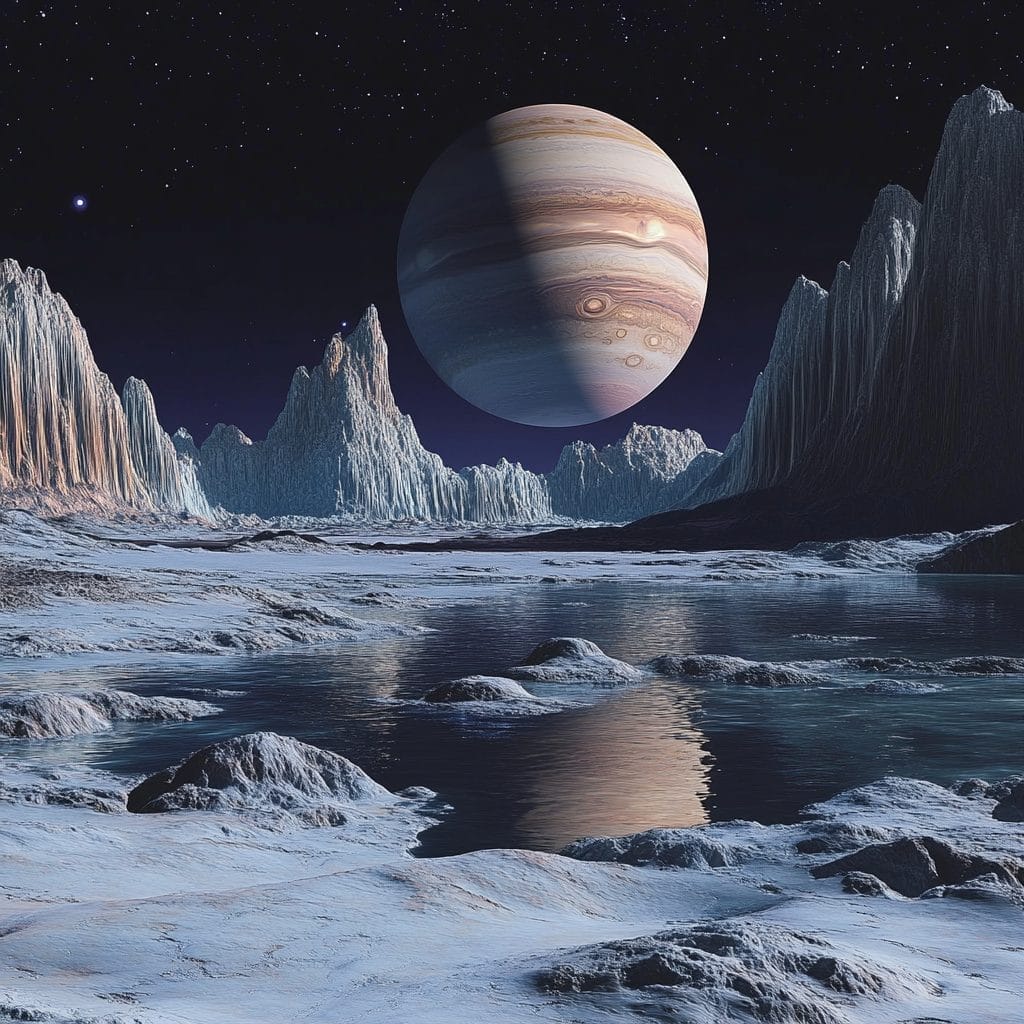
A small moon orbits Jupiter more than four hundred million miles from Earth. It is cloaked in a brilliant sheen of white and amber. This moon is named Europa which appears peaceful and still from the distance. But beneath its serene appearance lies one of the most tantalizing enigmas in our solar system. For decades, scientists have suspected that Europa conceals a vast, subsurface ocean which is a dark and alien sea hidden beneath a crust of ice. Could it also harbor life?
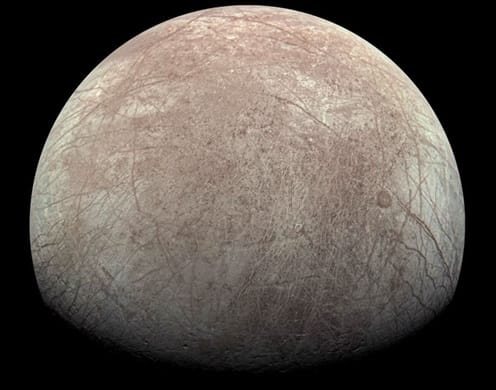
Jupiter’s icy moon Europa, image captured by NASA’s Juno spacecraft
Source: NASA
In the year 1610, Galileo Galilei discovered Io, Ganymede, Callisto, and Europa. Each holds a mystery of its own. Although Europa is not the largest of Jupiter’s moons, however, is the most intriguing one due to the smooth and glistening surface ensuring possibility of a vast ocean beneath its surface. Though slightly smaller than Earth’s Moon, Europa is a world of extremes—an ice-covered satellite orbiting a gas giant, warmed not by sunlight, but by gravitational forces.
Its orbit around Jupiter causes constant tidal flexing of the moon’s interior, generating heat that prevents its hidden ocean from freezing solid. This process, called tidal heating, fuels geological activity and perhaps sustains an internal environment where life might exist. This kind of energy source—distinct from the Sun—offers an entirely different model for sustaining life.
Photographs taken from NASA’s Galileo mission confirm the fact that Europa’s surface looks like a shattered mirror with fractures and streaks known as lineae. It showcases an ice shell that has been broken and reformed multiple times. Unlike the cratered and static surfaces of many other moons, Europa’s face appears young and active. Certain regions show blocks of ice that appear to have broken apart and drifted into new configurations and features. Scientists described it as “chaos terrain.” These patterns suggest that warm, possibly slushy water from below occasionally wells up and reshapes the surface.
According to secondary research, the thin outer shell which is assumed to be around 10 to 20 miles thick may not be a rigid barrier, but a dynamic skin. Cracks and crevices could allow materials from the surface to mix with those from the ocean below. This can enhance the potential for chemical complexity. Also, it is found that the temperature on the surface is -260°F (-160°C) which is far too cold for liquid water to exist without insulation. But beneath the icy crust, a liquid ocean of 60 miles deep may exist which is far deeper than Earth’s deepest trenches.
Comparing Europa to Other Ocean Worlds
Apart from Europa Ganymede and Callisto, also appear to harbor hidden seas. However, their ice shells may be over 100 miles thick, making communication between their surfaces and oceans unlikely. Moreover, they show less evidence of ongoing geological activity. Without a connection to the surface, the transfer of essential chemicals that are required for life may be limited.
Saturn’s moon Enceladus also shows signs of life with geysers of water and organic molecules erupting from its south pole. NASA’s Dragonfly mission is trying to discover more facts on – Titan, Saturn’s largest moon. It is believed that it has a subsurface ocean as well. Yet Europa remains exceptional because of its geological activity and its relatively accessible ocean—features that make it a prime location in the search for extraterrestrial life.
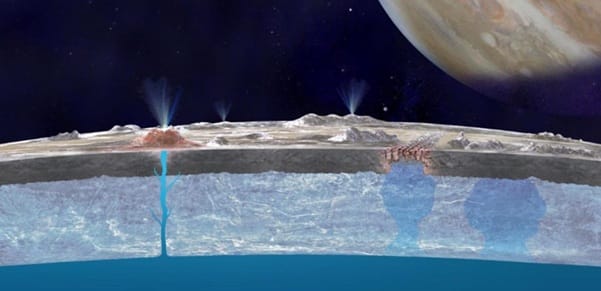
Europa’s icy crust, subsurface ocean and plumes of water vapor erupting
Source: NASA
The mystery of Europa has already drawn the attention of numerous spacecraft. According to secondary research the early observations were done by Pioneer and Voyager missions. Later, the Galileo spacecraft orbited Jupiter from 1995 to 2003, sharing compelling data and evidence for an internal ocean through magnetic field anomalies. Now, that is possible only if there is an induced field created by a salty, conductive layer beneath the crust.
In 2012, the Hubble Space Telescope had visuals of plumes of water vapor erupting from Europa’s surface. An anlysis of these plumes could possibly help to analyze the composition of the water better. With the hope to gather more information, a reanalysis of the facts gathered by Galileo in 2018 was done which further fueled excitement for future exploration.
NASA’s Juno spacecraft on the other hand is orbiting Jupiter, to gather more data on Europa. While, the European Space Agency’s JUICE mission (JUpiter ICy moons Explorer) is also exploring the details to understand the subsurface oceans and potential habitability.
A Deep, Dark Ocean Full of Possibilities
Europa’s ocean, if it exists as expected, may be more than twice the volume of all Earth’s oceans combined. Yet, this is no Caribbean Sea—it is pitch black, locked away from sunlight under a thick ice cover. This makes the potential for life here especially fascinating, because it would exist without the Sun—relying instead on chemical and geothermal energy.
Hydrothermal vents on Earth’s Ocean floors offer a promising analogue. The intriguing part is that in these deep, dark environments life thrives around superheated plumes that emit hydrogen sulfide and other chemicals. The bacteria present there converts these compounds into energy through chemosynthesis. This supports the entire ecosystems without a single ray of sunlight. If Europa’s seafloor hosts similar vents, it could nurture microbial life—or even more complex organisms adapted to the moon’s unique conditions.
The Chemistry of Life
As we all know that life requires – carbon, hydrogen, nitrogen, oxygen, phosphorus, and sulfur – collectively referred to as CHNOPS and Europa’s surface chemistry shows signs of sulfur compounds, salts, and potentially organic molecules. Some of these substances may have come from the ocean below. This clearly indicates that Europa might have the raw materials for life. Now, the detection of water vapor plumes is a major breakthrough and if the future missions can confirm the presence of organic molecules in the plumes, then it can indicate biosignatures – which means life might exist or once existed beneath the ice.
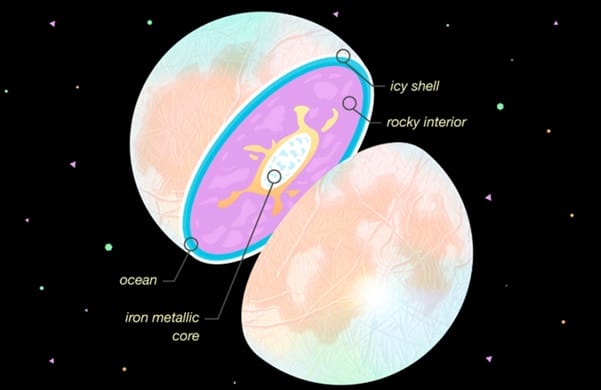
Visual representation of Europa’s core
Source: NASA
If life exists on Europa, what might it look like? Most scientists expect that microbial life would be the most likely form—resilient, single-celled organisms adapted to high pressure, darkness, and chemical energy sources. However, given enough time and energy, more complex life could evolve. It is not outlandish to imagine a food web rooted in chemosynthetic microbes, with higher-level consumers developing over geological timescales.
Alien creatures in Europa’s Ocean would be unlike anything we’ve seen on Earth. Bioluminescent animals, adapted to eternal darkness, might use light for communication or hunting. Others might use chemical sensors in place of vision. The possibility of discovering even simple alien ecosystems would revolutionize our understanding of biology and evolution.
Missions on the Horizon
By 2030, NASA’s Europa Clipper mission will be launched which will conduct detailed investigation. The spacecraft will perform dozens of flybys, mapping the moon’s surface, analyzing ice composition, and searching for signs of recent geological activity or water plumes. While it won’t land, Clipper’s findings could pave the way for a future lander or even a mission to drill through the ice and deploy a submersible.
These missions are complex. They must survive Jupiter’s intense radiation belts, operate autonomously due to communication delays, and perform precise scientific measurements millions of miles from Earth. Yet the scientific reward potentially discovering alien life makes the challenge worthwhile.
Why It Matters
The discovery of life on Europa, even microbial life suggests the fact that life is not unique to Earth. This has transformed our line of research and helped us to reconsider our place in the cosmos. Would Europan life share biochemical traits with life on Earth, or represent an entirely new branch of biology? Would it use DNA, or some other mechanism for heredity? Answering these questions would expand our understanding of what life is—and could be.
Redefining the Habitable Zone
Europa proves that habitability doesn’t require proximity to the Sun. The traditional “Goldilocks Zone” which is the area around a star where liquid water can exist might not be the only arena for life. If Europa is habitable, then so might be Enceladus, Titan, or even rogue planets adrift in interstellar space, warmed only by internal heat.
Europa forces us to rethink the requirements for life. Energy can come from chemistry. Water can exist under miles of ice. Life can emerge in darkness. This radically expands the range of environments we consider when searching for life beyond Earth.
A Cosmic Invitation
Europa is not just a scientific target; it is a symbol of exploration and wonder. Like many other oceans of the Earth’s past, it gives us the opportunity to discover more. Hence, we stand on the brink of a new era, one where robotic explorer will dive into alien oceans and discover traces of life. This frozen moon that is orbiting a distant giant, reminds us that the universe is still full of secrets and that some of the greatest discoveries may be waiting beneath the ice.
If this article triggers any interest in exploring the potential of life on Europa, then AIU offers a list of Mini courses, Blogs, News articles and many more on related topics that one can access such as:
Saving Our Marine Animals: A Call to Action
Saving Marine Animals: The Urgent Need for Conservation
Beyond Earth: The Expanding Horizons of Space Exploration
AIU also offers a comprehensive array of recorded live classes spanning various subjects. If any topic piques your interest, you can explore related live classes. Furthermore, our expansive online library houses a wealth of knowledge, comprising thousands of e-books, thereby serving as a valuable supplementary resource.
Reference
Life on Europa: Oceans Beneath the Ice
Europa: A World of Ice, With Potential for Life – NASA’s Europa ClipperÂ
Why Europa: Ingredients for Life – NASA Science
James Webb telescope finds potential signature of life on Jupiter’s icy moon Europa | Live Science
Is there a life on Europa? – The Environmental Literacy Council
We Asked a NASA Expert: Is There Potential for Life on Europa? [Video]
Overview | Why Europa – NASA’s Europa Clipper
Is There Potential for Life on Europa? We Asked a NASA Expert
Reminder to our Dear Students,
Please ensure you are logged in as a student on the AIU platform and logged into the AIU Online
Library before accessing course links. This step is crucial for uninterrupted access to your learning
resources.
Begin Your Journey!
AIU’s Summer of Innovation and Growth gives you the ability to earn up to $5000 in tuition credit by completing free lessons and courses.
Whether you’re looking to acquire new skills, advance your career, or simply explore new interests, AIU is your gateway to a world of opportunities. With free access to 3400 lessons and hundreds of courses the ability to earn credits and earn certificates there’s no better time to start learning.
Join us today as a Guest Student and take the first step towards a brighter, more empowered future.
Explore. Learn. Achieve.
"*" indicates required fields