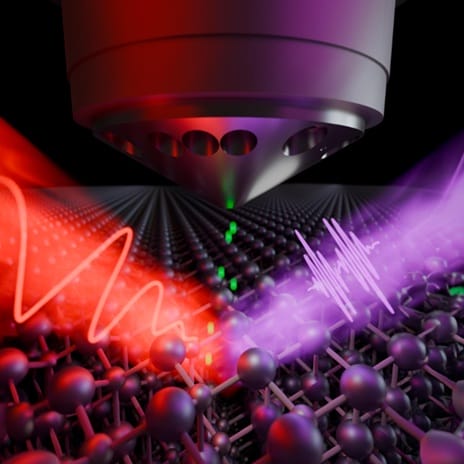
In 2023, the Nobel Committee for Physics honored a breathtaking scientific milestone — the ability to capture the fastest motion known in the universe: the movement of electrons. The prize was awarded to Pierre Agostini, Ferenc Krausz, and Anne L’Huillier for experimental methods that generate attosecond pulses of light for the study of electron dynamics in matter.
This recognition also highlighted decades of pioneering work in attosecond physics — a field dedicated to capturing, measuring, and manipulating phenomena so fast that they occur on timescales of attoseconds (1 attosecond = 10⁻¹⁸ seconds). To put that in perspective – there are as many attoseconds in a second as there have been seconds since the Big Bang.
If you think of science as a way of taking snapshots of nature, then these three physicists built the world’s fastest camera — one that can take pictures not of people or planets, but of the quantum heartbeat of matter itself.
Beyond Femtoseconds: the need for ever-faster “frames”
To appreciate the feat – let’s put an attosecond into perspective. Over the last few decades, ultrafast lasers and time-resolved spectroscopies have allowed scientists to observe and control processes on the femtosecond scale (10⁻¹⁵ seconds). Many chemical reactions, molecular vibrations, and energy transfers happen in tens to hundreds of femtoseconds, and techniques such as – pump–probe spectroscopy, ultrafast electron diffraction, and time-resolved spectroscopy have revolutionized our understanding.
Yet electrons — the microscopic carriers of charge, chemical bonds, and quantum behavior, move even faster. Many fundamental processes such as – photoionization, charge migration, ultrafast electron scattering evolve on attosecond timescales. Now, to “see” electrons in action, one needs “shutter speeds” of attoseconds without which, the picture remains blurred. Thus, the dream has been to develop light pulses so short that they can act as the world’s fastest camera – opening a window into the quantum world of electron motion.
To start with track electron dynamics in atoms, molecules, and solids and find out how electrons switch energy states, move between orbitals, tunnel, and respond to external fields. Then probe ultrafast ionization and recollision processes in strong laser fields, electrons are ripped off, then driven back to the ion — processes central to high-harmonic generation and attosecond pulse creation. Next, study correlated motion. When multiple electrons interact, their joint motion may hold clues to chemical reactivity, electron correlation, entanglement, and quantum coherence. Finally, control and manipulate matter in the future so that electrons can be steered on demand – influencing chemical reactions or material states with attosecond precision. But to reach this frontier, one must overcome fundamental challenges: generating such pulses, characterizing them, and applying them to experiments.
The Quest to See the Invisible Dance
Anne L’Huillier’s Discovery: Turning Light into Harmonics
According to secondary research, the journey began in the 1980s when French physicist Anne L’Huillier was experimenting with intense laser light passing through gases like neon or argon. To her surprise, the atoms emitted light not just at the laser’s frequency but also at higher multiples — second, third, fifth, even up to the 100th harmonic.
This phenomenon, called high-harmonic generation (HHG), became the foundation of attosecond science. Imagine striking a single piano key and hearing an entire chord of overtones ring out — that’s what happens when strong light interacts with atoms. Those overlapping “notes” of light contain the ingredients to create an ultra-short pulse.
L’Huillier realized that by combining many of these harmonics, one could generate bursts of light so brief that they lasted only attoseconds. Her discovery gave physicists the raw material to build an “attosecond flashlight.”
Pierre Agostini’s Timing Trick: The RABBITT Technique
French physicist Pierre Agostini took the next leap. To study something so fast, you need not just a pulse but also a way to measure it. Agostini developed a method charmingly named RABBITT — short for Reconstruction of Attosecond Beating by Interference of Two-photon Transitions.
Think of it as creating a strobe light that flashes attosecond pulses in a train — hundreds of them in rapid succession — and then using interference patterns (like ripples overlapping on water) to measure their timing with exquisite precision.
In 2001, Agostini’s team succeeded in producing a series of light flashes just 250 attoseconds long. For the first time, humanity had a reliable ruler to measure time on the electron’s scale.
Meanwhile, Hungarian-born physicist Ferenc Krausz had an even bolder goal: isolate a single attosecond flash — one clean frame, rather than a flickering sequence.
Using clever optical gating and laser control, Krausz managed to generate a lone pulse lasting about 650 attoseconds. That’s the temporal equivalent of capturing a single beat of a hummingbird’s wings in crisp detail.
According to secondary research, Krausz’s “attosecond camera” didn’t just illuminate electrons — it let scientists watch them move. They could now see how an electron leaves an atom when hit by light, how quickly it tunnels through an energy barrier, or how it transfers energy within a molecule.
Why It Matters: Watching Electrons in Action
Electrons are the drivers of everything – electricity, chemistry, magnetism – and the bonds that make matter stable. Yet, before attosecond science – their motion was hidden behind a blur of averages. Attosecond pulses act like a strobe light for quantum mechanics. By timing how electrons respond to a flash of light – physicists can map out their behavior in real time, looking at how they accelerate, scatter, and interact.
Some examples of what this allows:
Timing photoemission: measuring how long it takes an electron to escape from different atoms when struck by light.
Observing charge migration: watching how electrical charge flows through molecules before atoms even start to move.
Tracking energy transfer in solids: following how electrons carry and lose energy in materials — crucial for next-generation electronics and solar cells.
For the first time, scientists could study cause and effect as they happen on the quantum stage.
The Birth of Attosecond Science
With these tools – the early 2000s saw the birth of attosecond physics — a new field that bridges quantum mechanics, optics, and ultrafast technology. What followed was a wave of experiments probing how matter behaves when light strikes it faster than ever thought possible. In fact, those experiments revealed subtle delays in electron emission, the interplay of quantum states during ionization, and even coherence effects across different atoms. Each result deepened our understanding of how light and matter interact at the most fundamental level.
The field has since expanded into what’s now called attochemistry — the dream of controlling chemical reactions by steering electrons with light before atoms have time to move. It’s as if scientists are learning to “edit” nature’s choreography at its fastest tempo.
Why It’s Nobel-Worthy
The Nobel Committee emphasized that Agostini, Krausz, and L’Huillier didn’t just discover something new — they created methods that transformed the impossible into routine. Their work built an entire experimental toolkit now used worldwide to probe atomic and molecular dynamics.
Their contributions can be summed up as:
- L’Huillier: discovered the source of attosecond pulses (high-harmonic generation).
- Agostini: devised a way to measure attosecond timing precisely.
- Krausz: achieved control over isolated attosecond pulses and applied them to real systems.
Together, they gave humanity a new sense of time — one fast enough to catch the motion of the universe’s most restless particles.
Looking Ahead: The Future of Ultrashort Light
The story doesn’t end at attoseconds. Researchers are already dreaming of zeptosecond (10⁻²¹ s) pulses, which could probe nuclear dynamics inside atoms. Attosecond tools may soon merge with X-ray lasers and ultrafast electron microscopes – offering synchronized views of both atomic structure and electronic motion.
In fact, in technology, understanding and controlling electron motion could inspire petahertz electronics — circuits switching a million billion times per second — and new forms of data processing and quantum control.
And at a philosophical level – attosecond science expands our sense of time itself. It reminds us that beneath the steady rhythms of our everyday world, nature dances to an unimaginably fast beat — one we can finally watch, thanks to light itself.