
From Deforestation to Regeneration: How Costa Rica Became a Global Model for Green Transformation

How did a small Central American country achieve near-100% renewable energy?

Can reforestation and economic growth go hand in hand?

What can the world learn from Costa Rica’s green transformation?

Use your research skills and answer what can the world learn from Costa Rica’s green transformation? This question encourages exploration of case studies, industry reports, and data analysis to provide a comprehensive answer. Use credible sources such as academic journals, educational websites, and expert interviews to gather information and present a well-rounded answer.

(Login to your student section to access the AIU Additional Resources Library.)

From Deforestation to Regeneration: How Costa Rica Became a Global Model for Green Transformation


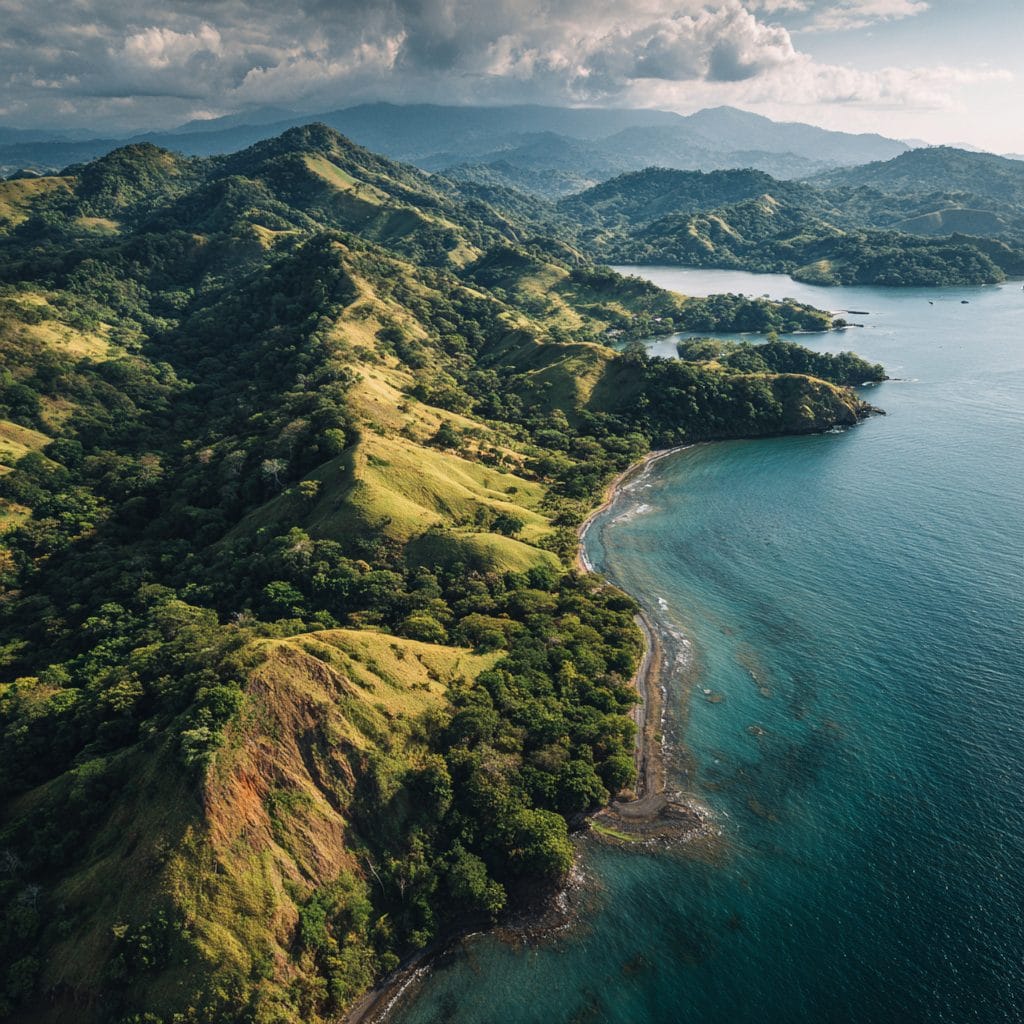
In a world grappling with – climate change, deforestation, and energy crises, Costa Rica – a small Central American nation with just over 5 million people has emerged as a quiet yet powerful environmental success story. The country has restored vast swathes of its forests by powering its economy with nearly 100% renewable energy.

Costa Rica’s remarkable journey from environmental degradation to sustainability is not just an inspiring story rather it is a blueprint for the rest of the world to follow. As global temperatures rise and biodiversity declines – Costa Rica’s experience offers key lessons on – political will, public policy, and the synergy between conservation and economic development.

Source: FAO Organization of the United Nations

The Forest Reborn: From Crisis to Conservation

In the 1940s – forests covered over 75% of Costa Rica’s land area. But by the 1980s – rapid deforestation that was driven by – agriculture, logging, and cattle ranching. This reduced the figure to 25%. The country was in fact losing around 50,000 hectares of forest land each year to provide for pasture.

Faced with environmental and economic collapse, Costa Rica transformed its way of existence. Starting in the late 1980s and accelerating through the 1990s – the government introduced a series of ambitious reforms:

  1. The Forestry Law of 1996 banned the clearing of mature forests for any other usage.
  2. Payments for Environmental Services (PES) programs offered landowners financial help to – preserve forests, reforest land, or sustainably manage timber.
  3. Partnerships with – NGOs, international donors, and the private sector further enhanced the conservation efforts.

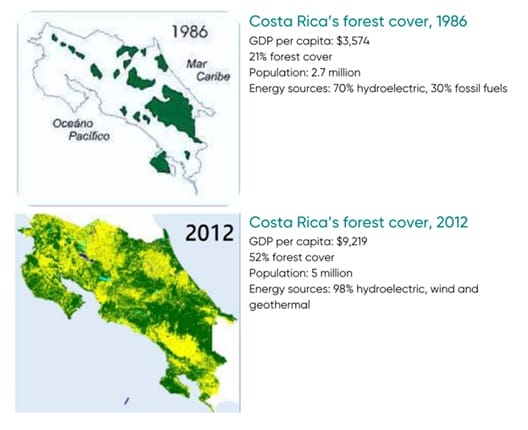
According to secondary research, by 2020 – forestland was recovered to over 53% of the country’s land area. This is not just a win for trees—this regrowth has helped protect biodiversity (Costa Rica is home to 5% of the world’s species), regulate water cycles, and lock away carbon.

Visual representation of Costa Rica’s path to sustainability

Source: Sustainable Agriculture Network

Running on Green Power: The Renewable Energy Revolution

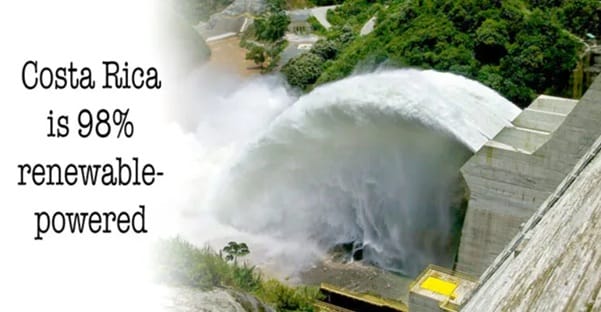
Costa Rica has shown the world that moving away from fossil fuels is possible. According to secondary research, in 2023 – it generated 99.6% of its electricity from renewable sources and used fossil fuels less than 0.5% – only during high demand or drought situations. Such a sustainable shift was an eye opener, and it was possible by the country’s rich natural resources such as – volcanic areas for geothermal energy and mountain rivers for hydropower. Moreover, the country made long-term investment in clean energy since the 1940s. With careful planning by Instituto Costarricense de Electricidad (ICE) from 1990 to 2020 – Costa Rica’s economy grew by over 250% while keeping carbon emissions among the lowest in Latin America.

Source: Alberto Font/The Tico TimWhat the World Can Learn: Key Lessons from Costa Ricaes

What the World Can Learn: Key Lessons from Costa Rica

  1. Strong Policy Frameworks Matter: Costa Rica’s transformation didn’t happen by accident. It was the result of – deliberate and sustained policy. Moreover, environmental laws, economic incentives for conservation, and national planning created an ecosystem where green choices were not just possible, but profitable.
  2. Aligning Economics with Ecology: By monetizing ecosystem services – Costa Rica showed that forests are more valuable than one can imagine. Landowners were paid for – carbon sequestration, biodiversity protection, and water services. This created a green economy that supported both people and the planet.
  3. Education and Public Buy-In: Environmental education is now part of the school curriculum. In fact, Costa Ricans are very supportive towards the conservation efforts. Such public engagement ensured further progress.
  4. Investing in Green Infrastructure: Costa Rica didn’t just protect nature – it invested in it! By building renewable energy capacity early – it now enjoys both energy security and economic benefits. Moreover, this has resulted in eco-tourism – a sector adding over $3 billion annually.
  5. No Military = More Money for Nature: Since abolishing its army in 1948 – Costa Rica has redirected funds that would have gone to defense into – health, education, and the environment. This unique budgetary flexibility gave it an edge in pursuing sustainable development further.

Challenges Ahead: Not a Utopia Yet

Costa Rica’s success is not without its complications. Climate change is already impacting hydroelectric generation due to the erratic rainfall. The country also faces pressure from – tourism-related development, urban expansion, and illegal logging in some regions.

Moreover, while electricity is clean, transport remains a carbon hotspot due to the increase in fossil fuel–powered vehicles. However, the government is planning for electric vehicles, but adoption is slow due to infrastructure gaps and the high cost of the electric vehicles.

Conclusion: A Greenprint for the Planet?

Costa Rica has proven that it is possible to restore nature and run a modern economy on green energy – if the intensions are right. It is indeed an example of how small nations can lead and influence global climate policy. However, the challenge now is scaling its success. As countries prepare for the next round of climate negotiations – the question isn’t whether Costa Rica has something to teach the world rather – whether the world is willing to learn.

If this article triggers curiosity in how a small nation like Costa Rica achieved such remarkable environmental success, then AIU offers a list of Mini courses, Blogs, News articles and many more on related topics that one can access such as:

  1. The Rise of Floating Solar Farms: A New Horizon for Renewable Energy
  2. The Future of Renewable Energy: A Path to Sustainable Development
  3. The Future Unfolding: Advancements in Renewable Energy Beyond Solar and Wind
  4. Renewable Energy Integration
  5. Battery Energy Storage: Transforming Renewable Energy into a Reliable Power Source
  6. Green Chemistry and Sustainable Materials
  7. Harvesting Electricity from Thin Air: A New Era in Renewable Energy
  8. Renewable Energy and Environmental Impact
  9. AI Powered Renewable Energy

AIU also offers a comprehensive array of recorded live classes spanning various subjects. If any topic piques your interest, you can explore related live classes. Furthermore, our expansive online library houses a wealth of knowledge, comprising thousands of e-books, thereby serving as a valuable supplementary resource.

  1. Biogas and Biomethane, Potential Renewable Energy Sources by Abdulqader Mohammed Alawi B
  2. Optimization of Renewable Energy Integration: Effective Approaches for Enhancing by Robenson Jean
  3. Smart Grids and Renewable Energies Integration in the era of Energy Transition by Robenson Jean
  4. Renewable Energy: A Primer for the Twenty-First Century
  5. Renewable Energy: Selected Issues Volume I
  6. Renewable Energy: Sources, Applications and Emerging Technologies
  7. Renewable Energy: Economics, Emerging Technologies, and Global Practices
  8. Renewable Energy: A Global Review of Technologies, Policies and Markets

Reference

  1. State of the World’s Forests 2020
  2. List of countries by renewable electricity production – Wikipedia
  3. Costa Rica restored its forests and switched to renewable energy — what can the world learn from it? | The Verge
  4. The Regreening of Costa Rica: A Model for Sustainable Transformation
  5. More Than 98 Percent of Costa Rica’s Energy Is Renewable—Here’s How
  6. Renewable Energy: The Costa Rica Model as an Example for the World ⋆ The Costa Rica News
  7. Costa Rica: A Biodiversity Haven and Global Leader in Environmental Conservation
  8. Costa Rica’s green energy miracle is at a critical juncture | International | EL PAÍS English

Reminder to our Dear Students,
Please ensure you are logged in as a student on the AIU platform and logged into the AIU Online
Library before accessing course links. This step is crucial for uninterrupted access to your learning
resources.

AIU Success Stories

Contact Us Today!

Begin Your Journey!
AIU’s Summer of Innovation and Growth gives you the ability to earn up to $5000 in tuition credit by completing free lessons and courses.
Whether you’re looking to acquire new skills, advance your career, or simply explore new interests, AIU is your gateway to a world of opportunities. With free access to 3400 lessons and hundreds of courses the ability to earn credits and earn certificates there’s no better time to start learning.
Join us today as a Guest Student and take the first step towards a brighter, more empowered future.
Explore. Learn. Achieve.

Let us know your goals and aspirations so we can chart a path at AIU to achieve them!
//
Admissions Counselor
Juan Mejia
Available
//
Admissions Counselor
Veronica Amuz
Available
//
Admissions Counselor
Ariadna Romero
Available
//
Admissions Counselor
Sandra Garcia-Fierro
Available
//
Admissions Counselor
Rene Cordon
Available
//
Admissions Counselor
Alba Ochoa
Available

"*" indicates required fields

This field is for validation purposes and should be left unchanged.

Submit your data.

After submitting, a widget will appear at the bottom-left corner so you can start your training.

Name*

Do you hate spam? Don’t worry, we hate them too. Your email is 100% secure with us.

"*" indicates required fields

This field is for validation purposes and should be left unchanged.

Submit the form below to begin your interview.

After submitting, a widget will appear at the bottom-left corner so you to start your AI interview.

Name*
Accepted file types: docx, pdf, Max. file size: 500 MB.

Do you hate spam? Don’t worry, we hate them too. Your email is 100% secure with us.