
- RESEARCHDistance Learning at AIU is enhanced by vast academic resources and innovative technologies build into the Virtual Campus: Hundreds of self-paced courses with video lectures and step by step lessons, thousands of optional assignments, 140,000 e-books, the Social Media & Networking platform allowing collaboration/chat/communications between students, and MYAIU develop students holistically in 11 areas beyond just academics.
- PROGRAMS OFFERED
- Areas of Study
- Courses and Curriculum
- Open Courses
- Register for a Program
- Associate Program
- Associate in Addiction Counseling
- Associate in Agriculture Food And Resources
- Associate in Anti Terrorism Security
- Associate in Behavior Analysis In Special Education
- Associate in Bioethics
- Associate in Climatology
- Associate in Cultural Theological Communication
- Associate in Culinary Arts
- Associate in Ecotechnology
- View all Associates Programs
- Bachelor Program
- Bachelors in Community Development
- Bachelors in Environmental Science
- Bachelor in Education (B.Ed, BS)
- Bachelors in Economics
- Bachelors in Entrepreneurship
- Bachelors in Financial Administration
- Bachelors in Human Resource Management
- Bachelors in Linguistics
- Bachelors in Nutritional Science
- Bachelors in Occupational Health and Safety
- Bachelors in Psychology
- View all Bachelor Programs
- Doctorate Program
- Doctor | of Biology (PhD)
- Doctorate in Business Administration (DBA, PhD)
- Doctor of Economics (PhD)
- Doctor of Electrical Engineering (D.Sc, PhD)
- Doctor of Finance (PhD)
- Doctorate in International Relations
- Doctorate in Information Technology (D.Sc)
- Doctor of Legal Studies (PhD)
- Doctor of Project Management (PhD)
- Doctor of Sociology (PhD, D.Sc)
- Doctorate in Sustainable Natural Resources Management
- View all Doctorate Programs
- Master Program
- Postdoctoral Program
- Postdoctoral in Animal Science
- Postdoctoral in Anti Terrorism Security
- Postdoctoral in Behavior Analysis In Special Education
- Postdoctoral in Bioethics
- Postdoctoral in Blockchain Technology and Digital Currency
- Postdoctoral in Business Management
- Postdoctoral in Cloud Computing
- Postdoctoral in Computer Engineering
- View all Postdoctoral Programs
AIU offers a wide range of majors in areas including the Arts, Business, Science, Technology, Social, and Human studies. More than 120 degrees and programs are available for adult learners at the associate’s, bachelor’s, master’s, doctoral and postdoctoral level. - VIRTUAL CAMPUS
Distance Learning at AIU is enhanced by vast academic resources and innovative technologies build into the Virtual Campus: Hundreds of self-paced courses with video lectures and step by step lessons, thousands of optional assignments, 140,000 e-books, the Social Media & Networking platform allowing collaboration/chat/communications between students, and MYAIU develop students holistically in 11 areas beyond just academics.
- ALUMNI
The world is YOUR campus!”, that is the message of AIU’s month magazine Campus Mundi. Hear the voices and see the faces that make up AIU. Campus Mundi brings the world of AIU to you every months with inspirational stories, news and achievements by AIU members from around the world (students and staff are located in over 200 countries).

Exploring the Power and Potential of DeepSeek-R1 in Computer-Use AI Agents

What if an AI could not only think—but also use your computer like a human assistant?
Could DeepSeek-R1 redefine how we interact with software forever?
Are we witnessing the birth of true digital co-workers powered by AI agents?
Use your research skills and answer whether DeepSeek-R1 will be the next big leap that turns AI from a conversational partner into a true digital co-worker? This question encourages exploration of case studies, industry reports, and data analysis to provide a comprehensive answer. Use credible sources such as academic journals, educational websites, and expert interviews to gather information and present a well-rounded answer.
(Login to your student section to access the AIU Additional Resources Library.)
Exploring the Power and Potential of DeepSeek-R1 in Computer-Use AI Agents
Artificial intelligence is rapidly evolving from mere chatbots to true computer-use agents—systems that don’t just converse, but act, reason, and orchestrate tasks across applications. One of the standout models in this wave is DeepSeek-R1. In this long-form article, we’ll dive deep into what DeepSeek-R1 is, how it’s being used to power computer-use agents, its strengths and limitations, and the future directions we might expect.
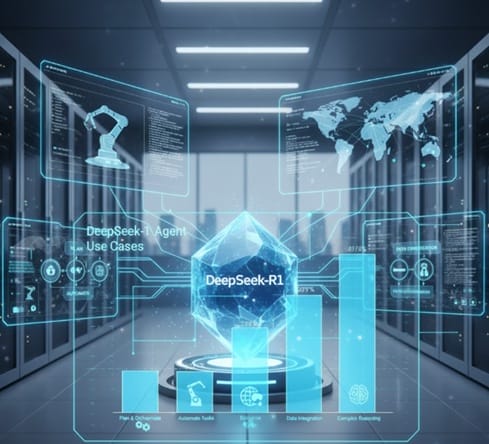
Capabilities of DeepSeek-R1 agent: Complex Reasoning, Data Integration, Automated Tasks, and Plan & Orchestrate
What is DeepSeek-R1?
At its core, DeepSeek-R1 is a reasoning-oriented Large Language Model (LLM) developed by DeepSeek. Although many of the technical details remain proprietary or emerging via open-source distills, several public write‐ups highlight key aspects:
- It’s positioned as an open (or semi‐open) model optimized for complex reasoning, code generation, debugging, and agentic tasks.
- It has been benchmarked favourably in some reasoning tasks compared to alternatives. For example, in one experiment the author found:
According to secondary research, DeepSeek-R1 is more accurate than Claude 3.5 Sonnet, increasing the correct score from 53.1% to 65.6% (a 12.5% absolute gain). The model is notable for enabling what some call “computer-use” capabilities (i.e., enabling AI agents to operate software, orchestrate workflows across tools, take actions rather than only reply). It supports deployment in local or self-hosted contexts (depending on the version) and is being used in multi-agent systems.
In short: DeepSeek-R1 is not just a chat‐model; it is built for agentic, action‐oriented tasks and reasoning workflows. And that positions it differently from many purely conversational models.
What do we mean by “Computer-Use Agents”?
Before digging further into how DeepSeek-R1 powers agents, it’s worth defining this term.
A computer‐use AI agent is a system that:
- Is autonomous (or semi-autonomous), not just reactive to user prompts, but can plan and execute tasks over time
- Has tool and application access: It can call functions, interact with APIs, browse the web, control software, manipulate spreadsheets, etc.
- Can reason and plan: It can break down a complex user request into subtasks, coordinate between tools, choose steps, correct errors, loop back if needed
- Has workflow orchestration: Agents may consist of multiple sub‐agents (worker, supervisor, planner) interacting to fulfill user goals
In an interview published by DeepSeek, their CEO mentioned that an LLM invocation can trigger other steps—like pulling in data, performing actions, and refining the response or asking follow-up questions—to better address the user’s input.
Thus, when we talk about “DeepSeek-R1 Computer-Use Agents”, we’re referring to agents built with DeepSeek-R1 (or its derivatives) that can not only “talk” but perform tasks on a computer: browsing, executing code, scheduling, automating workflows.
Why DeepSeek-R1 Is Gaining Attention for Agents
Several features make DeepSeek-R1 particularly well‐suited (or at least often chosen) for agentic setups. Let’s explore key strengths.
- Reasoning and Code Generation Capabilities
DeepSeek-R1 has been shown to handle reasoning and code generation tasks better than many peers. Its ability to interpret requirements, generate code, debug, and iterate is frequently referred to in developer‐centric applications. According to secondary research, a blog post is reported using DeepSeek-R1 to generate Python code that interacts with other tools to solve tasks—effectively enabling agentic behaviour even though the model isn’t explicitly built for tool-use.
- Cost & Access Considerations
While commercial models (GPT-4, Claude) tend to have higher costs and restrictions, DeepSeek-R1 appears in many user accounts as a cost‐effective alternative or even for local usage. R1 uses a mixed precision framework, relying on FP8 to improve efficiency instead of using a single precision type. That mix of performance and cost‐effectiveness is attractive for building agents where many calls and tasks may be involved.
- Community Adoption & Agent Framework Integration
There are multiple community reports and tutorials showing that DeepSeek-R1 is being used with agent frameworks (e.g., Crew AI + Vast.ai) for orchestration, tool integration, multi‐agent workflows. Even if some tool-calling support is still nascent, the uptake by hobbyists and developers signals that the model has “agentic potential”.
- Versatility: Multi‐Agent Coordination
One of the more interesting use cases is using DeepSeek-R1 as a planner or director in a multi‐agent system where it works as worker agents, supervisor agents, and the R1 model crafts the plan and assigns tasks. In fact, integration of DeepSeek-R1 into the newsletter AI agent team transformed how instructions are processed. It clarifies voice commands, then generates structured plans for the supervisor agent to execute. This shows a layered architecture: R1 as planner + other agents as executors.
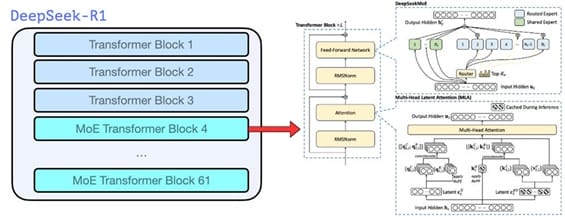
Illustrating the architecture of DeepSeek-R1
Typical Architectures & Use-Cases for DeepSeek-R1 Agents
Let’s explore some of the most common agent architectures and real-world use cases where DeepSeek-R1 is being applied.
Architecture Patterns
Planner/Director + Supervisor + Worker Agents
- Planner/Director: DeepSeek-R1’s role. It receives a high‐level user request (e.g., “Research new market trends for us and prepare a summary”) and breaks it down into subtasks: data retrieval, summarization, slide creation.
- Supervisor: A higher-level LLM or script that manages sub-agents, monitors progress, handles failures.
- Worker Agents: Specialized agents that execute tasks: search web, scrape data, generate slides, send emails, etc.
Single‐Agent with Code Actions
In simpler setups, DeepSeek-R1 is used alone to generate code actions: e.g., “Open browser, navigate to X, click Y, extract data, save to Excel.” Developer experiments showed that even though DeepSeek-R1 didn’t natively support tool calling; by translating intended actions into Python and running them, it effectively acted as an agent.
Distributed Deployment for Scale
When scaling, agents built on DeepSeek-R1 run across cloud or on‐premises infrastructure (e.g., Vast.ai GPUs) and coordinate multiple workflows in parallel.
Use-Cases
- Developer Productivity / Code Assistants
- R1 can power “developer-facing chatbots” that respond to code questions, review code, and suggest improvements.
- Code‐generation + debugging: Ask “generate a new API endpoint”, then R1 writes code, runs tests, diagnoses failures, rewrites.
- Task Automation & Workflow Orchestration
- Automating repetitive tasks like monitoring competitor websites, summarising data, alerting stakeholders. From the newsletter example: R1 helped rewrite ambiguous voice notes into clear instructions that the agent network executed.
- Browsing + data extraction: One tutorial showed using R1 for price comparison tasks (flight prices, competitor analysis) via browser automation.
- Multi-Agent Collaborative Systems
- In complex projects (e.g., marketing campaigns, research pipelines), agents co-operate: one monitors web, another analyses sentiment, another prepares deliverables; R1 acts as supervisor/planner.
- Example: On Reddit, users show how they used R1 via LangGraph + agent frameworks to coordinate multiple agents.
- Research & Reasoning Applications
- Because R1 is strong in reasoning, it is used for tasks requiring logic, chain-of-thought, debugging. This also means it’s suitable for agent tasks that require planning and conditional logic.
- In academia, variants like RealSafe-R1 focus on aligning reasoning models for safer usage.
Strengths vs. Weaknesses: A Balanced View
Strengths
- High reasoning capability: Compared to many models optimised for conversation, R1 shows strong performance in logic, code, planning.
- Flexibility & cost effectiveness: Because it can be deployed locally or in user-managed infrastructure, it enables more custom agent setups.
- Versatility for agents: Its code generation + reasoning makes it well-suited for “act” as well as “say”.
- Community traction: There’s a growing ecosystem of tools and tutorials leveraging R1 for agent use.
Weaknesses & Considerations
- Tool calling maturity: One of the recurring comments in community threads is that R1 “doesn’t support tool use natively” (or only very limited) thus builders must wrap code or frameworks around it.
DeepSeek-R1 doesn’t support tool use natively, but can be used for agentic tasks through code actions.
- Underthinking / long reasoning traces: From experiments:
Underthinking phenomenon when a reasoning model frequently switches between different reasoning thoughts without sufficiently exploring promising paths to reach a correct solution. This means sometimes R1 takes long or inefficient paths.
- Deployment complexity: Running large models with agent frameworks, tool orchestration, memory management, and safety is non-trivial.
- Safety, function calling & orchestration: Some frameworks report that even when tool‐calling icons exist, integration is still buggy.
- Hardware/resource demands: High reasoning models still require significant memory, GPU/compute, especially when used for agent workflows at scale.
Security & trust: As with any model that executes tasks autonomously, governance and human oversight are critical.

A futuristic control room – DeepSeek-R1 implementation
Implementation: How to Build Agents with DeepSeek-R1
Here’s a conceptual step-by-step blueprint for building an agent system powered by DeepSeek-R1.
- Plan the Task
- Define: What is the specific goal (e.g., Monitor competitors and send a weekly report)?
- Decide: What data, output format, and schedule are required?
- Choose the Structure
- Simple: Use a single R1 agent to plan, generate steps, and execute actions.
- Complex: Use a multi-agent system (R1 as the main planner, with other specialized agents and a supervisor) for highly complex or long-term tasks.
- Access DeepSeek-R1
- Method: Use a hosted API or self-host the model if you have the resources.
- Verify: Ensure you have enough compute power and that the R1 version supports needed features (like code generation and context size).
- Build Tool Infrastructure
- Define Tools: List the actions the agent can take (e.g., browser_search(), send_email()).
- Connect: Set up wrappers so the agent’s output (like “Action: browser_search”) triggers the actual tool execution. Use frameworks like LangChain or LangGraph.
- Design Control & Prompts
- Guide: Use system prompts (e.g., “You are a planning agent. Decompose the request, then select workers.”) to steer the agent’s behavior.
- Settings: Configure technical settings like temperature ($\sim 0.6$).
- Safety: Add “Human in the loop” confirmation for critical or irreversible actions (like publishing).
- Execute and Monitor
- Launch: Deploy the agent system.
- Track: Review logs and reasoning to evaluate the plan’s correctness, efficiency, and error rates.
- Capture: Log failure cases (e.g., when the plan goes off-track).
- Refine and Secure
- Guardrails: Implement safety checks to refuse malicious tasks and limit risky autonomy.
- Improve: Analyze the agent’s chain-of-thought and iterate on tools and prompts to boost performance.
- Scale and Maintain
- Growth: For large workflows, use distributed agents and load balancing (e.g., using platforms like Vast.ai).
- Ongoing: Monitor for performance degradation and keep detailed documentation and audit logs.
Real-World Impacts & Implications
Productivity & Cost Efficiency
With DeepSeek-R1 powering agents, organisations can automate workflows that previously required human latency, coordination, and multi‐tool juggling. For example: market research, monitoring, summarisation, content generation, code toolchains. The “agent” adds orchestration, not just responses.
Democratising AI Agents
Because R1 can be deployed locally or with lower cost, more small teams or individuals can build agent systems formerly reserved for large enterprises. Tutorials show non-coders building agents in 30 minutes using R1 plus browser tools.
New Business Models
With agents, new forms of services emerge: “virtual collaborator” agents that act in apps on behalf of users.
Technical & Ethical Considerations
- Autonomy: Agents acting on behalf of humans raise questions of supervision, accountability, error mitigation.
- Security: If agents can run code, browse, click, send emails, the risk of misuse rises. Models need safety alignment.
- Tool orchestration reliability: Checking that tool calls don’t go wrong, loops don’t become uncontrollable, reasoning stays bounded.
- Resource usage & sustainability: Running many agent workflows still consumes compute/energy; efficient models and quantisation matter (R1’s FP8 usage is one example).
- Market disruption: If agents reduce the need for human labour (especially for routine tasks), organisational and social impacts will follow. As one article put it: the emergence of agents is “eroding the value of large models” by shifting focus to orchestration and action rather than sheer model size.
Challenges and What to Watch
While the potential is huge, there are several “watch-points” for DeepSeek-R1 in agentic contexts.
Tool-Calling & Action Support
As many users reported, R1 currently has limitations in native tool calling. Thus, developers often implement wrappers and custom code to execute actions prompted by R1.
Efficiency and Reasoning Trace Length
R1 often produces very long reasoning traces at each step – limiting usefulness of this model in a single-agent setup. Longer reasoning may mean higher latency, cost, and complexity in managing reasoning loops. Optimisation and supervision are necessary.
Hardware & Deployment Constraints
Running large reasoning models, especially for multi‐agent orchestration, demands significant compute, memory, and reliable infrastructure. For smaller organisations, this may still pose a barrier.
Safety & Governance
When agents are executing tasks that affect business systems, public interfaces, or drive workflows, governance becomes critical: audit trails, human-in-the‐loop, ability to stop/monitor actions. Aligning reasoning models for safety (like RealSafe-R1) is an active research area.
Domain Integration & Customisation
Many agent use‐cases require domain knowledge or tool‐specific integration (CRMs, ERP systems, internal APIs). While R1 is general purpose, significant engineering is needed to tailor the agent for domain-specific tasks, integrate with enterprise systems, manage data privacy, etc.
Future Directions: What’s Next for DeepSeek-R1 Agents?
Looking ahead, we can expect several trends in the evolution of DeepSeek-R1 and its agentic use. As tool use becomes more mainstream, models like R1 will likely improve native tool‐calling support, tighter integration with frameworks (LangChain, LangGraph), better reliability, and simpler wrappers.
While much of R1’s focus is reasoning and code/text, we’ll see more multi‐modal agents: incorporating vision (UI screenshot analysis), voice, embedded sensors. Indeed, research such as “GUI-R1: A Generalist R1-Style Vision-Language Action Model for GUI Agents” points at this future.
To enable edge deployment or cost‐efficient scaling, distillations or quantised versions of R1 (or R1-style models) will proliferate. The idea: provide “agentic capability” in a smaller footprint. There are already community distills.
Also, there are more platforms specialised for building, monitoring, orchestrating agent‐networks (e.g., planning agent + supervisor + worker agents) that simplify deployment of R1-based systems. For example: multi‐agent frameworks integrated with R1 and providing dashboards, monitoring, and cost control.
As agent workflows mature, non-developer business users may adopt agent systems powered by R1: marketing automation, research assistants, operational agents. The “virtual collaborator” vision will become more tangible. With increased agent autonomy comes the need for regulation: making sure agents operate responsibly, avoid unintended consequences, and provide human oversight. Models like “RealSafe-R1” illustrate early efforts.
Conclusion
In summary, DeepSeek-R1 is a powerful and flexible reasoning model, ideally suited for building computers‐using AI agents—systems that do more than talk: they plan, act, orchestrate, and automate.
From developer assistants to multi‐agent workflows, from code generation to full business process automation, the potential is vast. But so are the challenges: tool integration, reasoning efficiency, deployment complexity, safety and governance.
If you’re considering building or leveraging agents powered by DeepSeek-R1, here are key takeaways:
- Start small: prototype a single‐agent workflow to test reasoning, tool integration, prompt design.
- Don’t skip on safety and monitoring: ensure human oversight, audit logs, fail-safes.
- Be prepared for engineering effort: agent orchestration is more than “just call the model”.
- Stay updated: the ecosystem (tools, distills, frameworks) is evolving fast.
- Think in workflows: the value of agents often comes from chaining actions and tool orchestration, not just single responses.
If this article triggers curiosity about how DeepSeek-R1 might reshape the future of work and automation, then AIU offers a list of Mini courses, Blogs, News articles and many more on related topics that one can access such as:
- The Subtle Impact of Artificial Intelligence in Everyday Life – Atlantic International University
- Artificial Intelligence and Global Power Dynamics
- Artificial Photosynthesis for Energy Production
- Artificial Intelligence in Design Tools
- Look at the AI tools you have for free – Atlantic International University
- The AI in AIU gives you power – Atlantic International University
- Dr. Lambert short video on the Tidal Wave of AI – Atlantic International University
AIU also offers a comprehensive array of recorded live classes spanning various subjects. If any topic piques your interest, you can explore related live classes. Furthermore, our expansive online library houses a wealth of knowledge, comprising thousands of e-books, thereby serving as a valuable supplementary resource.
- Artificial Intelligence with Drones by Abdullah M
- Importance of Artificial Lift Systems in Enhanced Hydrocarbon Recovery by Syed Hassaan A
- Natural vs artificial languages by Bojana Ristic
- DeepSeek-Latest news and insights
- DeepSeek V3.1 Outperforms Popular R1 in Benchmarks
- DeepSeek-OCR Turns Text into Vision, Slashing AI Costs
Reference
- DeepSeek-R1 agents with code actions – Martin Krasser’s Blog
- DeepSeek, next-generation AI agents may erode value of large models
- DeepSeek R1 – DeepSeek
- Running DeepSeek R1 + Crew AI on Vast.ai
- How Deepseek R1 Can Manage an Army of AI Agents! – The AI Automators
- 💬2 – NEW DeepSeek-R1 Computer Use AI Agents are INSANE (FREE!) 🤯
- [2504.10081] RealSafe-R1: Safety-Aligned DeepSeek-R1 without Compromising Reasoning Capability
- x.com/JulianGoldieSEO/status/1883095626646536491
Reminder to our Dear Students,
Please ensure you are logged in as a student on the AIU platform and logged into the AIU Online
Library before accessing course links. This step is crucial for uninterrupted access to your learning
resources.
AIU Success Stories


Contact Us Today!
Begin Your Journey!
AIU’s Summer of Innovation and Growth gives you the ability to earn up to $5000 in tuition credit by completing free lessons and courses.
Whether you’re looking to acquire new skills, advance your career, or simply explore new interests, AIU is your gateway to a world of opportunities. With free access to 3400 lessons and hundreds of courses the ability to earn credits and earn certificates there’s no better time to start learning.
Join us today as a Guest Student and take the first step towards a brighter, more empowered future.
Explore. Learn. Achieve.