Electrical Activity as a Hidden Engine in Lung Cancer
Electricity can be visualized as power lines, lightning bolts, or the buzzing inside a neon sign. But the truth is – it can be associated with cancer. Inside the lungs – tiny electrical sparks can help tumors grow, spread, and resist treatment.
Lung cancer, particularly small-cell lung cancer (SCLC), has long been notorious for its aggressiveness and rapid dissemination. A growing body of research, however, reveals an electrifying truth: bioelectricity is not just a passive occurrence but a driving force behind tumor progression—especially in NE-transformed cells.
Cancer Cells That Act Like Neurons
For decades, researchers thought electricity in the body belonged mostly to – the brain, heart, and nerves. But in small-cell lung cancer (SCLC)- an aggressive form that scientists found something surprising. Some cancer cells behave like neurons. These neuroendocrine (NE) cancer cells don’t just sit quietly dividing. They fire tiny bursts of electrical activity like brain cells sending messages. Patch-clamp experiments (a tool neuroscientists use to measure electrical currents) revealed that NE cancer cells can generate action potentials—the same kind of spikes that let neurons communicate. And here’s the kicker: this electrical activity fuels their malignant growth.
NE Cells: Electrically Excitable and Cancerous Powerhouses
Patch-clamp studies conducted on human SCLC cell lines (e.g., NCI-H69, H128, H146) reveal the presence of voltage-gated K⁺, Na⁺, and Ca²⁺ channels – capable of generating real electrical signals such as action potentials. In fact, according to a recent 2025 study – it is confirmed that NE cells within SCLC are electrically excitable, unlike their non-NE counterparts. This excitability promotes malignancy, metastasis, and sustained tumor growth. Specifically, these NE cells fire action potentials, a trait traditionally associated with neurons—and this electrical behavior directly accelerates tumor progression.
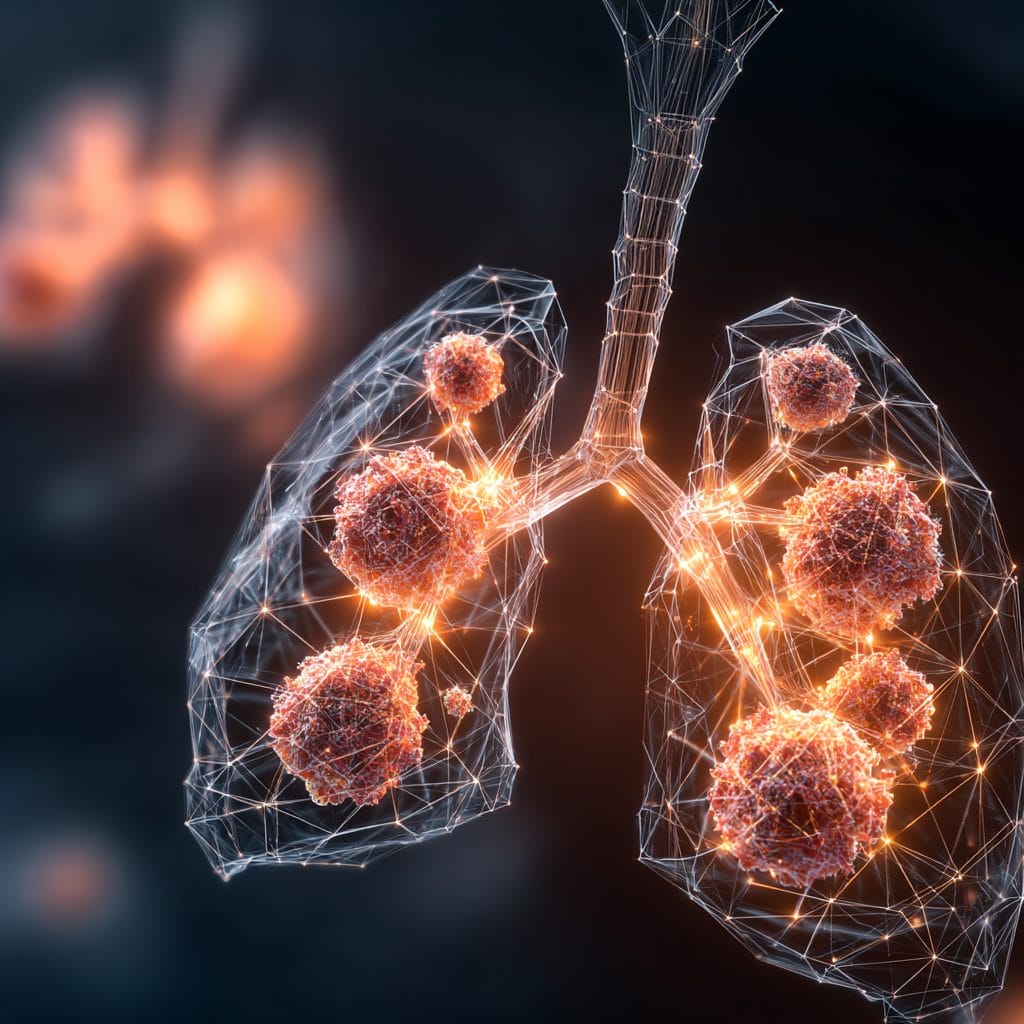
Depiction of lung cancer cells
Source: Depiction of lung cancer cells
Metabolic Demand Meets Electrical Excitability
Running on electricity isn’t free. Every “spark” burns through cellular fuel. NE cancer cells, constantly buzzing with activity, have a sky-high energy demand. But instead of relying on the typical Warburg effect where cancer cells prefer sugar-burning via glycolysis – these cells take a different route. They tap into oxidative phosphorylation (OXPHOS) – the same power-hungry pathway neurons use.
Even more fascinating – NE cells recruit nearby non-NE cells as metabolic sidekicks. These neighbors shuttle nutrients to keep the electrically active cancer cells firing. It’s like a gang of freeloaders building a power grid inside the tumor. The electrical activity comes at a cost — a significant increase in ATP demand. To meet this energy requirement – NE cells rely more heavily on oxidative phosphorylation (OXPHOS) rather than the typical aerobic glycolysis (Warburg effect) seen in many cancer types. Intriguingly, adjacent non-NE cells act as metabolic collaborators – supporting the NE cells by supplying critical metabolites—resembling the neuron–astrocyte metabolic shuttle in the brain.
As SCLC progresses – tumor innervation increases, and NE cells become more heterogeneous and electrically active – fueling a vicious cycle of tumor autonomy. Electrical activity both drives intra-tumoral diversity and strengthens the tumor’s long-term growth and metastatic potential.
Ion Channels Across Lung Cancer Subtypes
While the NE-electricity link is prominent in SCLC, other forms of lung cancer also display electrical dysregulation. According to secondary research, in lung adenocarcinoma, a panel of 37 ion-channel genes is differentially expressed—though with varied up- and down-regulation patterns across K⁺, Cl⁻, Na⁺, and TRP channels. This panel has prognostic value as an ion-channel expression signature (iLAS). In non-small cell lung cancer (NSCLC), ion channels—including TRP, potassium, and chloride channels—play roles in cell proliferation, migration, invasion, drug resistance, and overall tumor progression.
For example, Kv11.1 channels (a delayed-rectifier K⁺ channel) regulate SCLC cell proliferation. And alterations in Nav1.5/Nav1.6 sodium channels have been implicated in aggressive invasion and metastatic behavior.
Taiwanese researchers uncovered that small-cell lung cancer (SCLC) cells can generate their own electrical activity that mimics neuronal signals and drives tumor progression.
Source: Taiwan Insight
How Electric Fields Influence Lung Cancer Behavior
Beyond intrinsic electrical activity – external electric fields (EFs) also interact with lung cancer cells. Exposure of NSCLC cell lines (e.g., H460, H520) to direct current electric fields triggers electrotaxis – directed migration toward the cathode. This behavior intensifies with field strength and is modulated by MMP activity, especially MMP9. EFs also stimulate reactive oxygen species (ROS) generation and may alter ion-channel function, linking biophysical stimuli to molecular signaling pathways.
Moreover, a broader concept emerging in oncology is bioelectric dysregulation – cancer cells often exhibit depolarized resting potentials, compared to normal cells, facilitating proliferation and dedifferentiation. Ion-channel expression is a promising biomarker and therapeutic target across many cancers, affecting tumor initiation, stemness, invasion, and microenvironmental interactions.
Why This Matters: Clinical and Therapeutic Insights
Novel Therapeutic Targets – Ion channels and electrical signaling machinery may offer new avenues for targeted treatment – especially in aggressive NE SCLC, where conventional therapies struggle. The metabolic reliance of NE cells on OXPHOS, tied to electrical activity, presents a dual vulnerability – combining bioenergetics and electrophysiological disruption.
Electric properties such as resting membrane potentials or ion-channel expression patterns (like iLAS) may serve as early biomarkers for lung cancer or for predicting disease course. Again, non-invasive interventions like – electric field therapies (e.g., Novocure’s tumor-treating fields) already show promise in other cancers and are being investigated in lung cancer contexts.
Conclusion
The notion that electrical activity powers lung cancer progression – especially in neuroendocrine SCLC is transformative. Far from being a passive hallmark – bioelectricity actively drives malignancy, metabolic reprogramming, tumor heterogeneity, and metastasis. As research unravels this electrifying dimension – a new frontier emerges – one where bioelectric medicine, ion-channel–targeting strategies, and metabolic interventions could reshape the fight against lung cancer.
If this article triggers curiosity about how electricity fuels lung cancer, where else might bioelectricity play a hidden role in health and disease then AIU offers a list of Mini courses, Blogs, News articles and many more on related topics that one can access such as:
AIU also offers a comprehensive array of recorded live classes spanning various subjects. If any topic piques your interest, you can explore related live classes. Furthermore, our expansive online library houses a wealth of knowledge, comprising thousands of e-books, thereby serving as a valuable supplementary resource.
Reference
Reminder to our Dear Students,
Please ensure you are logged in as a student on the AIU platform and logged into the AIU Online
Library before accessing course links. This step is crucial for uninterrupted access to your learning
resources.