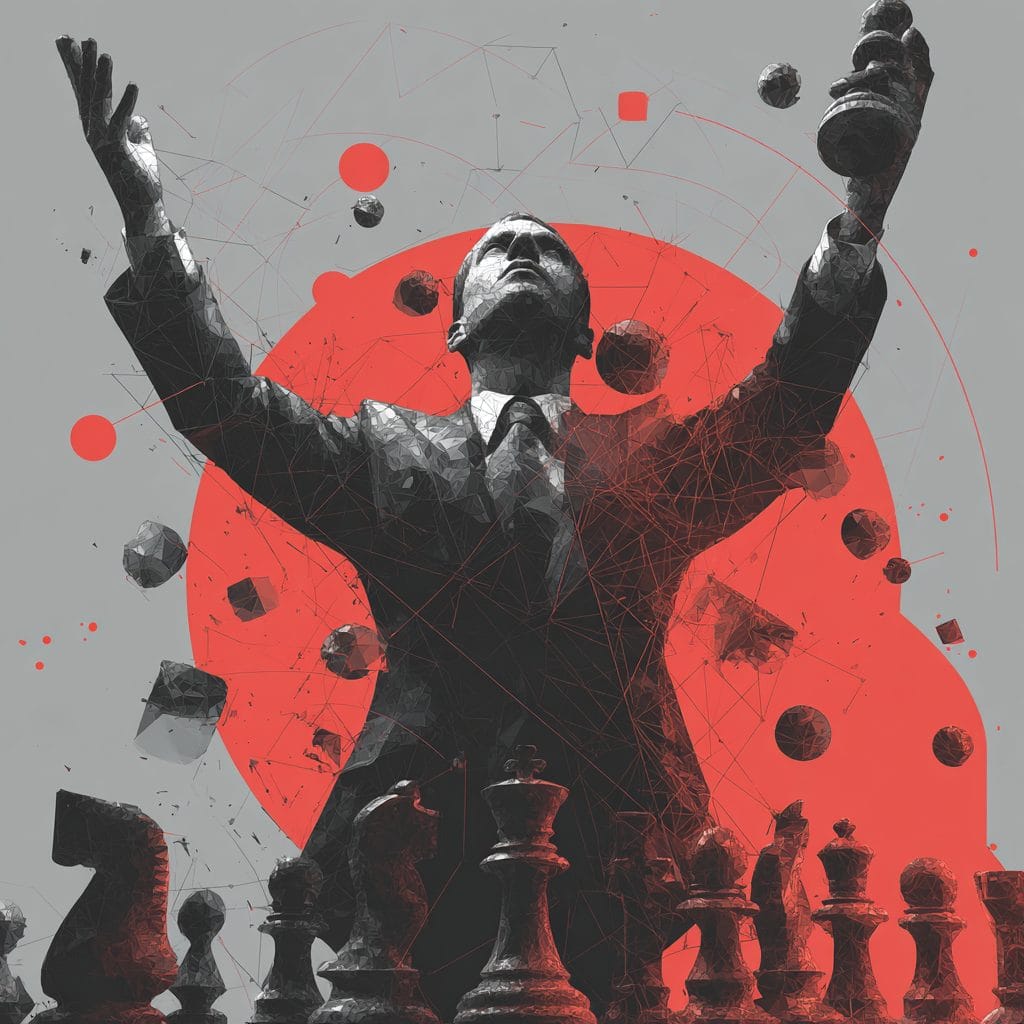
Business and Game Theory
Throughout human history, we have seen evidence that a single action can transform the course of our lives and societies. A perfect example is the Cuban Missile Crisis (1962), when the United States and the Soviet Union were on the brink of nuclear war. These countries had to make a decision: give in and cooperate, or continue to escalate the conflict? In this case, negotiation prevailed, thus avoiding a major catastrophe. However, it came at a great cost, as it was an arms race that ended up consuming trillions of dollars and brought with it global tension that lasted for decades.
An event of this magnitude was a historic milestone and, more than that, an example of how game theory can be applied. Game theory is simply a mathematical discipline that studies strategic interactions between people, companies, or nations. That is why players must focus on making the best decision, which will bring about the best possible outcome after implementation, bearing in mind that their actions affect not only themselves but also others.
But... what exactly is this theory?
This theory establishes four fundamental principles: first, there are the players, which can be countries, companies, businesses, or even social groups. Secondly, there are the rules, which determine what actions are available. Then we move on to the third point, which corresponds to strategies; a crucial point where each player makes a decision, which ultimately leads to the fourth point: the consequences, which are simply the result of those decisions made.
If we look for another example of how this theory works, we have the well-known but not so complicated “Prisoner’s Dilemma.” We are talking about two people who are arrested. They can choose whether to confess or remain silent. If both cooperate, they will receive a lighter sentence. But if one of the parties betrays the other and the other cooperates, the traitor will go free, and the other will receive a heavy sentence. And the last variation of this is that if both parties betray each other, they will both end up losing equally. This game tells us about a paradox: although it is common to “protect oneself by betraying the other,” it is undeniable that the best result comes from cooperation between the two.
Trust comes into play
Here we dive headfirst into one of the most fascinating contributions to game theory: trust. In the example given above, where we established that two players must decide whether to cooperate or cheat, we can see the following at a glance:
- If both cooperate = everyone wins
- If both cheat = everyone loses
- If one cheats and the other cooperates = both the cheater and the cooperator lose
The subtext is clear: trust is one of the best foundations for cooperation to flourish. Despite this, it is important to remember that trusting also implies being willing to show vulnerability, which brings with it the fear of being cheated. These are dilemmas that are not merely theoretical, as they can be extended to other areas such as business negotiations, interpersonal relationships, international politics, and even more current issues such as digital life.
Four rules for winning the trust game
Around 1977, a group of scientists organized a tournament called “The Iterated Prisoner’s Dilemma Tournament,” where computer programs were able to play many rounds of this trust game. The winners had characteristics that proved crucial:
- They were kind (Be Nice): They offered to cooperate first, and of course without deception or lies.
- They were strong (Be Strong): They did not allow abuse and responded to betrayal.
- They were compassionate (Be Forgiving): They punished deception, but in turn were able to cooperate again if the offender corrected their behavior.
- They were transparent (Be Clear): They used a strategy that was completely detectable and easy to understand, avoiding any confusion that this might cause.
The incredible and unique thing about this experiment is that it demonstrated how, in environments or contexts where interactions can be repeated, greater and more stable cooperation is more likely to occur than selfishness. It is not about being good, but about standing firm in applying justice while being kind, without falling into abuse. Currently, this discovery has been implemented in several areas, from biology, politics, and economics to artificial intelligence and human relations.
Companies that have successfully applied part of game theory
We can see how Game Theory is increasingly being applied to companies in today’s world. This has allowed them to develop greater confidence, serving as a key tool for growth, creating more effective strategies, and providing them with unique opportunities, all thanks to the best principle: cooperation. Below are three companies that have already achieved this.
Airbnb and its digital trust
Airbnb is a success story that can be taken as an example, because this company could not exist without trust. It is a somewhat risky model in which guests must place their trust in complete strangers to stay in their homes and vice versa. Hosts must also place some trust in strangers to allow them to stay. This is undoubtedly another example of how strategic cooperation leads to the creation of multimillion-dollar companies.
What was the perfect formula to make this business work? The rules of trust:
- Transparency: Clarity in policies.
- Authority: Strong consequences for those who do not follow the rules.
- Absolution or apology: Problems can be handled, but with a commitment to improve.
- Courtesy: Reputation rewards those who cooperate.
Cooperative competition and Tesla
In 2014, Elon Musk announced that his company would release its electric car patents, allowing other companies to use them freely. This seemed like an unusual move, and everyone wondered: why share such valuable information with competing companies?
Once again, this can be explained by game theory, which consists of competitors destroying each other, so that the loss would be for the common enemy, which is dependence on fossil fuels and climate change. In this case, Tesla cooperated partially, managing to boost the electric car market and also consolidating its leadership in the industry.
Likewise, this game can be seen in the application, kindness, and clarity of allowing part of its information or resources to be exposed; intelligent cooperation, taking into account that it would still make much more profit that way, and prevail by being the benchmark. Finally, strength, because its partiality led it to protect the innovation exposed to other areas.
The pharmaceutical industry, turning a crisis into an opportunity
It is said that when faced with a problem, we must seek solutions. This was precisely the case with the synchrony and cooperation of the pharmaceutical industries in response to the pandemic caused by the arrival of COVID-19 between 2020 and 2021. However, the real debate was between competing for the best results and customers, or sharing information to reach more people and save their lives.
At the beginning, many pharmaceutical companies did not want to share, so they worked in isolation, but as the days passed, they dared to collaborate by sharing essential data and even helping to form alliances that allowed for more effective vaccine distribution. Some of these companies were Pfizer and Biontech, which joined forces to produce the first authorized vaccines.
For its part, the American biotechnology company Moderna was not selfish and allowed other companies to access part of its research so that they could move forward more quickly and thus further accelerate the development of vaccines. This is yet another example of how cooperation to defeat this enemy called COVID was stronger than competition itself.
Game theory applied to world philosophies
Everyone has their own thoughts and ideology about whom to follow or what religion to belong to, but it is impressive to see how this fits in with game theory, which, in a way, all operate on a similar principle: “Don’t do unto others what you would not have them do unto you.”
In the case of game theory, it is clear that it is more about mathematical construction, cooperation, reciprocity, and trust, but ultimately, it applies to any field, and with a good strategy, you are sure to achieve greater empathy and fairness and come out as a winner.
Build and own your own future!
Every time you start the day, you are playing a new level in this world we call life. Therefore, it is important to keep in mind that every choice you make will not only affect your path, but also those around you. Whether it is in the area of health, career, or relationships, the ideal is always to seek the collective good without imposing only your ideas, because winning is not just about doing what you want, but strategically creating an avalanche of well-being for everyone by doing what you love.
Similarly, don’t forget that in building your path, the most vital thing is to form solid relationships, where cooperation will be the pillar for societies to be more just. But for this to happen, there must be kindness, strength, forgiveness, and clarity at all times. Only in this way will we be able to move toward a prosperous future in every aspect of our lives.
If you want to learn more about topics like this that inspire you to be a better person by applying unique techniques that allow for not only your academic development but also your personal development, you can delve into areas such as human development, arts, social innovation, or transformational leadership. Remember that at Atlantic International University, we offer personalized and flexible programs that are ideal for students to enhance their talents and turn them into a lifelong legacy. Studying in these areas will not only allow you to grow professionally but will also give you the tools to positively impact your community and the world.
Reminder to our Dear Students,
Please ensure you are logged in as a student on the AIU platform and logged into the AIU Online
Library before accessing course links. This step is crucial for uninterrupted access to your learning
resources.