
February 2025 Edition!
AIU News + Essays + Education + Culture + Science + Technology + Art + Design + Health + Environment + Human Rights + Animal & Nature Rights + + Theology + About AIU
Other Editions

AIU News + Essays + Education + Culture + Science + Technology + Art + Design + Health + Environment + Human Rights + Animal & Nature Rights + + Theology + About AIU
 JANUARY 6 2025.
 DECEMBER 13 2024.
 JANUARY 2025. This graduate
student completed his program
with a high cumulative grade
point average, which reflects
the quality of performance
within his major.
Congratulations!
JANUARY 2025. This graduate
student completed his program
with a high cumulative grade
point average, which reflects
the quality of performance
within his major.
Congratulations! NOVEMBER 20 2024.
Atlantic International
University proudly
highlights the remarkable
journey of
Samuel Ssewanyana, a
dedicated student who
pursued Bachelors in Business
Administration, with a commitment
to humanitarian work
and environmental sustainability
exemplifies the core
values of the university.
Samuel recently participated
in two significant humanitarian
initiatives: the “Compassion
for Gaza” campaign and the “Global IT Challenge
Competition for People
of Determination.” The
former aimed to provide
relief to war-affected
individuals in the Gaza
Strip, while the latter
focused on promoting the rights
and dignity of persons with
disabilities. Samuel’s involvement
in these events not only
showcased his dedication to social
impact but also transformed
his perspective on philanthropy.
He emphasized that anyone
can contribute to humanitarian
efforts, regardless of their financial status, by volunteering
their time and skills. ...
In addition to this, through
AIU’s “Go Green Campaigns,”
Samuel has gained valuable
insights into environmental
conservation and has become
an active participant in various
initiatives aimed at addressing
pressing environmental issues.
His journey began with his
registration under the Emirates
Foundation Volunteers platform,
where he received training
and participated in projects
like the “Environmental Eyes
Initiative”
NOVEMBER 20 2024.
Atlantic International
University proudly
highlights the remarkable
journey of
Samuel Ssewanyana, a
dedicated student who
pursued Bachelors in Business
Administration, with a commitment
to humanitarian work
and environmental sustainability
exemplifies the core
values of the university.
Samuel recently participated
in two significant humanitarian
initiatives: the “Compassion
for Gaza” campaign and the “Global IT Challenge
Competition for People
of Determination.” The
former aimed to provide
relief to war-affected
individuals in the Gaza
Strip, while the latter
focused on promoting the rights
and dignity of persons with
disabilities. Samuel’s involvement
in these events not only
showcased his dedication to social
impact but also transformed
his perspective on philanthropy.
He emphasized that anyone
can contribute to humanitarian
efforts, regardless of their financial status, by volunteering
their time and skills. ...
In addition to this, through
AIU’s “Go Green Campaigns,”
Samuel has gained valuable
insights into environmental
conservation and has become
an active participant in various
initiatives aimed at addressing
pressing environmental issues.
His journey began with his
registration under the Emirates
Foundation Volunteers platform,
where he received training
and participated in projects
like the “Environmental Eyes
Initiative”
 DECEMBER 9 2024.
Atlantic International
University proudly
highlights the inspiring
achievements
of Kel Malual Latjor
Balo, a Doctorate in
Legal Studies student, whose
educational journey has made a
significant impact.
Kel has been at the forefront
of educational reform in South
Sudan. Notably, he played a
pivotal role in coordinating the
establishment of a new state
university aimed at improving
access to higher education. His
efforts included: • Planning University
Operations: Collaborating
with local
and national education
authorities.
• Survey Research:
Leading a Knowledge,
Attitudes, and Practices
(KAP) survey in Duk County,
Jonglei State, to assess barriers
to school enrollment and
attendance.
• Community Engagement:
Working with organizations
like Christian Mission for
Development (CMD) to improve
educational access for
marginalized communities. Inspired by AIU’s emphasis
on integrating professional
development with academic
learning, Kel launched the
Child, Women, and Girls Legal
Aid (CWGLA) project in South
Sudan. This initiative aims to:
• Provide Free Legal Aid:
Addressing financial barriers
and ensuring legal representation
for vulnerable groups.
• Advocate for Legal Reforms:
Collaborating with
government institutions and
civil society to ...
Read full text:
DECEMBER 9 2024.
Atlantic International
University proudly
highlights the inspiring
achievements
of Kel Malual Latjor
Balo, a Doctorate in
Legal Studies student, whose
educational journey has made a
significant impact.
Kel has been at the forefront
of educational reform in South
Sudan. Notably, he played a
pivotal role in coordinating the
establishment of a new state
university aimed at improving
access to higher education. His
efforts included: • Planning University
Operations: Collaborating
with local
and national education
authorities.
• Survey Research:
Leading a Knowledge,
Attitudes, and Practices
(KAP) survey in Duk County,
Jonglei State, to assess barriers
to school enrollment and
attendance.
• Community Engagement:
Working with organizations
like Christian Mission for
Development (CMD) to improve
educational access for
marginalized communities. Inspired by AIU’s emphasis
on integrating professional
development with academic
learning, Kel launched the
Child, Women, and Girls Legal
Aid (CWGLA) project in South
Sudan. This initiative aims to:
• Provide Free Legal Aid:
Addressing financial barriers
and ensuring legal representation
for vulnerable groups.
• Advocate for Legal Reforms:
Collaborating with
government institutions and
civil society to ...
Read full text:
 DECEMBER 13 2024.
Assistant Commissioner
of Police Gary
McKenzie, head of
the Public Safety and
Traffic Enforcement
Branch (PSTEB), has
successfully earned a
Doctor of Psychology degree.
Dr McKenzie pursued his
studies at Atlantic International
University through an online
platform from September 2018
to October 2024.
In an interview with Observer
Online, Dr McKenzie expressed
pride in his academic achievement, acknowledging
the
challenges of balancing
his demanding
role within the
police force with his
studies. This accomplishment
adds
to his impressive academic
credentials, which include a
Bachelor of Laws degree from
the University of London,
earned in 2024.
His educational journey
began in 2006 when he earned
a Bachelor of Science in Psychology
and Political Science from the University of the
West Indies (UWI), Mona. He
later obtained an Associate of
Science in Police Studies and
Management from the University
of Technology, Jamaica,
in 2007.
In 2013, he earned a Master’s
degree from UWI and a
postgraduate certificate in
Road Safety for Low- and
Middle-Income Countries
from the University of Delft,
Netherlands. ...
Read full text:
DECEMBER 13 2024.
Assistant Commissioner
of Police Gary
McKenzie, head of
the Public Safety and
Traffic Enforcement
Branch (PSTEB), has
successfully earned a
Doctor of Psychology degree.
Dr McKenzie pursued his
studies at Atlantic International
University through an online
platform from September 2018
to October 2024.
In an interview with Observer
Online, Dr McKenzie expressed
pride in his academic achievement, acknowledging
the
challenges of balancing
his demanding
role within the
police force with his
studies. This accomplishment
adds
to his impressive academic
credentials, which include a
Bachelor of Laws degree from
the University of London,
earned in 2024.
His educational journey
began in 2006 when he earned
a Bachelor of Science in Psychology
and Political Science from the University of the
West Indies (UWI), Mona. He
later obtained an Associate of
Science in Police Studies and
Management from the University
of Technology, Jamaica,
in 2007.
In 2013, he earned a Master’s
degree from UWI and a
postgraduate certificate in
Road Safety for Low- and
Middle-Income Countries
from the University of Delft,
Netherlands. ...
Read full text:
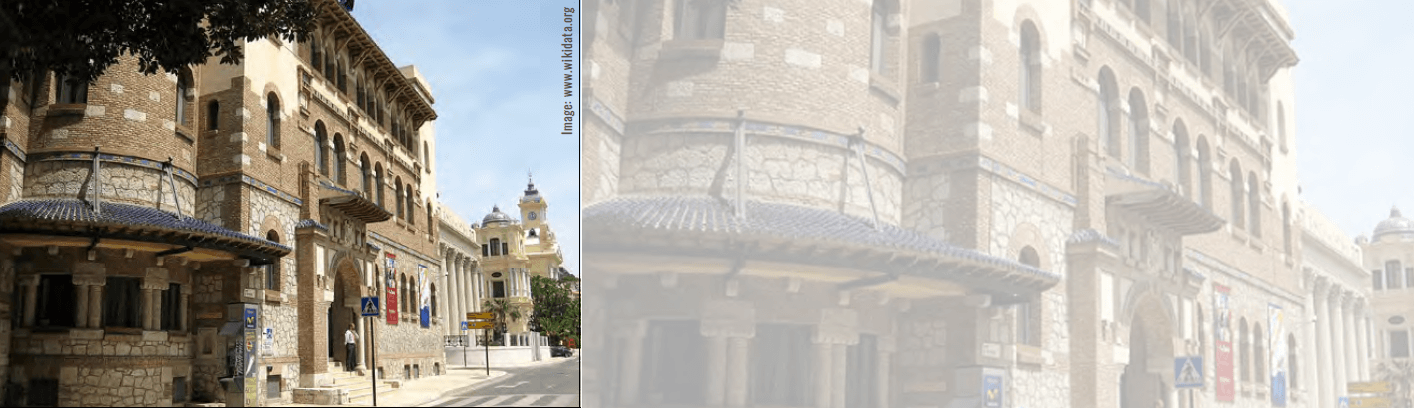 Call for Papers
This Conference will be held
2–4 July 2025
at University of Málaga,
Málaga, Spain.
We invite proposals for paper
presentations, workshops/
interactive sessions, posters/
exhibits, colloquia, focused
discussions, innovation showcases,
virtual posters, or virtual
lightning talks.
2025 Special Focus:
“Minds and machines:
Artificial intelligence,
algorithms, ethics, and order
in global society” Theme 1: Networks of Economy
and Trade. Theme 2: The
Power of Institutions.
Theme 3: Vectors of Society
and Culture. Theme 4: Ecological
Foundations.
Become a Presenter:
1. Submit a proposal
2. Review timeline
3. Register
Regular proposal deadline
2 April 2025
Regular registration deadline
2 June 2025
Call for Papers
This Conference will be held
2–4 July 2025
at University of Málaga,
Málaga, Spain.
We invite proposals for paper
presentations, workshops/
interactive sessions, posters/
exhibits, colloquia, focused
discussions, innovation showcases,
virtual posters, or virtual
lightning talks.
2025 Special Focus:
“Minds and machines:
Artificial intelligence,
algorithms, ethics, and order
in global society” Theme 1: Networks of Economy
and Trade. Theme 2: The
Power of Institutions.
Theme 3: Vectors of Society
and Culture. Theme 4: Ecological
Foundations.
Become a Presenter:
1. Submit a proposal
2. Review timeline
3. Register
Regular proposal deadline
2 April 2025
Regular registration deadline
2 June 2025

| Amílcar Mateus Joaquim Bachelor of Science Architecture Angola |
Ernesto Francisco Joao Bachelor of Engineering Environmental Health and Safety Angola |
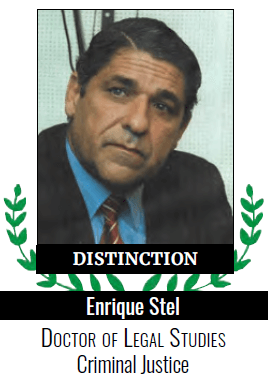
Enrique Stel Doctor of Legal Studies Criminal Justice Argentina |
Yousif Amin Al Ameen Doctor of Philosop hy Project Management Bahrain |
Ariel Richard Subelza Flores Bachelor of Science Electrical Engineering Bolivia |
Ginia Beradette Valenzuela Antigua Doctor of International Relations International Relations Dominican Republic |
| Lorena Javier Alcántara Master of Management Management and Productivity Dominican Republic |
Ramón Nicolás Jiménez Díaz Doctor of Philosop hy International Business Dominican Republic |
Hector Augusto Rodriguez Bachelor of Science Civil Engineering Dominican Republic |
Oscar Orlando Romero García Master of Science Organizational Development El Salvado |
Yésica Juana Castillo Galíndo Master of Science Health Sciences Guatemala |
Leslyn Ann Garraway Doctor of Science Urban and Regional Planning Guyana |
| Christine Russell Doctor of Education Early Childhood Education Jamaica |
Taneisha Reboe Master of Science Nutrition Jamaica |
Carlton D'Cruz Doctor of Education General Education Kenya |
Kaume Adams Kubai Master of Science Legal Studies Kenya |
Emmanuel Ruiz Romero Bachelor of Science Cyber Security and Hacking Mexico |
Canisio Heitor Jeronimo Chambale Bachelor of Science Petroleum Engineering Mozambique |
| Jacintha R. Brice Master of Science Psychology Netherlands |
Heather Ciweku Onoh Doctor of Philosop hy Renewable Energy Nigeria |
Andrew Aigbogie Mamedu Doctor of Philosop hy Political Science Nigeria |
Ibianga Philip Brown Doctor of Philosop hy Accounting Nigeria |
Aldo Gonzales Montoya Bachelor of Science Industrial Engineering Peru |
Hina Asif Bachelor of Science Counselling Psychology Qatar |
| Olympia Piper Cools Vitalis Doctor of Philosop hy Psychology Saint Lucia |
Bakary Sanneh Doctor of Science Agriculture Senegal |
Tsitsi Muvunzi Doctor of Philosop hy Project Management Sierra Leone |
George Sebastiano Akot Riing Bachelor of Science Architecture South Sudan |
Gloria Engracia Medina Cuéllar Doctor of International Relations International Public Relations Spa in |
Andres Rodrigo Barci Doctor of Business Administration Accounting Spain |
| Sherese S. Browne Bachelor of Social Sciences Social Work St. Vincent and the Grenadines |
Eng Muhigirwa Charles Doctor of Science Engineering Education Management Uganda |
Mauricio Nava Palacios Certificate of Management Business Management USA |
Mistreselasie Sentayehu Abate Master of Science Structural Engineering USA |
Audrey Leoni Lee- Peynado Doctor of Education Business Education USA |
Yuta M Silverman Doctor of Psychology Positive Psychology USA |
| Mohammad Hamidullah Sheikh Doctor of Philosop hy Business Administration USA |
Francisco Jose Cabello Guzman Bachelor of Business Administration Business Administration Venezuela |
||||
 Nevroy Francis
 Rachel Nyanquoi Jackson
 Hiroki Ito
 Jane Nampala Mayambala
We live in a world where
we don’t know where
we are going: a lot of technology,
there is talk of money
here and money there, but
at the same time we have an
education with great problems
to reach everyone, undeclared
wars, people killed for their
ideas by those who govern
through coups and people
dying of hunger because they
don’t get food.
We must add that everyone
says what they want, and they
take what they say as truth
and to increase the madness of
this world there are those who
govern according to what they
want because they feel like the
new “monarchs” and that the
countries belong to them.
We are in the society of the
instantaneous: commerce and
information. Instant commerce
was generated with
Globalization and Globalization
brought with it the
development of communication
that should also be fast,
instantaneous. But instant
communication created the
development of all the means
that allowed it and there are platforms and social networks!
The problem of the veracity
of these means also arose and
now we find ourselves in a serious
problem because there’re
no laws that control them in
terms of what they publish.
With globalization, the
problem arose that not all
countries had the infrastructure
to work in this way.
Time has shown what was
already known. You can see
the work of the last years of
the French philosopher and
sociologist Edgar Morin, for
example – Towards the abyss? Globalization in the 21st century.
We see governments emerging
everywhere whose forms
of election were based on misinformation.
The problem is
that most of the population of
the country you want doesn’t
have all the formal education
necessary to identify what is
true and what is false. The
United Nations Organization
-UN- in its area dedicated to
Science, Research and Culture,
UNESCO, is working to guide
digital media and platforms
towards the truth.
“They have committed to
work together to implement
the UNESCO Guidelines by cofinancing
a UNESCO-hosted
Global Regulators Forum,
which will meet regularly with
civil society to coordinate their
efforts for better governance
of digital platforms”. UNESCO
and media regulators created a global
ne twork to coo rdinate regulation of
digital platforms. UNESCO, 16 Augus t
2024. https://www.unesco.org/en/
articles/unesco-and-media-regulators-
create-global-network-to-coordinate-
regulation-of-digital-
How much does UNESCO
do? “UNESCO, with its 194
Member States, contributes to
peace and security by leading
multilateral cooperation
in education, science, culture, communication and information.
Headquartered in Paris,
UNESCO has offices in 54 countries
and employs more than
2,300 people. It oversees more
than 2,000 World Heritage
sites, Biosphere Reserves and
Global Geoparks; networks of
Creative, Educational, Inclusive
and Sustainable Cities;
and more than 13,000 partner
schools, university chairs and
training and research institutions.
The Director-General is
Audrey Azoulay”. UNESCO and
media regulators created a global
ne twork to coo rdinate regulation of
digital platforms. UNESCO, Augus t 16,
2024. https://www.unesco.org/en/articles/
unesco-and-media-regulatorscreate-
a-global-
By creating this Platform,
UNESCO aims to teach media
and platforms how to identify
false information that affects
citizens around the world.
UNESCO aims to bring together as many media and platforms
as possible and teach them
how to work with all citizens
of the world to promote the
truth. This network will have
scheduled meetings to follow
up on this work.
The transmission of false
information for precise purposes
is what is called disinformation.
“Disinformation,
understood as the deliberate
dissemination of false or
misleading information, and
fake news, which are presented
as true, but are completely invented
or distorted, have found
in social networks a favorable
medium for their propagation.
These digital platforms,
designed to connect people
and facilitate the exchange of
information, have amplified
the reach and speed with which
disinformation can reach millions
of users around the world
(Jumbo, 2021)”. LATAM - Latin
American Jou rnal of Soc ial Sciences .
2024. Volume 5 Number 2, p 139.
Introduc tion . https://doi.org/10.56712/
latam.v5i2.1865
The great thing about the
situation is that these platforms
make a lot of money
because users are manipulated
with everything that can be
done from Psychology to Marketing
and Politics.
The interesting thing will be
to see what happens to governing
countries when only the
truth follows from the truth.
If everything they have said
is false, how will they govern
when the facts every day show
that it’s impossible to do what
they said.
Governing is not a joke;
governing means clear rules
for the economy, for the rights
and obligations of all, for private
property, for the teaching
of all sciences and for health
protection.
If everything said is disinformation,
the management of
public affairs will demonstrate
the truth. “In the digital age,
social networks have emerged
as a powerful medium for the
dissemination of information,
but also as a significant
vehicle for the spread of disinformation.
This phenomenon
has taken on even greater
importance during global
conflicts, where accurate and
truthful information can have
a significant impact on public
perception and the course of
events”. LATAM- Latin American
Journal of Social Sciences . 2024.
Volume 5 Number 2, p 139. Introduction.
https://doi.org/10.56712/
latam.v5i2.1865
The problem with misinformation
is that those who
believe that because they are
told something through digital
media it must be true are
often people with little formal
education. The extraordinary
thing about the situation is
that their votes are bought in a way that looks legal: they will
receive these and those benefits.
They believe them, but
after those who wanted power
to achieve it, the problems
begin because the money obtained
goes to the group that
is with the “monarch”.
They are told that they must
meet these and those requirements
so that time passes, and
it turns out that they didn’t
have what was asked of them.
Chaos and discontent will
be generated by those who
no longer gave them education
when they realize that
they were used.
“While social media offer
unprecedented opportunities
for communication and
public participation, they also
pose significant challenges
in terms of the spread of misinformation
and the manipulation
of public opinion”.
LATAM - Latin American Jou rnal
of Soc ial Sciences . 2024. Volume 5
Number 2, p 140. Volume 5 Number
2, p 139 Introduc tion . https://doi.
org/10.56712/latam.v5i2.1865
It seems that 2025 will be
a year of surprises because
the economy that was sought
became global and instantly
populist governments now say that their economies will be
closed, they will not trade with
anyone for reasons that do not
make sense.
How long has it been since
trade began? Can a country
produce everything it needs?
What will the World Trade
Organization do? It seems that
everything that happened that
produced a global disagreement
that led to World War II
has been forgotten.
“Social media platforms
must take greater responsibility
for moderating content
and promoting media literacy
among their users. Governments can also play a crucial
role in promoting transparency
and countering misinformation
through effective policies
and regulations.” LATAM - Latin
American Jou rnal of Soc ial Sciences .
2024. Volume 5 Number 2, p 139.
Introduc tion . https://doi.org/10.56712/
latam.v5i2.1865
If governments must deal
with the misinformation that
media and platforms provide,
what can be done if the only
thing they seek is to benefit
from all those they left
without education, which is
why they believe them. It is
known and this is what UNESAmerican Journal of Soc ial Sciences. 2024. Volume 5 Number 2, p 139.
Introduc tion . https://doi.org/10.56712/
latam.v5i2.1865
The moments of History
don’t last forever, otherwise
we would still be in the Stone
Age; the interesting thing is
to know what the geniuses or
new “monarchs” of this 21st
century are going to do with
all the lies they have told and
what they are going to do. One
lie led to another.
Science is done with statements
that have been demonstrated
and proven. There are
also the principles of reason,
Aristotelian Logical Principles,
Principles under which science
is still done.
“We do not believe that there
is a non-Aristotelian logic in
the sense that there is a non-
Euclidean geometry, that is,
a logical system that assumes
the truth of the contraries of
the Aristotelian principles of
contradiction and excluded
middle, as well as of the valid
inferences drawn from them;
the systems recently presented
as alternative systems are
nothing but different systems
of notation or symbolization of
the same logical facts”. Cohen
and Nagel, 2019, p. 9.
“This concept goes beyond
simply understanding how the
media works, and encompasses
skills such as analyzing media
messages, recognizing biases and manipulations, and making
informed decisions about
the information consumed and
shared”. (Cobo, 2009). LATAM -
Latin American Jou rnal of Soc ial
Sciences . 2024. Volume 5 Number
2, p 139. Introduc tion . https://doi.
org/10.56712/latam.v5i2.1865
These are the Social Networks
we have:
1. Generalizing networks. Videos,
links, texts are shared,
example: Twitter, Facebook
and Instagram.
2. Networks for professionals.
They promote professional
development and
job opportunities. Xing and
networking.
3. Networks for visual content.
Videos and images
are shared. Snapchat and
Pinterest.
4. Microblogging networks.
Posts or tweets are published.
Tumblr and Twitter
5. Instant messaging networks.
Telegram, Facebook,
Messenger and WhatsApp 6. Interest-based networks.
TikTok and Reddit.
7. Niche or special interest
networks. Gooddreads and
Strava.
Given the world that we seem
to have for 2025, the convenient
and safe thing to have a
satisfactory life is to study.
Knowing is never too
much. You are doing a program
at Atlantic International
University, therefore:
Study to be free.
Study to know
the value you have
as a human being.
Study not be part
of those used
by the new leaders
or “monarchs”.
Remember that it’s
not just about being an
expert in the use of the
digital world, it’s also
about knowing science.
BIBLIOGRAPHY. Cohen M. y Ernest Nagel. 2019. Introducción a
la Lógica y al Método Científico. Argentina, Amorrortu editores.
| LATAM- Revista latinoamericana de Ciencias Sociales. 2024.
Volumen 5 Número 2. https://doi.org/10.56712/latam.v5i2.1865https://
doi.org/10.56712/latam.v5i2.1865 | Morin, E. 2010. ¿Hacia el abismo?
Globalización en el siglo XXI. España, Paidos. | UNESCO. Organización
de las Naciones Unidas para la Educación, la Ciencia
y la Cultura. La UNESCO y reguladores de medios crean una red
mundial para coordinar la regulación de las plataformas digitales.
UNESCO, 16 de agosto 2024. https://www.unesco.org/es/articles/
la-unesco-y-reguladores-de-medios-crean-una-red-mundial-para-coordinar-
la-regulacion-de-las

Introduction
Most people around the
world are suffering from
climatic changes due to the
non respect of the whole
ecological system. The need of
taking into consideration the characteristics of environment
when planning and acting in
all the daily-life situations has
become more and more important.
On the other hand, the
protection of the environment
is also one of the important need of mankind. People of
all ages are capable of understanding
the importance of
nature protection: protection of
animals and plants, of human
life and health; maintenance of
clean environment, of humans’ daily life and entertainment;
reduction of pollution,
prevention of a possible end
of the world (Dovilė Šorytė &
Vilmantė Pakalniškienė , 2019). In
this perspective, the issue of
harmony with the environment
remains a crucial worldwide
problematic.
Concerning that issue of
conformity with the environment
and as far as the architecture
field is concerned,
more and more people around
the world are interested in the
problem of building or constructing
houses in connection
with the environment. Building
design, building techniques
and building construction materials
that do not conflict with
the environment are used more
often in many countries.
Given the increasing human
need of reducing the gap
between human activities and
the environment; taking into
account the increasing human
need of improving the way of
resolving the housing problem
in the world and referring to human behavior that sometimes
disharmonize with the
ecological system, how can we
proceed to solve the problems
related to the Conflict between
the building occupants’ behavior
and the environmental
characteristics, from conflicts
interspaces in connection with
the principle of isomorphism in
architecture? Considering the
problem situation on a specific
building to be improved, would
it be pertinent, based on the
principle of isomorphism in
architecture, especially on the
relation of bijective correspondence
between spaces, to
explain problems of buildings
focused on the Conflict between
occupants’ behavior and
the environmental characteristics
of the building? These are
the questions to be examined
in this piece of work.
A four part analysis
This work, whose main
objective is to explain and to
solve the problems related
to the Conflict between the occupants’ behavior and the
environmental characteristics
of the building, from conflicts
interspaces in connection with
the principle of isomorphism in
architecture, is made up of four
parts. After the introduction,
theoretical framework, then
the methodological aspects,
later on, the results and finally
the conclusion are presented. Theoretical framework
The concept of isomorphism
in Architecture
Defining the concept of
isomorphism, Timmermans
(2012, p. 42) stated,
A homomorphism Ф A1→A2
is a mapping from A1 to A2
that preserves the structure
relations in A1 (…); if a homomorphism
Ф is one-toone,
onto and if its inverse
mapping Ф-1: A2→A1 is also
a homomorphism, then Ф is
called an isomorphism.
A homomorphism from A1 to
itself is called an endomorphism.
If this endomorphism
is also an isomorphism, it is
called an automorphism.
An isomorphism refers to a
one-to-one correspondence
between the elements of 2 or
more sets; a one-to-one relation
onto the map between
the sets which preserves the
relations existing between elements
in its domain1.
From the characteristics of
the definition of the concept
of isomorphism, some sciences
such as Biology, Chemistry,
many principles could
be identified as aspects of the
principle of isomorphism. They
are the principle of similitude
or similarity (of structures,
relations, operations…); the
principle of constancy (of
structures); the principle of
correspondence (of structure,
relations, operations…); the principle of extension or continuity
(of structures, relations,
operations…); the principle of
reciprocal influence and the
principle of the strength of the
original ecological unit.
According to Elvira Mumy
(2016), the principle of isomorphism
in Architecture refers
to a great analogy, a close
similarity and correspondence,
the extension of relations
between two or many domains,
structures, spaces, ecological
units, environmental sets or
systems. It could be divided
into many sets of aspects:
the unity of environment, the
relations, and the priority of the original ecological unit in
creating spaces or in solving
architectural problems.
These aspects and elements
are (i) the unity of the
environment which involves
the notions of constancy,
harmony of ecological units;
boomerang effect of negative
influences…; (ii) the
relations between ecological
units which is made up of
the notions of correspondence,
equivalence, extension
of the relations sets…
inside the space, the domain,
or between spaces, domains,
or ecological units; (iii) the
priority of original space which deals with the strength
of the original (initial) natural
ecological unit.
The principle of isomorphism
in architecture which
refers to a bijective correspondence
is made up of principles
such as the principle of correspondence,
the principle of extension/
continuity, the principle
of reciprocal influence,
the principle of the strength
of the original ecological unit,
the principle of constancy,
the principle of similarity /
similitude. The figure on the
left presents the extension of
the principle of isomorphism.
(See Figure 1)
The theory of linear spaces
and architecture
In the perspective ecological
design, Architects are intended
to create spaces whose link
with the whole world would be
as an isomorphism. One of the
pertinent theories connected to
the principle of isomorphism
in architecture is the theory of
linear spaces. In their research
on linear spaces, Agoshkov,
Dubovsky, and Shutiaye (2006,
p.5) stated:
The linear normalized spaces
X and Y are termed isomorphous
if the image J: X →
Y is defined on all X. This
image is linear and carries
out isomorphism X and Y as linear spaces and is such that
there are constants α > 0, ß >
0, such that for any f ε X the
inequality α|| f ||x≤|| J(f) ||Y
≤ ß|| f ||X is fulfilled.
According to Pankov (2010, p.17),
Linear spaces are isomorphic
if there exists a bijection
f: P → P_ such that f (L) =
L’; this bijection is called
a collineation of Π to Π’. A
bijection of P to P’ is said to
be a semicollineation of Π to
Π’ if it maps lines to subsets
of lines. An injection of P to
P’ sending lines to subsets of
lines is called an embedding
of Π in Π’ if distinct lines go
to subsets of distinct lines.
In congruence with these mathematical statements in
connection with architecture,
Statistics have shown
throughout the years that
all human activities have a
dramatic impact on the natural
environment. “The external
climate (temperature, humidity,
radiation and wind),
state Balocco and Grazzini
(2010, p. 1), “determines the
heating and cooling requirements
of the building.” Site
and Climatic Conditions such
as Solar Orientation, the local
climate, water and other available
resources, environmental
controls specifically air-quality
controls which provide ventilation,
a comfortable indoor climate and major possibilities
for energy savings, must
be taken into consideration
when designing and creating
spaces (Crawford, 2011; Apos poros ,
2012; Sayigh, 2014; Tabb and Devine,
2013;Yellamraju, 2011).
According to Santamouris
(2006), when working in the
context of environmental
design, the architect should
consider many factors such as
the shape and size, the ‘body’
and ‘skin’ of buildings, the use
of the sun’s energy and daylight,
the provisions of views
for occupants, the need of ventilation,
heat loss through the
building envelope that have an
impact on the environment.
About the environmental
Impact of Building Materials
and according to Bokalders and
Block (2010), some important
aspects should be taken into
account when choosing the
right material from an ecological
perspective. How the materials
will influence the interior
climate? How the materials will
impact the outdoor environment
in general? How plants
and animals are influenced
by the discharged caused by
the production and disposal of
these materials?
Architects of ecological
design are intended to build
houses, to create spaces that
are an image of the whole
environmental systems or
which harmonize with the whole ecological system (Roth,
2017). In this perspective, when
designing, planning, building,
architects should be aware
of the importance of bijective
correspondence, great analogy,
close similarities, extension of
relations between spaces to be
created and the environment or
at least the pertinent ecological
units of the related ecological
system.
Additionally, the ecologically
sustainable architecture and
construction is based on major
principles such as the use of
the natural resources suitable
to the environment, waste reduction,
recycling of resources;
protecting the critical resources,
water efficiency, resource
conservation, respecting the
harmony between the human
beings and his natural environment,
flexibility, durability
and using principles of physics
(the concept of heat transfer
for example) to improve
people’s behavior in a building
(Sendzimir and Bradley, 2002;
Akadiri, Chinyio and Olomolaiye,
2012; Piotrowich & Osgood, 2009).
As far as the theory of
linear spaces in relation with
architecture is concerned,
architects of ecological design
are intended to create
spaces whose link with the
whole world would be as an
isomorphism. This involves
the environmental characteristics
of the original space and surroundings as well as
people behavior
Methodological aspects
of the study
The situation of the residential
building
The client is facing a set of
problems in his residential
building. Firstly, the noise
produced by the music played
by his neighbors around is perceived
in his rooms, even when
all the openings are closed.
Secondly, he is also experiencing
much heat in his house.
Additionally, he suffers from
cooling and other problems.
The roof of his house is
made up of AL, the ceiling of
wood; the walls are made up
of cement block; the doors and
windows are made up of wood.
Also, there is no sufficient free
air movement in the building. In addition, rooms are not big;
day lighting, insufficient. From
the interview we got with him,
he stated that he needed an
explanation of that situation
and a renewed building that
would offer him a well-being
in harmony with his environment,
an ecologically sustainable
residential building.
Techniques and instruments
for data collection
A set of techniques and
instruments were used for
data collection: firstly, an
observation of the site and the
building, secondly an interview
addressed to the occupants of
the building. Table 1 drawn on
the right represents for each
main variable, the objective
or assessment criteria and the
technique(s) used for data collection.
(See Table 1) Some of these criteria correspond
to the main characteristics
of buildings suitable
to ecologically sustainable
architecture and construction
in connection with the research
problem and with the research
objective of the study.
Process of explaining the
problems related to the
Conflict between occupants’
behavior and the environmental
characteristics of
the building, from conflicts
interspaces in connection with
the principle of isomorphism
in architecture
In order to achieve the objective
of explaining the problems
related to the Conflict
between the occupants’ behavior
and the environmental
characteristics of the building,
from conflicts interspaces in
connection with the principle
of isomorphism in architecture,
a set of steps were observed.
Step 1: First assessment:
Defining the problem to
be solved from initial data
collected
Step 2: Detailed assessment:
analysis and diagnostic of the
situation
2.1. Definition of spaces
2.1.1. The original space
2.1.2. The target space
2.2. Definition of the relations
(different conflicting situations
between spaces)
2.2.1. Identification of the different relations between
spaces
2.2.2. Identification of harmonious
relations (identification
and definition of
the harmonious relation
of the building with its
environment)
2.3. Definition of the conflicting
situation
2.3.1. Identification of the
conflicting relationship of
the created space and its
environment)
2.3.2. Definition of the
conflicting relationship and
the conflicting situation (of
the building and its environment
from the principle
of correspondence)
2.4. Definition of the final
problem to be solved (from
the analysis of the situation
and referring to the
principle of correspondence
or bijective relation, state
the different conflict situations
within the whole set
of relations between spaces
-original space and target
space)
Step 3: Conclusion
The methodological aspects of
the study were centered on the
collection of data related to a
set of relevant criteria, using
observation and interview.
The process of determining
the pertinence of the use of
conflicts interspaces in connection
with the principle of isomorphism when explaining
problems of buildings was
aimed at evaluating the gap
between created spaces and
original spaces.
Results of the study
Referring to the principle of
isomorphism in architecture,
how can we use conflicts interspaces,
so as to understand
problems of buildings related
to the Conflict between the
occupants’ behavior and the
environmental characteristics
of the building? What are the components of the different
spaces? From the relations
between the spaces, what
are the different conflicting
situations? How will the final
problem related to the Conflict
between the occupants’ behavior
and the environmental
characteristics of the building
be defined? These are the
questions examined in this
piece of research.
The problems of buildings
and the conflict between
occupants’ behavior and the
environmental characteristics of the building with regard to
isomorphism
The case studied in this
piece of work is in connection
with the relation between
spaces: the created space that
corresponds to the building
and the initial space to which
the building is related. Before
thinking on the explanation
process, it is necessary to first
restate the principle of isomorphism,
and to define the main
characteristic property from
which this principle can be
defined. TO BE CONTINUED
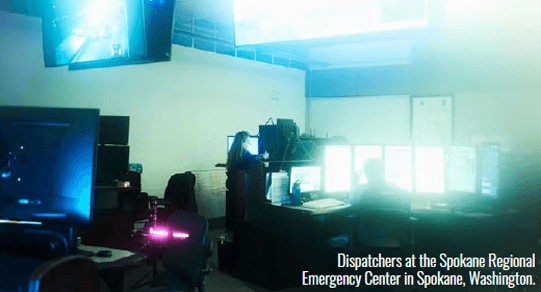 It was a Wednesday morning in May
2023, when the call —from someone
who identified himself only as
“Wayne”— came in via a publicly listed
regional emergency line. “I’m going
to walk into Central Valley High School
in Veradale with my AK-47,” Wayne
told the operator who first picked up.
... “I’m going to kill everyone I see.”
That operator transferred him to
Sarah Jones. ... who realized she was
speaking to an active school shooter,
and that she had seconds to persuade
this stranger not to carry out his plan.
“Hi. Wayne? What’s going on?”
Jones asked calmly. ... “All you need
to know is that I want cops here as
soon as possible. Because after I kill
everyone I see, I want to kill cops too.”
“Wayne,” Jones answered ... “Are you
in front of the school right now?” “Yes, I’m walking in now.” “OK, can you
stop, please?” Jones said. ... The only
answer was a series of rapid staccato
blasts: automatic gunfire. ...
The chaos, the fear, the dread and
immense disruption triggered by that
voice on the phone wasn’t targeted
at Spokane alone. The call was one of
dozens that a person would make to law
enforcement, targeting schools across
Washington state over a little more than
24 hours. ...
Torswats had been tormenting schools
all over the country. He was a player
in a loosely linked network of young
trolls who made hundreds of “swatting”
calls —hoaxes designed to send heavily
armed police to a victim’s door— and
bomb threats that triggered mass evacuations.
...
Read full text:
It was a Wednesday morning in May
2023, when the call —from someone
who identified himself only as
“Wayne”— came in via a publicly listed
regional emergency line. “I’m going
to walk into Central Valley High School
in Veradale with my AK-47,” Wayne
told the operator who first picked up.
... “I’m going to kill everyone I see.”
That operator transferred him to
Sarah Jones. ... who realized she was
speaking to an active school shooter,
and that she had seconds to persuade
this stranger not to carry out his plan.
“Hi. Wayne? What’s going on?”
Jones asked calmly. ... “All you need
to know is that I want cops here as
soon as possible. Because after I kill
everyone I see, I want to kill cops too.”
“Wayne,” Jones answered ... “Are you
in front of the school right now?” “Yes, I’m walking in now.” “OK, can you
stop, please?” Jones said. ... The only
answer was a series of rapid staccato
blasts: automatic gunfire. ...
The chaos, the fear, the dread and
immense disruption triggered by that
voice on the phone wasn’t targeted
at Spokane alone. The call was one of
dozens that a person would make to law
enforcement, targeting schools across
Washington state over a little more than
24 hours. ...
Torswats had been tormenting schools
all over the country. He was a player
in a loosely linked network of young
trolls who made hundreds of “swatting”
calls —hoaxes designed to send heavily
armed police to a victim’s door— and
bomb threats that triggered mass evacuations.
...
Read full text:
 Food delivery drivers can be a menace:
On scooters or e-bikes, they
weave in and out of traffic, run red
lights, and terrorize pedestrians on the
sidewalks. When they’re in cars, they
can make illegal U-turns, block bike
lanes, and double-park. Nearly everyone
hates delivery drivers. Major cities like
New York and Boston have been trying
to crack down on the chaos. The city
council in Washington, DC, just passed
legislation to try to regulate them, and
city residents have called for better
traffic regulation to restore order.
It’s an uphill battle. The delivery
companies’ high-powered lobbyists
have fought regulation, which is
complicated by genuine concerns for
the low-income immigrants exploited
by the delivery app companies. Rarely
discussed in all the furor, however, are the real monsters: the customers!
People who frequently use services
like DoorDash and Uber Eats are like the
single-occupancy commuter on the
Beltway, the Amtrak passenger who
piles his luggage on the adjacent seat
on a crowded train, or the driver who
blocks the intersection. They’re exemplars
of American individualism, where
one person’s immediate gratification
comes at the expense of an entire city’s
ability to use the crosswalks.
Delivery services can be legitimate
lifelines for people with disabilities,
new parents, the elderly, or people battling
an illness. But the couriers clogging
the roads and dominating sidewalks
today aren’t delivering a week’s
worth of groceries. ...
Read full text:
Food delivery drivers can be a menace:
On scooters or e-bikes, they
weave in and out of traffic, run red
lights, and terrorize pedestrians on the
sidewalks. When they’re in cars, they
can make illegal U-turns, block bike
lanes, and double-park. Nearly everyone
hates delivery drivers. Major cities like
New York and Boston have been trying
to crack down on the chaos. The city
council in Washington, DC, just passed
legislation to try to regulate them, and
city residents have called for better
traffic regulation to restore order.
It’s an uphill battle. The delivery
companies’ high-powered lobbyists
have fought regulation, which is
complicated by genuine concerns for
the low-income immigrants exploited
by the delivery app companies. Rarely
discussed in all the furor, however, are the real monsters: the customers!
People who frequently use services
like DoorDash and Uber Eats are like the
single-occupancy commuter on the
Beltway, the Amtrak passenger who
piles his luggage on the adjacent seat
on a crowded train, or the driver who
blocks the intersection. They’re exemplars
of American individualism, where
one person’s immediate gratification
comes at the expense of an entire city’s
ability to use the crosswalks.
Delivery services can be legitimate
lifelines for people with disabilities,
new parents, the elderly, or people battling
an illness. But the couriers clogging
the roads and dominating sidewalks
today aren’t delivering a week’s
worth of groceries. ...
Read full text:
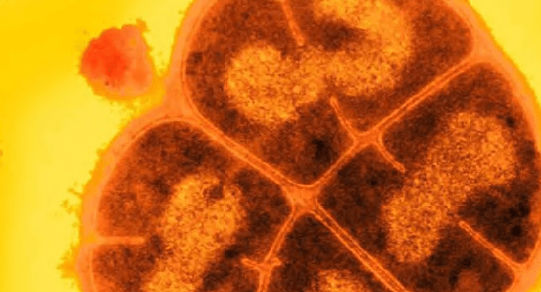 In the 1950s, scientists exposed a tin
of meat to a dose of radiation that
they expected would kill all forms of
life. But they discovered a surviving
microorganism: the bacteria Deinococcus
radiodurans.
It is able to withstand radiation doses
thousands of times higher than what it
would take to kill a human being, earning
it the nickname ‘Conan the Bacterium.’
Ever since its discovery, scientists
wondered why made it so resilient
against radiation. In a study published
in the journal Proceedings of the National
Academy of Sciences, researchers finally
home in on an answer. Three components
found in a Deinococcus radiodurans
cell —manganese ions, phosphate and
peptides— come together to create a very powerful antioxidant that is more
resistant to radiation than expected.
Study co-author Brian Hoffman, a
chemist at Northwestern U., says that
prior to the study, he thought the answer
would be a simple math problem:
Add the radioactive resistance of each
component and get the total amount of
radioactive resistance the overall bacterium
had. But the results surprised
him. “There’s something new that
forms when you put the pieces together.
It’s the combination [in which] they
interact with each other!” ...
In the 1950s, scientists exposed a tin
of meat to a dose of radiation that
they expected would kill all forms of
life. But they discovered a surviving
microorganism: the bacteria Deinococcus
radiodurans.
It is able to withstand radiation doses
thousands of times higher than what it
would take to kill a human being, earning
it the nickname ‘Conan the Bacterium.’
Ever since its discovery, scientists
wondered why made it so resilient
against radiation. In a study published
in the journal Proceedings of the National
Academy of Sciences, researchers finally
home in on an answer. Three components
found in a Deinococcus radiodurans
cell —manganese ions, phosphate and
peptides— come together to create a very powerful antioxidant that is more
resistant to radiation than expected.
Study co-author Brian Hoffman, a
chemist at Northwestern U., says that
prior to the study, he thought the answer
would be a simple math problem:
Add the radioactive resistance of each
component and get the total amount of
radioactive resistance the overall bacterium
had. But the results surprised
him. “There’s something new that
forms when you put the pieces together.
It’s the combination [in which] they
interact with each other!” ...
 In living things, structures are built
from simple, repeatable patterns.
These often come in the form of a disorganized
lattice. Large structures, like
bones or coral, emerge from repeated
rounds of growth of a fundamental
pattern that builds off of itself in a
haphazard way.
Despite this apparent disorganization,
the resulting structures can
acquire a variety of shapes and have
surprising strengths, versatility and
other useful properties. Most importantly,
the resulting structure often has
properties that the underlying lattice
unit doesn’t possess. ...
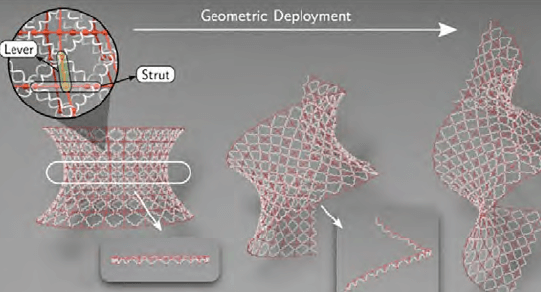
One promising kind of metamaterial
is known as a totimorphic lattice. The
basic component of this lattice is a triangular
structure. On one side is a fixed beam with a ball joint in the center.
An arm attaches to that ball joint, and
the other end of the arm is attached to
the ends of the fixed beam with two
springs. When many of these shapes
are attached together, the resulting
structure can morph into a wide variety
of shapes and structures, all with very
minimal input. This gives the totimorphic
lattice incredible flexibility.
In a recent paper, scientists with the
European Space Agency’s Advanced Concepts
Team took a major leap in advancing
totimorphic lattices from a hypothetical
idea to practical applications.
One major question with these lattices
was how to reconfigure a large structure
...
Read full text
In living things, structures are built
from simple, repeatable patterns.
These often come in the form of a disorganized
lattice. Large structures, like
bones or coral, emerge from repeated
rounds of growth of a fundamental
pattern that builds off of itself in a
haphazard way.
Despite this apparent disorganization,
the resulting structures can
acquire a variety of shapes and have
surprising strengths, versatility and
other useful properties. Most importantly,
the resulting structure often has
properties that the underlying lattice
unit doesn’t possess. ...
One promising kind of metamaterial
is known as a totimorphic lattice. The
basic component of this lattice is a triangular
structure. On one side is a fixed beam with a ball joint in the center.
An arm attaches to that ball joint, and
the other end of the arm is attached to
the ends of the fixed beam with two
springs. When many of these shapes
are attached together, the resulting
structure can morph into a wide variety
of shapes and structures, all with very
minimal input. This gives the totimorphic
lattice incredible flexibility.
In a recent paper, scientists with the
European Space Agency’s Advanced Concepts
Team took a major leap in advancing
totimorphic lattices from a hypothetical
idea to practical applications.
One major question with these lattices
was how to reconfigure a large structure
...
Read full text
 US robotics company Tombot has
unveiled Jennie, a battery and
AI-powered robotic pet designed to
provide companionship and comfort to
those struggling with cognitive health.
With artistic design by Muppets
creator Jim Henson’s Creature Shop,
Jennie was created by Tombot CEO Tom
Stevens in response to his mother's
dementia, which resulted in the pair
re-homing a dog after she could no
longer properly care for the pet.
According to Tombot, peer-reviewed
studies indicate robotic animals have
the capacity to ease the symptoms of
dementia such as hallucinations or aggressive
outbursts associated with the
condition.
Jennie was also designed as a
cost-effective and accessible alternative
to owning a real pet, a challenge
for some facing behavioural
or cognitive struggles. ...
Read full text
US robotics company Tombot has
unveiled Jennie, a battery and
AI-powered robotic pet designed to
provide companionship and comfort to
those struggling with cognitive health.
With artistic design by Muppets
creator Jim Henson’s Creature Shop,
Jennie was created by Tombot CEO Tom
Stevens in response to his mother's
dementia, which resulted in the pair
re-homing a dog after she could no
longer properly care for the pet.
According to Tombot, peer-reviewed
studies indicate robotic animals have
the capacity to ease the symptoms of
dementia such as hallucinations or aggressive
outbursts associated with the
condition.
Jennie was also designed as a
cost-effective and accessible alternative
to owning a real pet, a challenge
for some facing behavioural
or cognitive struggles. ...
Read full text
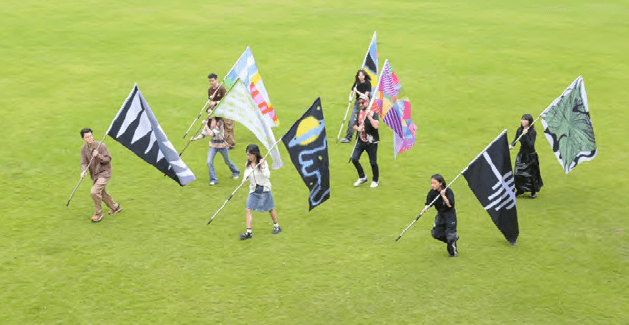 Jianping He, also known as Jumping
He, is a 51-year-old German-
Chinese graphic designer, teacher and
publisher. He was born in Hangzhou,
China. In 2002 he opened hesign in
Berlin, where he lives most of the year,
and in 2008 another office in his home
province, Hangzhou. ...
For 15 years, the DS academy in
Hangzhou has drawn from the rich
pedagogical traditions of both China
and the West. The school [the independently
funded art/design school that
He calls Design Summer academy] is
inspired by the ideas of two key figures:
20th-century Chinese educator Cai
Yuanpei, who promotes the concept of
aesthetic education in society, and John
Dewey, who considered education to be
“life itself.”
DS academy builds its coursework
on “exploration and innovation” in
order to cultivate artists and designers
who possess refined tastes, demonstrate
creative passion, and fluently
utilize modern technology. This is
accelerated through inventive classes
taught by a skilled, illustrious international
faculty that weds contemporary
practice and technology with a history
of Eastern and Western accomplishments,
thus bridging the gap between
design as pragmatics and art. He’s
recipe of in-person learning, handson
training and intensive craftsmanship
nurtures individual thought. That
he does it without official funding
is a design thinker’s miracle. ...
Read full text
Jianping He, also known as Jumping
He, is a 51-year-old German-
Chinese graphic designer, teacher and
publisher. He was born in Hangzhou,
China. In 2002 he opened hesign in
Berlin, where he lives most of the year,
and in 2008 another office in his home
province, Hangzhou. ...
For 15 years, the DS academy in
Hangzhou has drawn from the rich
pedagogical traditions of both China
and the West. The school [the independently
funded art/design school that
He calls Design Summer academy] is
inspired by the ideas of two key figures:
20th-century Chinese educator Cai
Yuanpei, who promotes the concept of
aesthetic education in society, and John
Dewey, who considered education to be
“life itself.”
DS academy builds its coursework
on “exploration and innovation” in
order to cultivate artists and designers
who possess refined tastes, demonstrate
creative passion, and fluently
utilize modern technology. This is
accelerated through inventive classes
taught by a skilled, illustrious international
faculty that weds contemporary
practice and technology with a history
of Eastern and Western accomplishments,
thus bridging the gap between
design as pragmatics and art. He’s
recipe of in-person learning, handson
training and intensive craftsmanship
nurtures individual thought. That
he does it without official funding
is a design thinker’s miracle. ...
Read full text
 Founded in 2018 by Som Ray and
Clem De Alcala in Brooklyn, New
York, CLIP aims to overcome the constraints
of e-bikes and existing e-bike
conversion kits.
According to the company, CLIP is
the “world’s first no tools plug and
play solution to upgrade a regular bike
into an e-bike”. Unlike existing e-bike
conversion kits, the format doesn’t require
the user to make any alterations
to their bike before attaching it.
“The idea was born from my own
need —while living in Brooklyn I
bought a bike to commute to work,
but it became a pain because of a long
uphill gradient,” CLIP co-founder Som
Ray told Dezeen. “An obvious solution
was to get an e-bike, but I’d already
invested in my own bike and loved
it, and an e-bike is a whole magnitude
more expensive,” he said. ...
Read full text
Founded in 2018 by Som Ray and
Clem De Alcala in Brooklyn, New
York, CLIP aims to overcome the constraints
of e-bikes and existing e-bike
conversion kits.
According to the company, CLIP is
the “world’s first no tools plug and
play solution to upgrade a regular bike
into an e-bike”. Unlike existing e-bike
conversion kits, the format doesn’t require
the user to make any alterations
to their bike before attaching it.
“The idea was born from my own
need —while living in Brooklyn I
bought a bike to commute to work,
but it became a pain because of a long
uphill gradient,” CLIP co-founder Som
Ray told Dezeen. “An obvious solution
was to get an e-bike, but I’d already
invested in my own bike and loved
it, and an e-bike is a whole magnitude
more expensive,” he said. ...
Read full text
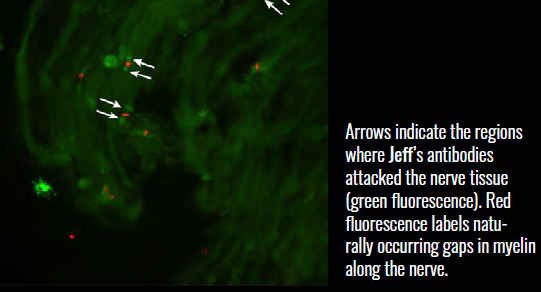 When Jeff Yau started having
strange symptoms after his COVID-
19 infection —numbness, tingling,
and shaking— he experienced what
thousands of others with long COVID
have found: answers were hard to find,
and treatments weren’t working.
But Dr. Jeff Yau was in a unique position:
he’s a neuroscientist who had the
training, resources, and —most importantly—
a strong scientific network to
help him seek out answers. So when his
treatments failed, Jeff turned to science
to figure out why. ...
Over the months, the tingling and
numbness worsened and spread ... But
when Jeff developed a tremor, causing
his hands to shake uncontrollably,
he knew something was seriously
wrong. ... A spinal tap, where fluid was
extracted from Jeff’s spine, was the
first step to unlocking the mystery of
his symptoms: he had an autoimmune
disorder called chronic inflammatory
demyelinating polyneuropathy (CIDP).
... Antibodies from his immune system
were attacking a fatty tissue called
myelin that insulates nerve cells and
allows the nerves to transmit information
efficiently. ... After several failed
treatments and a clinical lab test that
failed to identify the antibodies that
were wreaking havoc on his nerves, Jeff
turned to his collegue Dr. Matt Rasband
for help. ... For both neuroscientists,
the hardship of Jeff’s illness was subsumed
by the excitement of scientific
discovery. ...
Read full text
When Jeff Yau started having
strange symptoms after his COVID-
19 infection —numbness, tingling,
and shaking— he experienced what
thousands of others with long COVID
have found: answers were hard to find,
and treatments weren’t working.
But Dr. Jeff Yau was in a unique position:
he’s a neuroscientist who had the
training, resources, and —most importantly—
a strong scientific network to
help him seek out answers. So when his
treatments failed, Jeff turned to science
to figure out why. ...
Over the months, the tingling and
numbness worsened and spread ... But
when Jeff developed a tremor, causing
his hands to shake uncontrollably,
he knew something was seriously
wrong. ... A spinal tap, where fluid was
extracted from Jeff’s spine, was the
first step to unlocking the mystery of
his symptoms: he had an autoimmune
disorder called chronic inflammatory
demyelinating polyneuropathy (CIDP).
... Antibodies from his immune system
were attacking a fatty tissue called
myelin that insulates nerve cells and
allows the nerves to transmit information
efficiently. ... After several failed
treatments and a clinical lab test that
failed to identify the antibodies that
were wreaking havoc on his nerves, Jeff
turned to his collegue Dr. Matt Rasband
for help. ... For both neuroscientists,
the hardship of Jeff’s illness was subsumed
by the excitement of scientific
discovery. ...
Read full text
 Natural short sleepers are genetically
wired to need only four to six
hours of sleep a night. These outliers
suggest that quality, not quantity, is
what matters. If scientists could figure
out what these people do differently it
might, they hope, provide insight into
sleep’s very nature.
Scientists once thought sleep was
little more than a period of rest ... But
modern sleep research has shown that
sleep is an active, complicated process
we don’t necessarily want to cut short.
During sleep, scientists suspect that
our bodies and brains are replenishing
energy stores, flushing waste and toxins,
pruning synapses and consolidating
memories. As a result, chronic sleep
deprivation can have serious health
consequences. ... We’ve always known there are short
sleepers and long sleepers, but most
people fall in between, they’ve been out
there, but the reason that they haven’t
been recognized is that they generally
don’t go to doctors.” ... That changed
when Louis Ptáček and his colleague
Ying-Hui Fu, a human geneticist and
neuroscientist at UC San Francisco, were
introduced to a woman who naturally
woke up in the wee hours of the morning,
when it was “cold, dark, and lonely.”
Her granddaughters inherited her same
sleep habits. The researchers pinpointed
the genetic mutation for this rare type of
morning lark, and after they published
their findings, thousands of extreme early
risers came out of the woodwork. ...
Read full text:
Natural short sleepers are genetically
wired to need only four to six
hours of sleep a night. These outliers
suggest that quality, not quantity, is
what matters. If scientists could figure
out what these people do differently it
might, they hope, provide insight into
sleep’s very nature.
Scientists once thought sleep was
little more than a period of rest ... But
modern sleep research has shown that
sleep is an active, complicated process
we don’t necessarily want to cut short.
During sleep, scientists suspect that
our bodies and brains are replenishing
energy stores, flushing waste and toxins,
pruning synapses and consolidating
memories. As a result, chronic sleep
deprivation can have serious health
consequences. ... We’ve always known there are short
sleepers and long sleepers, but most
people fall in between, they’ve been out
there, but the reason that they haven’t
been recognized is that they generally
don’t go to doctors.” ... That changed
when Louis Ptáček and his colleague
Ying-Hui Fu, a human geneticist and
neuroscientist at UC San Francisco, were
introduced to a woman who naturally
woke up in the wee hours of the morning,
when it was “cold, dark, and lonely.”
Her granddaughters inherited her same
sleep habits. The researchers pinpointed
the genetic mutation for this rare type of
morning lark, and after they published
their findings, thousands of extreme early
risers came out of the woodwork. ...
Read full text:
 Just a few years ago, the closure of
the Indian Point nuclear power plant
was celebrated by a broad coalition of
environmentalists, residents and even
actors as a victory for public safety and
environmental protection.
But times may be changing in New
York, where rising greenhouse gas
emissions are now threatening the
state’s ambitious climate goals. State
officials are exploring a new generation
of nuclear technologies, driven
by concerns that natural gas, solar
and wind power may not be enough to
meet growing energy demand, especially
during peak periods. “We need to
understand how this [nuclear] technology
has advanced, what are the current
resources that could be used, and to really
be quite careful and objective about
looking at the opportunity that it may
present,” said Doreen Harris, president
and chief executive of the New York
State Energy Research and Development
Authority (NYSERDA).
In September, the agency convened
a summit meeting and released a draft
blueprint outlining plans to evaluate
advanced nuclear technologies, including
advanced light water reactors,
sodium and molten salt reactors, hightemperature
gas reactors and even
fusion reactors. NYSERDA also sought
input from stakeholders to determine
the potential role of next-generation
nuclear power in New York and identify
opportunities to leverage federal
funding programs. ...
Read full text:
Just a few years ago, the closure of
the Indian Point nuclear power plant
was celebrated by a broad coalition of
environmentalists, residents and even
actors as a victory for public safety and
environmental protection.
But times may be changing in New
York, where rising greenhouse gas
emissions are now threatening the
state’s ambitious climate goals. State
officials are exploring a new generation
of nuclear technologies, driven
by concerns that natural gas, solar
and wind power may not be enough to
meet growing energy demand, especially
during peak periods. “We need to
understand how this [nuclear] technology
has advanced, what are the current
resources that could be used, and to really
be quite careful and objective about
looking at the opportunity that it may
present,” said Doreen Harris, president
and chief executive of the New York
State Energy Research and Development
Authority (NYSERDA).
In September, the agency convened
a summit meeting and released a draft
blueprint outlining plans to evaluate
advanced nuclear technologies, including
advanced light water reactors,
sodium and molten salt reactors, hightemperature
gas reactors and even
fusion reactors. NYSERDA also sought
input from stakeholders to determine
the potential role of next-generation
nuclear power in New York and identify
opportunities to leverage federal
funding programs. ...
Read full text:
 In 2020, ... my fiancé and I decided to
get out of New York City for a while.
... Our two week stay [in Los Angeles]
has become five years. While debating
whether we were going to move to
Los Angeles full time, my partner and
I joked that we had to choose between
the “fire coast” and the “water coast.”
New York City had been getting pummeled
by a series of tropical storms and
downpours, and vast swaths of California
were fighting some of the most
devastating wildfires it had ever seen.
We settled on the fire coast, mostly to
try something new. It turns out this was
a false choice. ... Both coasts are the fire
coast, and the water coast. ...
My group chats are full of my friends
saying that they are fine, followed by
stories and messages explaining that actually, they are not fine. ... Almost
all of my friends in the city have now
left their homes to go somewhere safer;
some people I know have lost their
homes. ... Earlier on Tuesday, I texted
my mom “yes we are fine, it is very far
away from us. It is many miles from
us. We have an air purifier. It’s fine.”...
Within minutes of waking up [next
day], we knew that we should leave. ...
A friend in Richmond, Virginia texted
... “We had a bad ice storm this week
and ... The whole city has been without
water since Monday.” ... Once we were
out of Los Angeles, I stopped at a Best
Buy to get an air purifier ... and kept
driving away from the fire. I do not
know when we will be able to go back.
...
Read full text:
In 2020, ... my fiancé and I decided to
get out of New York City for a while.
... Our two week stay [in Los Angeles]
has become five years. While debating
whether we were going to move to
Los Angeles full time, my partner and
I joked that we had to choose between
the “fire coast” and the “water coast.”
New York City had been getting pummeled
by a series of tropical storms and
downpours, and vast swaths of California
were fighting some of the most
devastating wildfires it had ever seen.
We settled on the fire coast, mostly to
try something new. It turns out this was
a false choice. ... Both coasts are the fire
coast, and the water coast. ...
My group chats are full of my friends
saying that they are fine, followed by
stories and messages explaining that actually, they are not fine. ... Almost
all of my friends in the city have now
left their homes to go somewhere safer;
some people I know have lost their
homes. ... Earlier on Tuesday, I texted
my mom “yes we are fine, it is very far
away from us. It is many miles from
us. We have an air purifier. It’s fine.”...
Within minutes of waking up [next
day], we knew that we should leave. ...
A friend in Richmond, Virginia texted
... “We had a bad ice storm this week
and ... The whole city has been without
water since Monday.” ... Once we were
out of Los Angeles, I stopped at a Best
Buy to get an air purifier ... and kept
driving away from the fire. I do not
know when we will be able to go back.
...
Read full text:
 How much personal wealth should
one person have? Should anyone
have more than £10 million in wealth?
Or is £1 million too much? Those are
some of the questions put forward by
Dutch economist and philosopher Ingrid
Robeyns in her new book Limitarianism:
The Case Against Extreme Wealth.
In it, she calls for governments to cap
the amount of wealth any one individual
can own.
Robeyns argues that there is a strong
moral case for capping the wealth
of individuals. Not only do extreme
wealth gaps further entrench inequality
but huge riches are often acquired
by questionable means, whether that be
through exploitative business practices
or outright criminality. Even well-intentioned
philanthropists can’t make up
for the damage that the excessive wealth
of just a few thousand people can do to
the rest of society, Robeyns said.
Developed countries with adequate
social safety nets, such as her native
Netherlands, should impose a limit
of €10 million on individual personal
wealth, according to Robeyns. Individuals
should also apply a voluntary
moral code on wealth. She said
an “ethical limit [on wealth] will be
around 1 million pounds, dollars or
euros per person.”
“Thinkers have been making the case
for this ‘limitarianism’ and the capping
of business rewards for centuries”,
albeit in slightly different forms, said
Stewart Lansley, visiting fellow at the
U. of Bristol, in a review of Robeyns’
book for the London School of Economics.
...
How much personal wealth should
one person have? Should anyone
have more than £10 million in wealth?
Or is £1 million too much? Those are
some of the questions put forward by
Dutch economist and philosopher Ingrid
Robeyns in her new book Limitarianism:
The Case Against Extreme Wealth.
In it, she calls for governments to cap
the amount of wealth any one individual
can own.
Robeyns argues that there is a strong
moral case for capping the wealth
of individuals. Not only do extreme
wealth gaps further entrench inequality
but huge riches are often acquired
by questionable means, whether that be
through exploitative business practices
or outright criminality. Even well-intentioned
philanthropists can’t make up
for the damage that the excessive wealth
of just a few thousand people can do to
the rest of society, Robeyns said.
Developed countries with adequate
social safety nets, such as her native
Netherlands, should impose a limit
of €10 million on individual personal
wealth, according to Robeyns. Individuals
should also apply a voluntary
moral code on wealth. She said
an “ethical limit [on wealth] will be
around 1 million pounds, dollars or
euros per person.”
“Thinkers have been making the case
for this ‘limitarianism’ and the capping
of business rewards for centuries”,
albeit in slightly different forms, said
Stewart Lansley, visiting fellow at the
U. of Bristol, in a review of Robeyns’
book for the London School of Economics.
...
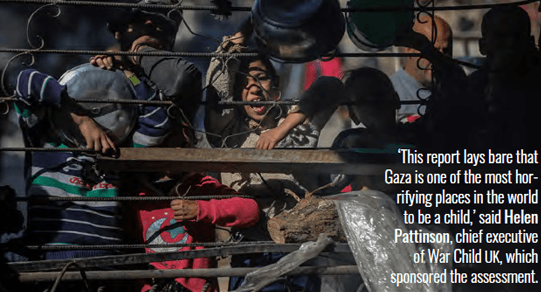 A new study of children living through
the war in Gaza has found that 96%
of them feel that their death is imminent
and almost half want to die as
a result of the trauma they have been
through.
A needs assessment, carried out by a
Gaza-based NGO sponsored by the War
Child Alliance charity, also found that
92% of the children in the survey were
“not accepting of reality”, 79% suffer
from nightmares and 73% exhibit symptoms
of aggression.
“This report lays bare that Gaza is one
of the most horrifying places in the world
to be a child,” Helen Pattinson, chief executive
of War Child UK, said. “Alongside
the levelling of hospitals, schools and
homes, a trail of psychological destruction
has caused wounds unseen but no less destructive on children who hold no
responsibility for this war.”
The survey questioned parents or
caregivers of 504 children from families
where at least one child is disabled,
injured or unaccompanied. The sample
was split between southern and northern
Gaza and was complemented by more
in-depth interviews. The survey was
carried out in June 2024, so is likely to
understate the accumulated psychological
impact of Gaza’s children now, after
more than 14 months of Israel’s assault
on the territory. The estimated death toll
in Gaza is more than 44,000 and a recent
assessment by the UN Human Rights
Office found that 44% of the fatalities it
was able to verify were children. ...
A new study of children living through
the war in Gaza has found that 96%
of them feel that their death is imminent
and almost half want to die as
a result of the trauma they have been
through.
A needs assessment, carried out by a
Gaza-based NGO sponsored by the War
Child Alliance charity, also found that
92% of the children in the survey were
“not accepting of reality”, 79% suffer
from nightmares and 73% exhibit symptoms
of aggression.
“This report lays bare that Gaza is one
of the most horrifying places in the world
to be a child,” Helen Pattinson, chief executive
of War Child UK, said. “Alongside
the levelling of hospitals, schools and
homes, a trail of psychological destruction
has caused wounds unseen but no less destructive on children who hold no
responsibility for this war.”
The survey questioned parents or
caregivers of 504 children from families
where at least one child is disabled,
injured or unaccompanied. The sample
was split between southern and northern
Gaza and was complemented by more
in-depth interviews. The survey was
carried out in June 2024, so is likely to
understate the accumulated psychological
impact of Gaza’s children now, after
more than 14 months of Israel’s assault
on the territory. The estimated death toll
in Gaza is more than 44,000 and a recent
assessment by the UN Human Rights
Office found that 44% of the fatalities it
was able to verify were children. ...
 One of the four lynx captured in the
Scottish Highlands this week has
died. The animal, which had been illegally
released, was caught on Friday
near Kingussie in the Cairngorms national
park. The Eurasian lynx was one
of four that had been discovered running
wild in the Dell of Killiehuntly area. Two
were captured on Thursday [January
9th] and are being kept in quarantine
at Edinburgh zoo. The other pair were
trapped the next day and the survivor
will join the first two in captivity.
Dr Helen Senn, the head of conservation
at the Royal Zoological Society of
Scotland (RZSS), said the circumstances
behind the death of the lynx were not
yet known. “However, we will be carrying
out a postmortem to try to establish
what happened,” she added. “Whatever the case, this unfortunate
development just serves to further
demonstrate the folly of abandoning
these amazing animals in the wild,
with no preparation or real concern
for their welfare. We can only imagine
the stress that all four of the recovered
lynx must have experienced after
being thrust into an entirely new and
extremely harsh environment to fend
for themselves.”
Temperatures in the area plunged
to as low as -14C (6.8F) this week.
Usually they hover around 0C at this
time of year. Adult lynx are roughly
the size of a labrador and are shy and
solitary creatures that very rarely attack
humans. ...
One of the four lynx captured in the
Scottish Highlands this week has
died. The animal, which had been illegally
released, was caught on Friday
near Kingussie in the Cairngorms national
park. The Eurasian lynx was one
of four that had been discovered running
wild in the Dell of Killiehuntly area. Two
were captured on Thursday [January
9th] and are being kept in quarantine
at Edinburgh zoo. The other pair were
trapped the next day and the survivor
will join the first two in captivity.
Dr Helen Senn, the head of conservation
at the Royal Zoological Society of
Scotland (RZSS), said the circumstances
behind the death of the lynx were not
yet known. “However, we will be carrying
out a postmortem to try to establish
what happened,” she added. “Whatever the case, this unfortunate
development just serves to further
demonstrate the folly of abandoning
these amazing animals in the wild,
with no preparation or real concern
for their welfare. We can only imagine
the stress that all four of the recovered
lynx must have experienced after
being thrust into an entirely new and
extremely harsh environment to fend
for themselves.”
Temperatures in the area plunged
to as low as -14C (6.8F) this week.
Usually they hover around 0C at this
time of year. Adult lynx are roughly
the size of a labrador and are shy and
solitary creatures that very rarely attack
humans. ...
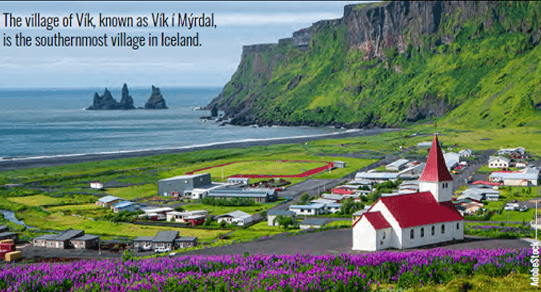 Huldufólk [hidden people —fae elves
who dwell in the rocks and only
appear to some humans] are thought
to live parallel lives to humans. As long
as we don’t disturb them, they don’t
disturb us. They may even help us in
times of need. Threaten their homes,
however, and they can cast great malady
and misfortune upon us. ...
According to a 2007 survey, 62% of
Icelanders say that the existence of
Huldufólk is possible, likely, or certain.
The Hidden People are so ingrained in
Icelandic culture that, since at least the
1930s, activists have disrupted construction
projects in defense of elf habitat
and culture. These efforts have, in
some ways, protected the natural landscapes
that Iceland is famous for. This
Arctic country attracts around 2 million tourists each year, many of whom are
drawn to its waterfalls and geysers,
volcanoes and ice caves, Northern Lights
and tectonic fissures. Believe in the
elves or not, the Huldufólk have played
a role in conserving these natural wonders.
... Protection for elves has even
been etched into a 2012 law, which, according
to the Iceland Monitor, protects
magical and folkloric places, including
those important to elves. ...
“Everyone is aware that the land is
alive, and one can say that the stories
of hidden people and the need to work
carefully with them reflects an understanding
that the land demands respect,”
Terry Gunnel, a folklore professor from
the University of Iceland, told The Independent
...
Huldufólk [hidden people —fae elves
who dwell in the rocks and only
appear to some humans] are thought
to live parallel lives to humans. As long
as we don’t disturb them, they don’t
disturb us. They may even help us in
times of need. Threaten their homes,
however, and they can cast great malady
and misfortune upon us. ...
According to a 2007 survey, 62% of
Icelanders say that the existence of
Huldufólk is possible, likely, or certain.
The Hidden People are so ingrained in
Icelandic culture that, since at least the
1930s, activists have disrupted construction
projects in defense of elf habitat
and culture. These efforts have, in
some ways, protected the natural landscapes
that Iceland is famous for. This
Arctic country attracts around 2 million tourists each year, many of whom are
drawn to its waterfalls and geysers,
volcanoes and ice caves, Northern Lights
and tectonic fissures. Believe in the
elves or not, the Huldufólk have played
a role in conserving these natural wonders.
... Protection for elves has even
been etched into a 2012 law, which, according
to the Iceland Monitor, protects
magical and folkloric places, including
those important to elves. ...
“Everyone is aware that the land is
alive, and one can say that the stories
of hidden people and the need to work
carefully with them reflects an understanding
that the land demands respect,”
Terry Gunnel, a folklore professor from
the University of Iceland, told The Independent
...
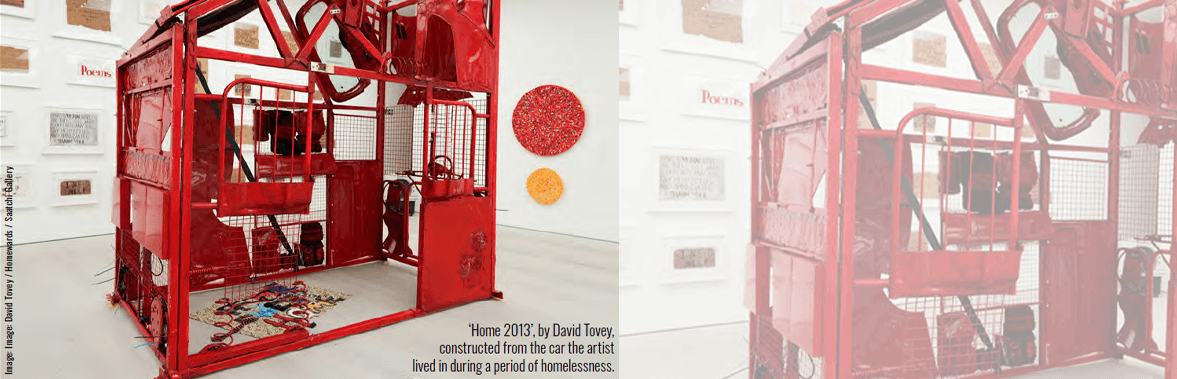
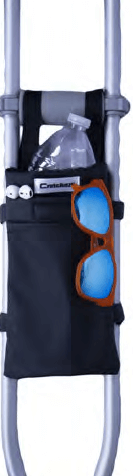 This
crutch bag allows
you to easily carry
your items while
on crutches.
The bag attaches
with adjustable
Velcro straps that
allow you to find
the ideal placement
on your crutches.
www.crutcheze.com
This
crutch bag allows
you to easily carry
your items while
on crutches.
The bag attaches
with adjustable
Velcro straps that
allow you to find
the ideal placement
on your crutches.
www.crutcheze.com
 Made with recycled cotton,
it features handy drawstring closure
and is available in small, medium
and large sizes or a set of all three.
www.greentulip.co.uk
Made with recycled cotton,
it features handy drawstring closure
and is available in small, medium
and large sizes or a set of all three.
www.greentulip.co.uk

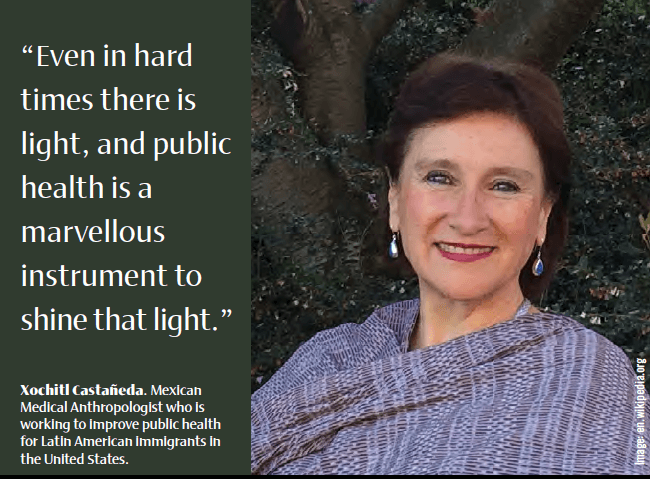

 The Bachelor of Theology (BA) program
objective is to help students
who are planning to invest their lives in
church or mission vocations to achieve
the desired level of knowledge through
biblical and theological studies. The
Bachelor of Theology program is offered
online via distance learning. After
evaluating both academic record and
life experience, AIU staff working in
conjunction with Faculty and Academic
Advisors will assist students in setting
up a custom-made program, designed
on an individual basis. This flexibility
to meet student needs is seldom found
in other distance learning programs.
Our online program does not require
all students to take the same subjects/
courses, use the same books, or
learning materials. Instead, the online
Bachelor of Theology curriculum is
designed individually by the student
and academic advisor. It specifically
addresses strengths and weaknesses
with respect to market opportunities in
the student’s major and intended field
of work. Understanding that industry
and geographic factors should influence
the content of the curriculum instead
of a standardized one-fits-all design is
the hallmark of AIU’s unique approach
to adult education. This philosophy
addresses the dynamic and constantly
changing environment of working professionals
by helping adult students in
reaching their professional and personal
goals within the scope of the degree
program.
The Bachelor of Theology (BA) program
objective is to help students
who are planning to invest their lives in
church or mission vocations to achieve
the desired level of knowledge through
biblical and theological studies. The
Bachelor of Theology program is offered
online via distance learning. After
evaluating both academic record and
life experience, AIU staff working in
conjunction with Faculty and Academic
Advisors will assist students in setting
up a custom-made program, designed
on an individual basis. This flexibility
to meet student needs is seldom found
in other distance learning programs.
Our online program does not require
all students to take the same subjects/
courses, use the same books, or
learning materials. Instead, the online
Bachelor of Theology curriculum is
designed individually by the student
and academic advisor. It specifically
addresses strengths and weaknesses
with respect to market opportunities in
the student’s major and intended field
of work. Understanding that industry
and geographic factors should influence
the content of the curriculum instead
of a standardized one-fits-all design is
the hallmark of AIU’s unique approach
to adult education. This philosophy
addresses the dynamic and constantly
changing environment of working professionals
by helping adult students in
reaching their professional and personal
goals within the scope of the degree
program.
 Atlantic International University is accredited by the Accreditation Service for International
Schools, Colleges and Universities (ASIC). ASIC Accreditation is an internationally
renowned quality standard for colleges and universities. Visit ASIC’s Directory of Accredited
Colleges and Universities. ASIC is a member of CHEA International Quality Group
(CIQG) in the USA, an approved accreditation body by the Ministerial Department of the Home Office
in the UK, and is listed in the International Directory of the Council for Higher Education Accreditation
(CHEA). The University is based in the United States and was established by corporate charter in 1998.
Atlantic International University is accredited by the Accreditation Service for International
Schools, Colleges and Universities (ASIC). ASIC Accreditation is an internationally
renowned quality standard for colleges and universities. Visit ASIC’s Directory of Accredited
Colleges and Universities. ASIC is a member of CHEA International Quality Group
(CIQG) in the USA, an approved accreditation body by the Ministerial Department of the Home Office
in the UK, and is listed in the International Directory of the Council for Higher Education Accreditation
(CHEA). The University is based in the United States and was established by corporate charter in 1998.
 In some cases, accredited colleges
may not accept for transfer courses and degrees
completed at unaccredited colleges, and some
employers may require an accredited degree as
a basis for eligibility for employment. Potential
students should consider how the above may affect
their interests, AIU respects the unique rules and
regulations of each country and does not seek to
influence the respective authorities. In the event
that a prospective student wishes to carry out any
government review or process in regards to his
university degree, we recommend that the requirements
of such are explored in detail with the relevant
authorities by the prospective student as the
university does not intervene in such processes.
AIU students can be found in over 180 countries,
they actively participate and volunteer
in their communities as part of their academic
program and have allocated thousands of service
hours to diverse causes and initiatives. AIU
programs follow the standards commonly used by
colleges and universities in the United States with
regards to the following: academic program
structure, degree issued, transcript, and
other graduation documents.
AIU graduation documents can include
an apostille and authentication from the
US Department of State to facilitate their
use internationally.
In some cases, accredited colleges
may not accept for transfer courses and degrees
completed at unaccredited colleges, and some
employers may require an accredited degree as
a basis for eligibility for employment. Potential
students should consider how the above may affect
their interests, AIU respects the unique rules and
regulations of each country and does not seek to
influence the respective authorities. In the event
that a prospective student wishes to carry out any
government review or process in regards to his
university degree, we recommend that the requirements
of such are explored in detail with the relevant
authorities by the prospective student as the
university does not intervene in such processes.
AIU students can be found in over 180 countries,
they actively participate and volunteer
in their communities as part of their academic
program and have allocated thousands of service
hours to diverse causes and initiatives. AIU
programs follow the standards commonly used by
colleges and universities in the United States with
regards to the following: academic program
structure, degree issued, transcript, and
other graduation documents.
AIU graduation documents can include
an apostille and authentication from the
US Department of State to facilitate their
use internationally.
| Dr. Franklin Valcin Presi den t/Academic Dean |
Dr. José Mercado Chief Executive Officer Chairman of the Board of Trustees |
Ricardo González, PhD Provost |
| Dr. Ricardo Gonzalez Chief Operation Officer and MKT Director |
Linda Collazo Logistics Coordinator |
AIU Tutors Coordinators: Deborah Rodriguez Amiakhor Ejaeta Amanda Gutierrez William Mora Miriam James Admissions Coordinators: Amalia Aldrett Sandra Garcia Junko Shimizu Veronica Amuz Alba Ochoa Jenis Garcia Judith Brown Chris Soto René Cordón Dr. Anderas Rissler Academic Coordinators: Dr. Adesida Oluwafemi Dr. Emmanuel Gbagu Dr. Lucia Gorea Dr. Edgar Colon Dr. Mario Rios Freddy Frejus Dr. Nilani Ljunggren De Silva Dr. Scott Wilson Dr. Mohammad Shaidul Islam |
| Dr. Miriam Garibaldi Vice provost for Research |
Carolina Valdes Human Resource Coordinator |
|
| Dr. Ofelia Miller Director of AIU |
Carlos Aponte Teleco mmunications Coordinator |
|
| Clara Margalef Director of Special Projects of AIU |
David Jung Corporate/Legal Counsel |
|
| Juan Pablo Moreno Director of Operations |
Bruce Kim Advisor/Consultant |
|
| Paula Viera Director of Intelligence Systems |
Thomas Kim Corporate/ Accounting Counsel |
|
| Felipe Gomez Design Director / IT Supervisor |
Maricela Esparza Administrative Coordinator |
|
| Kevin Moll Web Designer |
Chris Benjamin IT and Hosting Support |
|
| Daritza Ysla IT Coordinator |
Maria Pastrana Accounting Coordinator |
|
| Daritza Ysla IT Coordinator |
Roberto Aldrett Communications Coordinator |
|
| Nadeem Awan Chief Programming Officer |
Giovanni Castillo IT Support |
|
| Dr. Edward Lambert Academic Director |
Antonella Fonseca Quality Control & Data Analysis |
|
| Dr. Ariadna Romero Advisor Coordinator |
Adrián Varela Graphic Design |
|
| Jhanzaib Awan Senior Programmer |
Vanesa D’Angelo Content Writer |
|
| Leonardo Salas Human Resource Manager |
Jaime Rotlewicz Dean of Admissions |
|
| Benjamin Joseph IT and Technology Support |
Michael Phillips Registrar’s Office |
|
| Rosie Perez Finance Coordinator |
||
 The School of Business and Economics
allows aspiring and practicing
professionals, managers, and entrepreneurs
in the private and public sectors
to complete a self paced distance
learning degree program of the highest
academic standard.
The ultimate goal is to empower
learners and help them take advantage
of the enormous array of resources
from the world environment in order
to eliminate the current continuum of
poverty and limitations.
Degree programs are designed for
those students whose professional experience has been in business,
marketing, administration, economics,
finance and management.
The School of Business and Economics
allows aspiring and practicing
professionals, managers, and entrepreneurs
in the private and public sectors
to complete a self paced distance
learning degree program of the highest
academic standard.
The ultimate goal is to empower
learners and help them take advantage
of the enormous array of resources
from the world environment in order
to eliminate the current continuum of
poverty and limitations.
Degree programs are designed for
those students whose professional experience has been in business,
marketing, administration, economics,
finance and management.
 The School of Social and Human Studies
is focused on to the development of
studies which instill a core commitment
to building a society based on social and
economic justice and enhancing opportunities
for human well being.
The founding principles lie on the
basic right of education as outlined
in the Declaration of Human Rights.
We instill in our students a sense of
confidence and self reliance in their
ability to access the vast opportunities
available through information channels,
the world wide web, private, public,
nonprofit, and nongovernmental organizations in an ever expanding
global community.
Degree programs are aimed towards
those whose professional life has been
related to social and human behavior,
with the arts, or with cultural studies.
The School of Social and Human Studies
is focused on to the development of
studies which instill a core commitment
to building a society based on social and
economic justice and enhancing opportunities
for human well being.
The founding principles lie on the
basic right of education as outlined
in the Declaration of Human Rights.
We instill in our students a sense of
confidence and self reliance in their
ability to access the vast opportunities
available through information channels,
the world wide web, private, public,
nonprofit, and nongovernmental organizations in an ever expanding
global community.
Degree programs are aimed towards
those whose professional life has been
related to social and human behavior,
with the arts, or with cultural studies.
 The School of Science and Engineering
seeks to provide dynamic, integrated,
and challenging degree programs
designed for those whose experience
is in industrial research, scientific production,
engineering and the general
sciences. Our system for research and
education will keep us apace with the
twenty-first century reach scientific
advance in an environmentally and
ecologically responsible manner to allow
for the sustainability of the human
population. We will foster among our
students a demand for ethical behavior,
an appreciation for diversity, an understanding
of scientific investigation, knowledge of design innovation, a
critical appreciation for the importance
of technology and technological change
for the advancement of humanity.
The School of Science and Engineering
seeks to provide dynamic, integrated,
and challenging degree programs
designed for those whose experience
is in industrial research, scientific production,
engineering and the general
sciences. Our system for research and
education will keep us apace with the
twenty-first century reach scientific
advance in an environmentally and
ecologically responsible manner to allow
for the sustainability of the human
population. We will foster among our
students a demand for ethical behavior,
an appreciation for diversity, an understanding
of scientific investigation, knowledge of design innovation, a
critical appreciation for the importance
of technology and technological change
for the advancement of humanity.
 With access to a global catalog created and maintained collectively by more than
9,000 participating institutions, AIU students have secured excellent research
tools for their study programs.
With access to a global catalog created and maintained collectively by more than
9,000 participating institutions, AIU students have secured excellent research
tools for their study programs.