 FEBRUARY 23,
2024.
FEBRUARY 23,
2024. MARCH 6, 2023.
 Call for Papers
This Conference will be held
17-19 July 2024
at Jagiellonian University,
Kraków, Poland.
Call for Papers
This Conference will be held
17-19 July 2024
at Jagiellonian University,
Kraków, Poland. MARCH, 2024.
This graduate student
completed the majority of
the requirements to obtain
honors, which included a 4.0
GPA, published works, recommendation
from her advisors,
patent a product, etc.
Congratulations!
MARCH, 2024.
This graduate student
completed the majority of
the requirements to obtain
honors, which included a 4.0
GPA, published works, recommendation
from her advisors,
patent a product, etc.
Congratulations! MARCH, 2024.
This graduate student
completed their program with
a high cumulative grade point
average, which reflects the
quality of performance within
their respective major.
Congratulations!
MARCH, 2024.
This graduate student
completed their program with
a high cumulative grade point
average, which reflects the
quality of performance within
their respective major.
Congratulations! Call for Papers
This Conference will be held
24-25 October 2024
at Interamerican Open
University, Buenos Aires,
Argentina.
Call for Papers
This Conference will be held
24-25 October 2024
at Interamerican Open
University, Buenos Aires,
Argentina.
| Mihail Zace Bachelor of Science Electrical Engineering Alba nia |
João Quipanda Manuel Master of Science Electrical Engineering Angola |
Jose Mucolo Vidal Master of Science Marine Engineering Angola |
El Hay Irina Bachelor of Science Architecture Argentina |
Shaun Ramon Toussaint Bachelor of Science Electrical Engineering Aruba |
Rachel Nekati Doctor of Philosop hy Cognitive Psychology and Neuroscience Botswana |
| Akintunde Emmanuel Soji Master of Management Project Management Cameroo n |
Dieudonne Kwamou Siyapje Bachelor of Science Computer Engineering Cameroo n |
Julio Rivera Master of Business Administration Public Administration Canada |
Javier Vicente Arbeláez Botero Bachelor of Marketing Marketing Colombia |
Matala Kasinde Jonathan Luc Doctor of Public Health Programs Administration Congo (DRC ) |
Giorgos Louka Doctor of Science Nutrition Science Cyprus |
| Ahmed Said Barkad Bachelor of Business Administration Banking and Finance Djibo uti |
Iván Tarquino Vladimir Viloria Peña Bachelor of Architecture Design Dominican Republic |
Ana Esther Beltre Encarnación Bachelor of Business Administration Business Administration Dominican Republic |
Manuel Jesus Muriel Contreras Bachelor of Theology Theology Dominican Republic |
Jorge Ernesto Guzmán Argueta Bachelor of Metallurgical Engineering Materials El Salvador |
Kanbiro Orkaido Deyganto Doctor of Philosop hy Business Adm. - Project Mgmt - Sust. Dev. Ethiop ia |
| Carlos Roberto Gutierrez Bachelor of Science Industrial Engineering France |
Heber Misael Morales-Vargas Master of Arts Musicology and Education Guatemala |
María Cristina Chambasis Cruz Doctor of Education Education Honduras |
Rebeca Sylvianne Rivera Meynen Master of Business Administration Management Honduras |
Mohammad Bazzaz Doctor of Science Criminology Iran |
Mouna Azzam (Hourani) Doctor of Education Education Israel |
| Patrick A. Linton Doctor of Philosop hy Cyber Security Jamaica |
Michelle Marie Douglas-Campbell Doctor of Science Child and Adolescent Mental Health Jamaica |
Harriet Hamgor Akinyi Bachelor of Education Education Kenya |
Francis Mwangangi Kitetu Bachelor of Business and Economics Human Resources Management Kenya |
Agnes Kavere Onyisa Master of Social Sciences Social and Human Behavior Kenya |
Gwendelyn Wambui Kariuki Bachelor of Science Food Science Kenya |
| Philip Kamau Manyara Bachelor of Science Business Information Technology Kenya |
Albert Mutua Muasya Master of Business Administration Business Administration Kenya |
Maryanne Nyawira Muasya Bachelor of Business Administration Business Administration Kenya |
Jacintha R. Brice Bachelor of Science Psychology Netherlands |
Derwis Jose Rodriguez Mejia Doctor of Business Administration Business Administration Nicaragua |
Juan Jose Montoya Pérez Bachelor of Science Juridical Science Nicaragua |
| Nkem Arthur Usenekong Master of Science Public Health Nigeria |
Uche Michael Okezie Master of Science Public Health Nigeria |
Yusufu Ishaku Master of Science Economics Nigeria |
Destiny Ford Da-Silva Bachelor of Science Civil Engineering Nigeria |
Farinto Peter Adewale Bachelor of Arts Legal Studies Nigeria |
Omolola Funmilola Adeyanju Doctor of Philosop hy Business Administration Nigeria |
| Edgar Orlando Grajales Martinez Bachelor of Science Electronic Engineering Panama |
Aracelly Cobos Bachelor of Science Psychology Panama |
Carlos Alberto Salinas Labarche Bachelor of International Business International Commerce Paraguay |
Fiona Foo Jye Chyi Bachelor of Engineering Business Management, Telecommunication Romania |
Kaizer Fanana Mfeka Post-Doctor of Education Education South Africa |
Perrin Joshua David Bachelor of Education Early Childhood Education South Korea |
| Ihiju Margret Bachelor of Nutrition Nutrition Science and Engineering South Sudan |
Kiden Mary Stephen Bachelor of Business Accounting Accounting South Sudan |
Daniela Natalia (DaNa) Tripodi Doctor of Engineering Engineering Management Spa in |
Janice Eugene Bachelor of Science Legal Studies St. Lucia |
Funmilola Modupe Gbadeyan Doctor of Science Management United Kingdom |
Silvia Andrea Mazzondo Estévez Doctor of Education Education Uruguay |
| Glamilis Esther Marchena Ramos Bachelor of Science Bioanalysis USA |
Carmen Irene Alcantara Gonzales Master of Science Educational Psychology USA |
Keila Karie Mulero Silva Doctor of Philosop hy Anti-Money Laund. and Counter Terrorism USA |
Webster Musonda Master of Science Public Health USA |
Amos B Robinson, Jr Doctor of Finance Finance USA |
Wedzerai Makaya Doctor of Business Management Business Management Zimbab we |

 Mohamed Siddiq Raja Abdul Razack
  Butrous Gabriel Kamelo
  Cordelia Clara Adeline Pratt

Odysseus is the concept
of Greco-Roman culture
identified as: Odysseus, Ulysses
(Latin); He is the hero of a Greek
epic poem written by Homer ss.
IX–VIII BC. The Odyssey.
Odysseus is a Nova-C space
vehicle in the works of the
company Intuitive Machines
together with NASA (National
Aeronautics and Space Administration)
American agency
of the civil space program
founded by Dwight D. Eisenhower
in 1958 whose director
Bill Nelson considered the trip
of this robot: “as a great leap
for all humanity” following
Neil Armstrong who was the
first person to set foot on the
Moon in 1969.
The Odysseus was sent to
the Moon on February 9, 2024.
The importance of Odysseus is
that it’s a robot that landed
on the south pole of the Moon
where scientists hypothesize
that there is frozen water in
its craters; it’s a transcendental
investigation for humanity
as will be in education the
World Convention on
Higher Education.
How did this convention
come about? The convention
emerged at the UNESCO General
Conference in November 2019.
The convention establishes
universal principles for entering
Higher Education and for
its quality in a non-discriminatory
manner, recognizing
the periods of studies carried
out remotely.
“By ratifying the Global
Convention, countries undertake
to strengthen international
cooperation in the field
of higher education, to improve
its quality in their countries
and in the world, and to contribute to academic mobility
and the recognition of qualifications.
become a reality for
millions of people around the
world”. UNESCO. World Con ven tion on
Highe r Educ ation . https://www.unesco.
org/es/higher-education/globalconvention
March 7, 2024
The provisions of the World
Convention on Higher Education
have as their basic objective
what costs a lot of effort to
students, such as the recognition
of formal studies from one
country to another and professional
experiences.
There are many procedures
to be carried out, although it’s
said that there is recognition
only of studies because professional
experience is not talked
about. Even though they are
recognized studies in an area
of the world with prestigious
universities, their recognition
is denied and no matter how
long the process is, students
don’t have the opportunity to
complete any procedure.
The Convention aims to
review formal, informal, and
experiential knowledge.
Therefore, the Convention
will carry out the following
work: “qualification that gives
access to higher education:
any degree, diploma, certificate
or distinction issued by a
competent authority attesting
to having satisfactorily completed
an education program,
or validation of prior learning, when applicable, and that
confers to its holder the right
to be taken into account for
admission to higher education”.
UNESCO. World Con ven tion on
Highe r Educ ation . https://www.unesco.
org/es/higher-education/globalconvention.
Extraordinary sess ion ,
March 7, 2024
The Convention has well
established all the elements to
be addressed so that Higher
Education reaches more people
who, being able to continue in
their training, see their opportunities
for growth:
“Section II. Objectives of the
convention. Article II.
Based on the regional
recognition agreements and
reinforcing their coordination,
reviews and achievements,
the objectives of this Convention
are:
1. Promote and strengthen
international cooperation in
the field of higher education;
(sic)
2. Support initiatives, policies
(sic) and innovations at the
interregional level for international cooperation in the
field of higher education.
3. Facilitate global mobility
and merit in higher education
for the mutual benefit of
qualification holders, higher
education institutions,
employers, and any other interested
parties of the States
Parties -sic– to this Convention,
understanding and
while respecting the diversity
of the higher education
systems of the States Parties.
UNESCO. World Con ven tion on Highe r
Educ ation . https://www.unesco.org/es/
higher-education/global-convention
Extraordinary sess ion , March 7, 2024
Below, we present the States
that are part of the convention.
Andorra, Armenia, Australia,
Cape Verde, Ivory Coast,
Croatia, Cuba, Slovakia, State
of Palestine, Estonia, Finland,
France, Guinea, Hungary, Iceland,
Japan, Lithuania, Nicaragua,
Norway, United Kingdom
of Great Britain & Northern
Ireland, Republic of Moldova,
Romania, Holy See, Sweden,
Tunisia, Uruguay and Yemen
UNESCO. World Con ven tion on Highe r
Educ ation https://www.unesco.org/es/
higher-education/global-convention
Extraordinary sess ion , March 7, 2024
The countries to be part of
the benefits of the Convention
are registered three months
after presenting the necessary
documents, so there may be
others that made their request
and don’t yet appear on the list.
We mention Odysseus because
the convention will become an
extraordinary contribution for
all human beings who are now
in one country and tomorrow
in the other or who are part of
remote companies.
If there is frozen water
on the Moon it would be an
investigation with extraordinary
results, the same as if
there are criteria for so many
people who have studies not
recognized by other countries
and without the possibility of
continuing, now it will be their
space to do so.
There were no established
rules for those with unfinished
programs and they stayed
there. Now there is an open
door for that step towards a
satisfactory life, leaving behind:
“this couldn’t be done.”
“The entry into force of the
Global Convention is a decisive
event for higher education
worldwide, bringing us closer
to achieving SDG 4.3 on quality
tertiary education. It is a
powerful tool to create a more
equitable, accessible (sic) and
sustainable future for all. It
is a call to action for teachers,
policymakers (sic) and
students to come together to
build a world where everyone
can learn, grow and succeed”.
UNESCO- The World Con ven tion on Highe r
Educ ation en ters into force : A new era
begins for studen ts aroun d the wo rld.
https://www.unesco.org/es/articles/entra-en-vigor-la-convencion-mundial-
sobre-la-educacion-superiorcomienza-
una-nueva-era-para-los
8- march - 2023
Given the current development
of science with Artificial
Intelligence, the problems of
climate change, the volatility
of the labor market, another
model or paradigm is needed
for teaching and learning in
Higher Education. Universities
must welcome all people of all
ages, some for training and
others to continue training in
the jobs they have.
Firm commitments and better
policies than the ones we
live in are needed.
A lot of science and less
understanding: that is today’s
world. “Offering flexible
schedules, locations, and
learning modalities, as well
as shorter non-degree programs
and alternative credentials,
such as certificates and
credentials, employer industry
certifications, and microcredentials,
(sic) can help meet
the diverse educational needs
of learners throughout life”.
UNESCO- Highe r educ ation ins titutions mus t
evolve to become benchm arks for lifelon g
learning https://www.uil.unesco.org/
es/articles/
UNESCO’s objective for
Higher Education means a
revolution for knowledge and
the development of people. A
new world would open because
the way Higher Education is organized continues to depend
on the countries and the rulers
in power. Education at all its
levels today has become in
many countries the instrument
to create generations
that support ideologies with
their thinking, in many cases,
outside of Human Rights.
Education has always meant
the level of thinking that
people want to reach; today it
is the level of thinking of the
ruling oligarchies.
Let us hope that the Higher
Education Convention that
UNESCO works on has the necessary
support from the people
and governments so that
today’s world with Artificial
Intelligence and other developments
in science works at the
level of these works and we
leave the society of hate speech
and misinformation.
It seems a great irony that
with the current development
of science what we are doing
is hatred and seeing how we
disappear anyone who wants to
work for good.
You are studying at Atlantic
International University (AIU)
which offers you recognition
in credits of your professional
experience, presenting work
for participation in events
related to professional practice,
completion of essays, completion
of multiple-choice tests
and professional practices.
It’s an extraordinary
moment in history
—benefit from it!
BIBLIOGRAPHY. NASANET – El Módulo Odysseus aterriza con Éxito
en la Luna. https://www.lanasa.net/noticias/spaceflight/el-modulo-odysseusaterriza-
con-exito-en-la-luna 23- 2- 2024 | UNESCO. Convención
Mundial sobre la Educación Superior https://www.unesco.org/es/
higher-education/global-convention Sesión extraordinaria, 7 de Marzo
de 2024 | UNESCO - Entra en vigor la Convención Mundial sobre la
Educación Superior: Comienza una nueva era para los estudiantes
de todo el mundo. https://www.unesco.org/es/articles/entra-en-vigor-laconvencion-
mundial-sobre-la-educacion-superior-comienza-una-nueva-erapara-
los 8-marzo-2023 | UNESCO - Las instituciones de enseñanza
superior deben evolucionar para convertirse en referentes para el
aprendizaje a lo largo de la vida. https://www.uil.unesco.org/es/articles/
las-instituciones-de-ensenanza-superior-deben-evolucionar-para-convertirseen-
referentes-para-el 2–junio-2023

Emotional Intelligence (EI)
serves as a profound cornerstone
not only in personal
development but also in fostering
a deeper and more fulfilling
experience of love. Coined by
psychologists Peter Salovey and
John Mayer and popularized by
Daniel Goleman, EI encapsulates
the ability to recognize,
comprehend, regulate, and utilize
emotions effectively. This
article delves into the intersection
of emotional intelligence,
personal growth, and its pivotal
role in fostering enriched
and meaningful connections in
love relationships.
Goleman’s model highlights
five essential components of EI:
self-awareness, self-regulation,
motivation, empathy, and
social skills.
1. Self-awareness involves
recognizing one's emotions,
strengths, and weaknesses,
leading to a deeper understanding
of oneself.
2. Self-regulation encompasses
managing and controlling emotional impulses,
maintaining composure,
and adapting to different
situations.
3. Motivation drives individuals
towards their goals,
overcoming obstacles and
setbacks.
4. Empathy involves understanding
and resonating with
the emotions of others, fostering
better relationships.
5. Social skills include effective
communication and building
connections.
The development of EI is
intrinsically linked to personal
growth. It enables individuals
to navigate life’s complexities
with resilience, awareness, and
adaptability.
High EI individuals exhibit
enhanced problem-solving
abilities, effective stress
management, and improved
decision-making skills. They
tend to maintain healthier relationships,
experience greater
life satisfaction, and exhibit
higher levels of resilience in
the face of adversity.
Self-awareness, a
fundamental aspect of EI, leads
to a deeper understanding of
one’s values, aspirations, and
emotional triggers. It empowers
individuals to identify their
strengths and areas for improvement,
facilitating personal
development. Self-regulation
allows individuals to manage
their emotions effectively,
fostering a sense of control and
stability in diverse situations.
Moreover, motivation as a
component of EI propels personal
development by driving
individuals toward their goals,
even when faced with challenges.
This intrinsic motivation
leads to perseverance, resilience,
and the ability to bounce
back from setbacks. Empathy
and social skills further contribute
to personal growth by
nurturing harmonious relationships
and creating a supportive
network.
Emotional intelligence
and love
Love, in its various forms,
intertwines deeply with emotional
intelligence. A strong foundation in EI is instrumental
in building and maintaining
healthy, fulfilling relationships.
Empathy, a critical component
of EI, plays a pivotal role in
understanding a partner’s emotions,
perspectives, and needs,
fostering a deeper connection.
Moreover, self-awareness
within the context of a loving
relationship allows individuals
to understand their own emotional
needs, vulnerabilities,
and triggers. It enables individuals
to communicate these
effectively to their partners,
fostering understanding and
empathy in the relationship.
Self-regulation in love
relationships is crucial. It
enables individuals to manage
emotional reactions during
conflicts, preventing impulsive
or hurtful behaviors. The
ability to maintain composure
and address issues calmly
contributes to the stability and
longevity of the relationship.
Motivation, a driving force in
EI, keeps the flame of love alive
by inspiring individuals to invest
in the relationship, overcome
obstacles, and work through
challenges together. Empathy
and social skills foster effective
communication, intimacy, and
mutual support, strengthening
the bond between partners.
Developing emotional
intelligence for love
and personal growth
Developing EI is an ongoing
journey that involves self-reflection,
practice, and learning
from experiences. Mindfulness,
meditation, self-assessment,
and seeking feedback
from trusted individuals can
aid in enhancing emotional
intelligence.
In the context of love, practicing
active listening, expressing
emotions honestly, and
being open to understanding a
partner’s feelings are vital for
nurturing a healthy and thriving
relationship.
Conclusion
Emotional Intelligence acts
as a transformative force in
personal development and in
cultivating fulfilling love relationships.
Its five components
—self-awareness, self-regulation,
motivation, empathy, and
social skills— not only facilitate
personal growth but also form
the bedrock of healthy, empathetic,
and enduring connections
in love. Embracing and
honing emotional intelligence
equips individuals to lead more
fulfilling lives and to experience
the beauty and depth of love in
its many forms.
JOURNAL ARTICLES: Petrides, K. V., & Furnham, A. (2000). On the
dimensional structure of emotional intelligence. Personality and
Individual Differences, 29(2), 313-320. | Lopes, P. N., Brackett, M.
A., Nezlek, J. B., Schütz, A., Sellin, I., & Salovey, P. (2004). Emotional
intelligence and social interaction. Personality and Social
Psychology Bulletin, 30(8), 1018-1034. | Mayer, J. D., Caruso, D.
R., & Salovey, P. (1999). Emotional intelligence meets traditional
standards for an intelligence. Intelligence, 27(4), 267-298.
Bar-On, R. (1997). The Emotional Quotient Inventory (EQ-i):
Technical Manual. Multi-Health Systems. RESEARCH PAPERS:
Ciarrochi, J. V., Chan, A. Y., & Caputi, P. (2000). A critical evaluation
of the emotional intelligence construct. Personality and
Individual Differences, 28(3), 539-561. | Extremera, N., & Fernández-
Berrocal, P. (2005). Perceived emotional intelligence and life
satisfaction: Predictive and incremental validity using the Trait
Meta-Mood Scale. Personality and Individual Differences, 39(5),
937-948. | Mayer, J. D., Salovey, P., Caruso, D. R., & Sitarenios, G.
(2003). Measuring emotional intelligence with the MSCEIT V2.0.
Emotion, 3(1), 97. | Zeidner, M., Matthews, G., & Roberts, R. D.
(2009). What we know about emotional intelligence: How it affects
learning, work, relationships, and our mental health. MIT Press.
 In a notorious 2003 essay, entrepreneur
and self-proclaimed nerd Paul
Graham addresses a question that few
would ever think to ask — Why are
nerds unpopular? Graham comes to
the conclusion that nerds are unpopular
because the schooling system is
fundamentally broken. When he pulls
us back to take a cold hard look at
the schooling system, we see that the
endemic cruelty we all witnessed as
young people isn’t inevitable.
“There is a strong correlation between
being smart and being a nerd,”
Graham writes, “and an even stronger
inverse correlation between being a
nerd and being popular. Being smart
seems to make you unpopular.”
So why, then, are smart people
unpopular? Graham admits that asking
such a question would seem odd to a high school student. That being
smart makes you unpopular is taken
as self-evident. But in the working
world, being smart does not make you
unpopular. It could in fact make you
very popular, it can be advantageous in
gaining popularity. The same, Graham
argues, could be said for elementary
school. Nerds aren’t bullied until they
reach high school. Graham’s best guess
is that nerds aren’t unpopular because
they are intelligent, nerds are unpopular
because, being intelligent, they
don’t try enough to be popular —they
are too busy trying to get smarter.
Most high school children are obsessed
with what their peers think.
Trying to be popular is a full-time
occupation for the average high school
student. ...
In a notorious 2003 essay, entrepreneur
and self-proclaimed nerd Paul
Graham addresses a question that few
would ever think to ask — Why are
nerds unpopular? Graham comes to
the conclusion that nerds are unpopular
because the schooling system is
fundamentally broken. When he pulls
us back to take a cold hard look at
the schooling system, we see that the
endemic cruelty we all witnessed as
young people isn’t inevitable.
“There is a strong correlation between
being smart and being a nerd,”
Graham writes, “and an even stronger
inverse correlation between being a
nerd and being popular. Being smart
seems to make you unpopular.”
So why, then, are smart people
unpopular? Graham admits that asking
such a question would seem odd to a high school student. That being
smart makes you unpopular is taken
as self-evident. But in the working
world, being smart does not make you
unpopular. It could in fact make you
very popular, it can be advantageous in
gaining popularity. The same, Graham
argues, could be said for elementary
school. Nerds aren’t bullied until they
reach high school. Graham’s best guess
is that nerds aren’t unpopular because
they are intelligent, nerds are unpopular
because, being intelligent, they
don’t try enough to be popular —they
are too busy trying to get smarter.
Most high school children are obsessed
with what their peers think.
Trying to be popular is a full-time
occupation for the average high school
student. ...
 Some reasons are obvious: ingrained
obedience, ignorance, and the benefits
of participation in the dominant
culture. But there are also psychological
barriers to resistance, which have been
explored in psychological research.
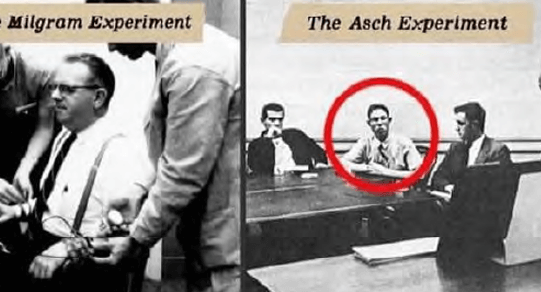
Conformity. In the 1950s, psychologist
Solomon Asch conducted a series
of experiments into social effects on
perception. Asch set out to prove that
when faced with a crystal-clear, objective
question, a person’s judgment
should not be affected by others. However,
he found that in more than half of
the trials the subjects went along with
consensus, even though the correct
answer was obvious.
Other psychologists found that
those most likely to conform tended
to have high levels of anxiety, low
status, a high need for approval, and
authoritarian personalities (the people
who are likely to boss others around
are themselves psychologically pliable).
Authority. Yale psychologist Stanley
Milgram began a series of experiments
in 1961, to understand the degree to
which those responsible for the holocaust
were “just following orders.” The
subject was instructed by an authority
to give increasingly powerful shocks to
another person, an actor who pretended
to be shocked. He found that 65% of
people administered successive shocks
all the way up to the maximum voltage.
Real-world people face a worse situation
than the subjects of the experiment,
who did not risk censure from
their family or social group, losing
their jobs, or public ridicule. ...
Source: A. McBay, D. Jensen, and L. Keith (2011). Deep Green
Resistance, chapter 7: Psychology of Resistance.
Some reasons are obvious: ingrained
obedience, ignorance, and the benefits
of participation in the dominant
culture. But there are also psychological
barriers to resistance, which have been
explored in psychological research.
Conformity. In the 1950s, psychologist
Solomon Asch conducted a series
of experiments into social effects on
perception. Asch set out to prove that
when faced with a crystal-clear, objective
question, a person’s judgment
should not be affected by others. However,
he found that in more than half of
the trials the subjects went along with
consensus, even though the correct
answer was obvious.
Other psychologists found that
those most likely to conform tended
to have high levels of anxiety, low
status, a high need for approval, and
authoritarian personalities (the people
who are likely to boss others around
are themselves psychologically pliable).
Authority. Yale psychologist Stanley
Milgram began a series of experiments
in 1961, to understand the degree to
which those responsible for the holocaust
were “just following orders.” The
subject was instructed by an authority
to give increasingly powerful shocks to
another person, an actor who pretended
to be shocked. He found that 65% of
people administered successive shocks
all the way up to the maximum voltage.
Real-world people face a worse situation
than the subjects of the experiment,
who did not risk censure from
their family or social group, losing
their jobs, or public ridicule. ...
Source: A. McBay, D. Jensen, and L. Keith (2011). Deep Green
Resistance, chapter 7: Psychology of Resistance.
 As far as astronomers studying the
observable universe can tell, only
around 5% of it is made up of matter.
The rest, or the overwhelming majority
of it, is made up of dark matter (around
27%) and dark energy (around 68%).
Dark matter is invisible matter that
doesn’t emit its own light and only
interacts with normal matter through
gravity, which we can see evidence for
in galaxies and galaxy clusters. But
given that there appears to be five times
as much of it as regular matter, scientists
are of course on the hunt for direct
evidence of its existence.
One approach to finding it, maybe
counterintuitively as dark matter
explains what we see in the stars and
galaxies, is to head underground.
There are several underground facilities
around the world where physicists
look for signs of Weakly Interacting
Massive Particles (WIMPs), among other
things such as measuring impacts of
neutrinos. The idea is that the WIMPs
must be passing through the Earth all
the time as it moves through space, so
to detect them we simply need detectors
sensitive enough to capture those weak
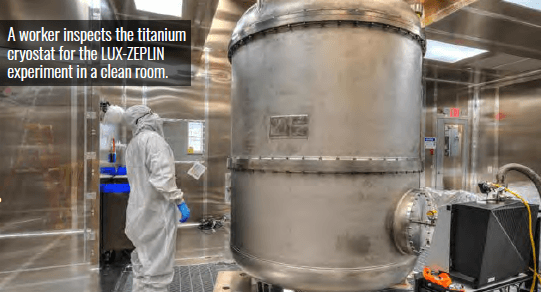
interactions. “In [the Stanford LUX-ZEPLIN
experiment], two massive electrical
grids apply an electric field across
the volume of liquid, which pushes
these released electrons to the liquid’s
surface,” Hugh Lippincott, Associate
Professor of Physics explained. ...
As far as astronomers studying the
observable universe can tell, only
around 5% of it is made up of matter.
The rest, or the overwhelming majority
of it, is made up of dark matter (around
27%) and dark energy (around 68%).
Dark matter is invisible matter that
doesn’t emit its own light and only
interacts with normal matter through
gravity, which we can see evidence for
in galaxies and galaxy clusters. But
given that there appears to be five times
as much of it as regular matter, scientists
are of course on the hunt for direct
evidence of its existence.
One approach to finding it, maybe
counterintuitively as dark matter
explains what we see in the stars and
galaxies, is to head underground.
There are several underground facilities
around the world where physicists
look for signs of Weakly Interacting
Massive Particles (WIMPs), among other
things such as measuring impacts of
neutrinos. The idea is that the WIMPs
must be passing through the Earth all
the time as it moves through space, so
to detect them we simply need detectors
sensitive enough to capture those weak
interactions. “In [the Stanford LUX-ZEPLIN
experiment], two massive electrical
grids apply an electric field across
the volume of liquid, which pushes
these released electrons to the liquid’s
surface,” Hugh Lippincott, Associate
Professor of Physics explained. ...
 This week a startup called Cognition
AI caused a bit of a stir by releasing
a demo showing an artificial intelligence
program called Devin performing
work usually done by well-paid software
engineers. Chatbots like ChatGPT
and Gemini can generate code, but
Devin went further, planning how to
solve a problem, writing the code, and
then testing and implementing it.
Devin’s creators brand it as an “AI
software developer.” When asked to
test how Meta’s open source language
model Llama 2 performed when accessed
via different companies hosting
it, Devin generated a step-by-step plan
for the project, generated code needed
to access the APIs and run benchmarking
tests, and created a website summarizing
the results. It’s always hard to judge staged
demos, but Cognition has shown Devin
handling a wide range of impressive
tasks. It wowed investors and engineers
on X, receiving plenty of endorsements,
and even inspired a few
memes —including some predicting
Devin will soon be responsible for a
wave of tech industry layoffs.
Devin is just the latest, most polished
example of a trend I’ve been tracking
for a while —the emergence of AI
agents that instead of just providing
answers or advice about a problem presented
by a human can take action to
solve it. A few months back I test drove
Auto-GPT, an open source program that
attempts to do useful chores by taking
actions on a ...
Read full text
This week a startup called Cognition
AI caused a bit of a stir by releasing
a demo showing an artificial intelligence
program called Devin performing
work usually done by well-paid software
engineers. Chatbots like ChatGPT
and Gemini can generate code, but
Devin went further, planning how to
solve a problem, writing the code, and
then testing and implementing it.
Devin’s creators brand it as an “AI
software developer.” When asked to
test how Meta’s open source language
model Llama 2 performed when accessed
via different companies hosting
it, Devin generated a step-by-step plan
for the project, generated code needed
to access the APIs and run benchmarking
tests, and created a website summarizing
the results. It’s always hard to judge staged
demos, but Cognition has shown Devin
handling a wide range of impressive
tasks. It wowed investors and engineers
on X, receiving plenty of endorsements,
and even inspired a few
memes —including some predicting
Devin will soon be responsible for a
wave of tech industry layoffs.
Devin is just the latest, most polished
example of a trend I’ve been tracking
for a while —the emergence of AI
agents that instead of just providing
answers or advice about a problem presented
by a human can take action to
solve it. A few months back I test drove
Auto-GPT, an open source program that
attempts to do useful chores by taking
actions on a ...
Read full text
 Singapore brand Will & Well has
designed a clothing collection
to enable people with disabilities to
dress more easily, while also appealing
to anyone who ever struggled with
a clasp. Their new collection, titled
Adaptable, which features clothing with
easy-to-use alternatives to elements
such as back zips, hook-and-eye
closures, armholes and buttons —
elements
that everyone has struggled with
at some point, even without the disadvantage
of restricted mobility.
Will & Well uses photography of both
disabled and able-bodied models on its
website and promotes itself as an "inclusive"
brand rather than one strictly
for people with disabilities.
‘At the end of the day, nobody can
escape age,” head of communications
Cheryl Tan said. “And you’re
not going to be as flexible as you
were when you were younger.” ...
Read full text:
Singapore brand Will & Well has
designed a clothing collection
to enable people with disabilities to
dress more easily, while also appealing
to anyone who ever struggled with
a clasp. Their new collection, titled
Adaptable, which features clothing with
easy-to-use alternatives to elements
such as back zips, hook-and-eye
closures, armholes and buttons —
elements
that everyone has struggled with
at some point, even without the disadvantage
of restricted mobility.
Will & Well uses photography of both
disabled and able-bodied models on its
website and promotes itself as an "inclusive"
brand rather than one strictly
for people with disabilities.
‘At the end of the day, nobody can
escape age,” head of communications
Cheryl Tan said. “And you’re
not going to be as flexible as you
were when you were younger.” ...
Read full text:
 There are typically three types of
cone cells in humans. Cones that
detect short wavelengths (blue), medium
(green), and long (red). However,
we do see more than just the red,
green, and blue colors. The cone cells
in our eyes overlap in the wavelengths
they detect.
When a wavelength of 570 nanometers
enters the eye, it stimulates
both the long and medium cones. The
responses are combined and sent along
the optic nerve as one signal. And it is
this signal that we interpret as yellow
light. An odd quirk of this system
is that when two beams of light at
the exact same ratio enter the eye the
signal that is sent off to the brain is the
same. These two combined light rays
also cause us to see yellow. ...
A single wavelength of light or a combination of wavelengths of light
stimulates our cones in the same manner…
except for one.
Magenta… there is no wavelength of
light for magenta. Instead, we perceive
it only when the short and long cones
pick up a signal from pure red and pure
blue light. Our brains literally make
up magenta. Why? We don’t know.
It is probably quite useful, however.
Much of our early primate ancestors
inhabited green forests. Magenta
flowers would have had the highest
contrast against a green background
making it easy for our ancestors
to find a tasty snack. ... Watch the
original video by BBC: https://youtu.be/
CtLOH_uRg-M?si=FhhOLDEm0KU-jsoE
Read full text
There are typically three types of
cone cells in humans. Cones that
detect short wavelengths (blue), medium
(green), and long (red). However,
we do see more than just the red,
green, and blue colors. The cone cells
in our eyes overlap in the wavelengths
they detect.
When a wavelength of 570 nanometers
enters the eye, it stimulates
both the long and medium cones. The
responses are combined and sent along
the optic nerve as one signal. And it is
this signal that we interpret as yellow
light. An odd quirk of this system
is that when two beams of light at
the exact same ratio enter the eye the
signal that is sent off to the brain is the
same. These two combined light rays
also cause us to see yellow. ...
A single wavelength of light or a combination of wavelengths of light
stimulates our cones in the same manner…
except for one.
Magenta… there is no wavelength of
light for magenta. Instead, we perceive
it only when the short and long cones
pick up a signal from pure red and pure
blue light. Our brains literally make
up magenta. Why? We don’t know.
It is probably quite useful, however.
Much of our early primate ancestors
inhabited green forests. Magenta
flowers would have had the highest
contrast against a green background
making it easy for our ancestors
to find a tasty snack. ... Watch the
original video by BBC: https://youtu.be/
CtLOH_uRg-M?si=FhhOLDEm0KU-jsoE
Read full text
 “Designers must understand that
objects must be designed to be
repaired and anticipate the end-oflife
process. The material assumes a
new role because it must be recyclable
even after being recycled,” said Marco
Capellini, sustainable design consultant
(www.capcon.it).
Being sustainable in 2024 is assumed,
both in personal life and in the profession.
Small changes in our routines
make us feel better, like using compostable
product packaging, cloth bags
at the grocery store, or driving electric.
But here comes the challenging part.
We all know that the problem lies in
our behaviors; it’s not sustainable to
simply fix mistakes and bad attitudes.
Instead, we must prevent those situations
to trigger a circular process.
We must embrace it as consumers but
also as industry actors. Designers and
companies bear significant responsibility
...
Read full text
“Designers must understand that
objects must be designed to be
repaired and anticipate the end-oflife
process. The material assumes a
new role because it must be recyclable
even after being recycled,” said Marco
Capellini, sustainable design consultant
(www.capcon.it).
Being sustainable in 2024 is assumed,
both in personal life and in the profession.
Small changes in our routines
make us feel better, like using compostable
product packaging, cloth bags
at the grocery store, or driving electric.
But here comes the challenging part.
We all know that the problem lies in
our behaviors; it’s not sustainable to
simply fix mistakes and bad attitudes.
Instead, we must prevent those situations
to trigger a circular process.
We must embrace it as consumers but
also as industry actors. Designers and
companies bear significant responsibility
...
Read full text
 For most people, crushes come and
go. But for others, the longing can
last years and become addictive. A spark
of interest turns into obsessive rumination
sustained by a pernicious cocktail
of hope and doubt. This is not a crush.
This is limerence. Limerence is a state
of overwhelming and unexpected longing
for emotional reciprocation from
another human, known as a limerent
object (L.O.), who is often perceived as
perfect but unavailable.
This may sound similar to the lyrics
of a Taylor Swift love song, a scene
in “The Great Gatsby,” or the lines in a
Shakespeare sonnet. The experience
of limerence is timeless, but the term
is relatively new. In 1979, Dorothy
Tennov, an experimental psychologist
and professor at the University of
Bridgeport, coined the term limerence
in her book “Love and Limerence: The
Experience of Being in Love,” based on a
decade of research and several hundred
case studies on romantic attachment.
What differentiates limerence from a
crush or love is the intensity, an emotional
roller coaster that fluctuates from
euphoria to despair. Giulia Poerio, a
psychologist and researcher at the University
of Sussex in England, said, “Any
sign of rejection can make somebody hit
a low, and any sign of interest can make
somebody hit a high.” It’s an endless
mind game of, “She loves me, she loves
me not.” Limerents, deeply fearful of rejection,
allow their self-esteem to rest in
the hands of an L.O. who may not even
know they exist. ...
For most people, crushes come and
go. But for others, the longing can
last years and become addictive. A spark
of interest turns into obsessive rumination
sustained by a pernicious cocktail
of hope and doubt. This is not a crush.
This is limerence. Limerence is a state
of overwhelming and unexpected longing
for emotional reciprocation from
another human, known as a limerent
object (L.O.), who is often perceived as
perfect but unavailable.
This may sound similar to the lyrics
of a Taylor Swift love song, a scene
in “The Great Gatsby,” or the lines in a
Shakespeare sonnet. The experience
of limerence is timeless, but the term
is relatively new. In 1979, Dorothy
Tennov, an experimental psychologist
and professor at the University of
Bridgeport, coined the term limerence
in her book “Love and Limerence: The
Experience of Being in Love,” based on a
decade of research and several hundred
case studies on romantic attachment.
What differentiates limerence from a
crush or love is the intensity, an emotional
roller coaster that fluctuates from
euphoria to despair. Giulia Poerio, a
psychologist and researcher at the University
of Sussex in England, said, “Any
sign of rejection can make somebody hit
a low, and any sign of interest can make
somebody hit a high.” It’s an endless
mind game of, “She loves me, she loves
me not.” Limerents, deeply fearful of rejection,
allow their self-esteem to rest in
the hands of an L.O. who may not even
know they exist. ...
 Sleep is the cornerstone of human
well-being. Nonetheless, there is a
trend where some people shun sleep,
resorting to alertness aids in pursuit of
heightened productivity.
The suprachiasmatic nucleus (SCN) is
a brain region that helps regulate our
circadian rhythms (sleep-wake cycles).
Disruptions to SCN function can have
adverse implications for sleep quality,
health, and well-being. In modern society,
circadian misalignment is common
and is associated with poor health.
Through its interactions with light
input, neurotransmitters, hormonal
signals, and clock genes, the SCN
coordinates the timing of sleep and
wakefulness, maintaining that our
internal clock remains synchronized
with the external environment. The SCN is a tiny yet sophisticated region in the
hypothalamus. It plays a crucial role in
regulating our circadian rhythm.
The SCN comprises two nuclei (cores),
each housing around 10,000 neurons.
Within the SCN, there are “core” and
“shell” subregions distinguished by the
presence of specific neuropeptides. The
retinol-recipient core contains vasoactive
intestinal peptide and gastrin-releasing
peptide, while arginine vasopressin-
expressing cells are in the shell.
The SCN acts as our body’s internal
clock, helping to regulate physiological
processes over a roughly 24-hour cycle,
but not exactly. These processes include
sleep patterns, hormone release, body
temperature, and metabolism. ...
Read full text:
Sleep is the cornerstone of human
well-being. Nonetheless, there is a
trend where some people shun sleep,
resorting to alertness aids in pursuit of
heightened productivity.
The suprachiasmatic nucleus (SCN) is
a brain region that helps regulate our
circadian rhythms (sleep-wake cycles).
Disruptions to SCN function can have
adverse implications for sleep quality,
health, and well-being. In modern society,
circadian misalignment is common
and is associated with poor health.
Through its interactions with light
input, neurotransmitters, hormonal
signals, and clock genes, the SCN
coordinates the timing of sleep and
wakefulness, maintaining that our
internal clock remains synchronized
with the external environment. The SCN is a tiny yet sophisticated region in the
hypothalamus. It plays a crucial role in
regulating our circadian rhythm.
The SCN comprises two nuclei (cores),
each housing around 10,000 neurons.
Within the SCN, there are “core” and
“shell” subregions distinguished by the
presence of specific neuropeptides. The
retinol-recipient core contains vasoactive
intestinal peptide and gastrin-releasing
peptide, while arginine vasopressin-
expressing cells are in the shell.
The SCN acts as our body’s internal
clock, helping to regulate physiological
processes over a roughly 24-hour cycle,
but not exactly. These processes include
sleep patterns, hormone release, body
temperature, and metabolism. ...
Read full text:
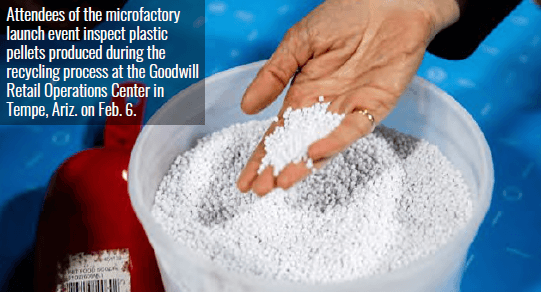 Phoenix —Dozens gathered in an
industrial area of the city in early
February to tour a recycling facility
billed as a potential solution to the
world’s plastic crisis. As the visitors
listened, a wall of bins 100 feet long
and 30 feet wide stood behind them,
filled with just a week’s worth of plastics
from local Goodwills.
The plan, city leaders, experts from
Arizona State University and community
partners said, offered not a revolutionary
technology but a rethinking
of how the plastic recycling industry
works. Common plastic products that
people don’t typically recycle would be
collected at local Goodwill stores and
sent to this new “microfactory.” Here,
they’d be washed and shredded, melted
down, and then turned into pellets.
From there, they can make products
and sell them to the local community
or just sell the pellets to larger
manufacturers.
Put it all together and it could be part
of a circular economy that makes products
out of waste materials rather than
using new natural resources, with all
stages of the plastic recycling process
taking place under one roof, employing
locals and helping to minimize the
amount of traveling and emissions
needed to turn a piece of broken plastic
into something new rather than waste
in a landfill or the world’s oceans. If
they could make the microfactory work
in Phoenix, the tour organizers said,
it could spread a new way of recycling
around the globe. ...
Read full text:
Phoenix —Dozens gathered in an
industrial area of the city in early
February to tour a recycling facility
billed as a potential solution to the
world’s plastic crisis. As the visitors
listened, a wall of bins 100 feet long
and 30 feet wide stood behind them,
filled with just a week’s worth of plastics
from local Goodwills.
The plan, city leaders, experts from
Arizona State University and community
partners said, offered not a revolutionary
technology but a rethinking
of how the plastic recycling industry
works. Common plastic products that
people don’t typically recycle would be
collected at local Goodwill stores and
sent to this new “microfactory.” Here,
they’d be washed and shredded, melted
down, and then turned into pellets.
From there, they can make products
and sell them to the local community
or just sell the pellets to larger
manufacturers.
Put it all together and it could be part
of a circular economy that makes products
out of waste materials rather than
using new natural resources, with all
stages of the plastic recycling process
taking place under one roof, employing
locals and helping to minimize the
amount of traveling and emissions
needed to turn a piece of broken plastic
into something new rather than waste
in a landfill or the world’s oceans. If
they could make the microfactory work
in Phoenix, the tour organizers said,
it could spread a new way of recycling
around the globe. ...
Read full text:
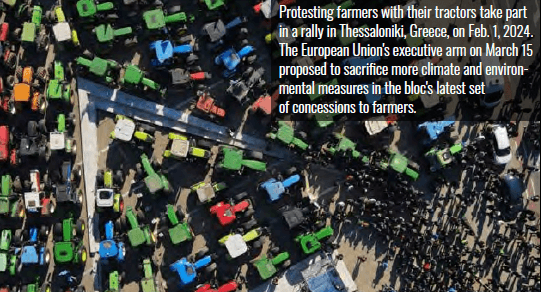 The European Union’s executive arm
Friday [March 15] proposed sacrificing
even more climate and environmental
measures in the bloc’s latest set
of concessions to farmers apparently
bent on continuing disruptive tractor
protests until the June EU elections.
Angering environmentalists across
the 27 nations, the Commission proposed
to further loosen rules imposed
on agriculture that they said, not so
long ago, were inherent parts of the
bloc’s strategy to become climate neutral
by 2050. That iconic challenge put
the EU in the global vanguard of fighting
climate change.
“The main goal of these legislative
proposals is to further ease the administrative
burden for EU farmers and give
farmers and Member States greater flexibility for complying with certain
environmental conditionalities,” said a
statement from Ursula von der Leyen’s
Commission.
Under the proposals, the conditions
to move farming to become more climate
friendly were weakened or cut in
areas such as crop rotation, soil cover
protection and tillage methods. And
small farmers, representing some twothirds
of the workforce and the most
active within the continentwide protest
movement, will be exempt from some
controls and penalties under the new
rules. Politically, the bloc has moved
rightward over the past year and the
plight of farmers has become a rallying
cry for populists and conservatives who
claim ...
Read full text:
The European Union’s executive arm
Friday [March 15] proposed sacrificing
even more climate and environmental
measures in the bloc’s latest set
of concessions to farmers apparently
bent on continuing disruptive tractor
protests until the June EU elections.
Angering environmentalists across
the 27 nations, the Commission proposed
to further loosen rules imposed
on agriculture that they said, not so
long ago, were inherent parts of the
bloc’s strategy to become climate neutral
by 2050. That iconic challenge put
the EU in the global vanguard of fighting
climate change.
“The main goal of these legislative
proposals is to further ease the administrative
burden for EU farmers and give
farmers and Member States greater flexibility for complying with certain
environmental conditionalities,” said a
statement from Ursula von der Leyen’s
Commission.
Under the proposals, the conditions
to move farming to become more climate
friendly were weakened or cut in
areas such as crop rotation, soil cover
protection and tillage methods. And
small farmers, representing some twothirds
of the workforce and the most
active within the continentwide protest
movement, will be exempt from some
controls and penalties under the new
rules. Politically, the bloc has moved
rightward over the past year and the
plight of farmers has become a rallying
cry for populists and conservatives who
claim ...
Read full text:
 Content metadata specialist Gracenote
is joining forces with leading
advocates for equitable representation
in media on a new Studio System
feature, Diversity Spotlight. The
enhancement leverages insights from
IllumiNative, Gold House, RespectAbility,
National Hispanic Media Coalition
(NHMC) and Coalition of Asian Pacifics
in Entertainment (CAPE) to highlight
people and projects that meet a range
of diversity-specific criteria and open
new casting, funding and collaboration
opportunities.
By raising the visibility of diverse
talent and representative projects
among Studio System’s broad industry
user base, Gracenote and its advocacy
group partners are accelerating efforts
to bring more equitable representation
and authentic content to viewers.
A recent Attitudes on Representation
Study conducted by Nielsen found that
a majority of US audiences wanted to
see more of their identity group in programming,
underscoring the demand
and highlighting the opportunity.
Despite the industry’s pledges to
improve diversity, equity and inclusion,
many groups still remain underrepresented
in TV content compared to
their respective population estimates.
For example, Latinx representation in
programming is only 5.7% although the
group makes up 20% of the US population
according to Gracenote Inclusion
Analytics data. Similarly, representation
of disabled people is only 6.6% despite
the fact that one in four Americans has
a disability. ...
Read full text:
Content metadata specialist Gracenote
is joining forces with leading
advocates for equitable representation
in media on a new Studio System
feature, Diversity Spotlight. The
enhancement leverages insights from
IllumiNative, Gold House, RespectAbility,
National Hispanic Media Coalition
(NHMC) and Coalition of Asian Pacifics
in Entertainment (CAPE) to highlight
people and projects that meet a range
of diversity-specific criteria and open
new casting, funding and collaboration
opportunities.
By raising the visibility of diverse
talent and representative projects
among Studio System’s broad industry
user base, Gracenote and its advocacy
group partners are accelerating efforts
to bring more equitable representation
and authentic content to viewers.
A recent Attitudes on Representation
Study conducted by Nielsen found that
a majority of US audiences wanted to
see more of their identity group in programming,
underscoring the demand
and highlighting the opportunity.
Despite the industry’s pledges to
improve diversity, equity and inclusion,
many groups still remain underrepresented
in TV content compared to
their respective population estimates.
For example, Latinx representation in
programming is only 5.7% although the
group makes up 20% of the US population
according to Gracenote Inclusion
Analytics data. Similarly, representation
of disabled people is only 6.6% despite
the fact that one in four Americans has
a disability. ...
Read full text:
 For most of the world, restrictions
put in place during the Covid-19
pandemic are a distant memory. In
North Korea, however, key pandemicrelated
restrictions are still in place.
In 2020, as the global pandemic
raged, North Korea’s government
largely sealed its border with neighboring
China. It imposed excessive
and unnecessary quarantines and new
restrictions on economic activity and
freedom of movement.
These measures have severely undermined
food security in the country.
Previously, many products North
Koreans needed to survive entered the
country from China through formal
and informal trade routes. The Covidrelated
restrictions have worsened the
already grave humanitarian and human
rights situation in the country. UN Security Council sanctions from
2016 and 2017, which limited most
exports and some imports, add to
the difficulties. The intention of the
sanctions may have been to try to
push the North Korean government to
moderate some of its more unhinged
geopolitical actions.
However, the sanctions have had the
unintentional effect of hurting ordinary
North Koreans. Their economic impact
has harmed people’s ability to make
a living and access food and essential
goods. In a sense, people are caught
between the hammer of an extremely
abusive government and the anvil of
an international community, which is
so frustrated with the ...
For most of the world, restrictions
put in place during the Covid-19
pandemic are a distant memory. In
North Korea, however, key pandemicrelated
restrictions are still in place.
In 2020, as the global pandemic
raged, North Korea’s government
largely sealed its border with neighboring
China. It imposed excessive
and unnecessary quarantines and new
restrictions on economic activity and
freedom of movement.
These measures have severely undermined
food security in the country.
Previously, many products North
Koreans needed to survive entered the
country from China through formal
and informal trade routes. The Covidrelated
restrictions have worsened the
already grave humanitarian and human
rights situation in the country. UN Security Council sanctions from
2016 and 2017, which limited most
exports and some imports, add to
the difficulties. The intention of the
sanctions may have been to try to
push the North Korean government to
moderate some of its more unhinged
geopolitical actions.
However, the sanctions have had the
unintentional effect of hurting ordinary
North Koreans. Their economic impact
has harmed people’s ability to make
a living and access food and essential
goods. In a sense, people are caught
between the hammer of an extremely
abusive government and the anvil of
an international community, which is
so frustrated with the ...
 The wild population of Mexican
wolves saw another year of growth
in 2023, according to the results of
the annual survey. The 2023 population
census revealed a minimum of
257 Mexican wolves distributed across
Arizona and New Mexico. This increase
marks the eighth consecutive year of
population growth, the longest continuous
streak since recovery efforts began.
The 2023 population minimum count
represents a six percent increase from
the minimum of 242 wolves counted in
2022. Survey results show the population
is distributed with a minimum of 144
wolves in New Mexico and 113 in Arizona.
“In the aggregate, the 2023 data
points out that Mexican wolf recovery
has come a long way since the first
release,” said Jim deVos, Arizona Game and Fish Department Mexican Wolf Coordinator.
“Each year, the free-roaming
Mexican wolf population numbers
increase and the areas they occupy
expands. Genetic management using
pups from captivity is also showing
results. In total, 99 pups carefully selected
for their genetic value have been
placed in 40 wild dens since 2016, and
some of these fosters have produced
litters of their own. While recovery is in
the future, examining the last decade of
data certainly provides optimism that
recovery will be achieved.”
Mexican wolf population information
is gathered from November through
February by the Interagency Field Team.
During this time, the field team conducts
...
The wild population of Mexican
wolves saw another year of growth
in 2023, according to the results of
the annual survey. The 2023 population
census revealed a minimum of
257 Mexican wolves distributed across
Arizona and New Mexico. This increase
marks the eighth consecutive year of
population growth, the longest continuous
streak since recovery efforts began.
The 2023 population minimum count
represents a six percent increase from
the minimum of 242 wolves counted in
2022. Survey results show the population
is distributed with a minimum of 144
wolves in New Mexico and 113 in Arizona.
“In the aggregate, the 2023 data
points out that Mexican wolf recovery
has come a long way since the first
release,” said Jim deVos, Arizona Game and Fish Department Mexican Wolf Coordinator.
“Each year, the free-roaming
Mexican wolf population numbers
increase and the areas they occupy
expands. Genetic management using
pups from captivity is also showing
results. In total, 99 pups carefully selected
for their genetic value have been
placed in 40 wild dens since 2016, and
some of these fosters have produced
litters of their own. While recovery is in
the future, examining the last decade of
data certainly provides optimism that
recovery will be achieved.”
Mexican wolf population information
is gathered from November through
February by the Interagency Field Team.
During this time, the field team conducts
...
 Nepenthes carnivorous plants look
like toilets, trapping insects and
other small creatures in a bowl-shaped
pitcher with an overhanging lid. But
some species of nepenthes growing on
mountains in Borneo have given up
carnivory and instead encourage animals
to poo in their pitchers.
This toilet habit was discovered when
mountain tree shrews were found sitting
on the enormous pitchers of nepenthes
lowii, and as the shrews licked fatty food
oozing from the lid of the pitcher they
plopped their droppings inside. It was
later found that rats, bats and a bird also
made use of the plant toilets.
Other nepenthes species were also
found collecting animal droppings,
such as nepenthes hemsleyana, which
even advertises itself to a particular
species of bat using the shape of its pitchers to reflect the animal’s ultrasound
calls. The pitchers provide a
special ridge for the bat to cling on to
while it relieves itself.
All these plants grow on mountain
peaks where insects are scarce, making
carnivory very difficult. But the poo
habit was found to be so nutritious it
gave these pitcher plants more than
twice the nitrogen of prey caught by
carnivorous nepenthes plants. ...
Nepenthes carnivorous plants look
like toilets, trapping insects and
other small creatures in a bowl-shaped
pitcher with an overhanging lid. But
some species of nepenthes growing on
mountains in Borneo have given up
carnivory and instead encourage animals
to poo in their pitchers.
This toilet habit was discovered when
mountain tree shrews were found sitting
on the enormous pitchers of nepenthes
lowii, and as the shrews licked fatty food
oozing from the lid of the pitcher they
plopped their droppings inside. It was
later found that rats, bats and a bird also
made use of the plant toilets.
Other nepenthes species were also
found collecting animal droppings,
such as nepenthes hemsleyana, which
even advertises itself to a particular
species of bat using the shape of its pitchers to reflect the animal’s ultrasound
calls. The pitchers provide a
special ridge for the bat to cling on to
while it relieves itself.
All these plants grow on mountain
peaks where insects are scarce, making
carnivory very difficult. But the poo
habit was found to be so nutritious it
gave these pitcher plants more than
twice the nitrogen of prey caught by
carnivorous nepenthes plants. ...

 A Fresh Air Monitor™
improving your indoor climate
and health. When the air quality
is poor Canairi® will drop down,
until you open the window to bring it
back to life. Simple as that.
www.kickstarter.com
A Fresh Air Monitor™
improving your indoor climate
and health. When the air quality
is poor Canairi® will drop down,
until you open the window to bring it
back to life. Simple as that.
www.kickstarter.com
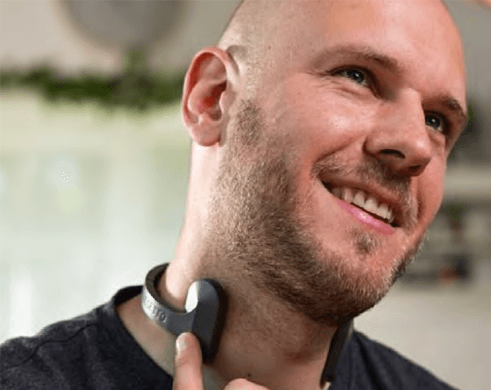 This vagus nerve
stimulation device
helps you relax in
under 10 minutes.
Sit back, close your
eyes, and let the
Pulsetto wave
of calmness wash
away your stress
and anxiety.
pulsetto.tech
This vagus nerve
stimulation device
helps you relax in
under 10 minutes.
Sit back, close your
eyes, and let the
Pulsetto wave
of calmness wash
away your stress
and anxiety.
pulsetto.tech


 In a Bachelor’s program in Oil, Gas,
and Energy Engineering, students
delve into a comprehensive array of
core courses and topics essential for
understanding the complexities of energy
systems. The curriculum typically
covers a range of subjects, such as
Energy Systems Engineering, providing
insights into the design, analysis,
and optimization of energy systems
for various applications.
Additionally, students explore
Renewable Energy technologies and
their integration into existing infrastructure,
preparing them for the
transition toward sustainable energy
sources. Furthermore, core courses
may include specialized topics like
Offshore Engineering, which focuses
on the unique challenges and strategies
in offshore oil and gas exploration
and production. Through a blend
of unique theoretical knowledge and
practical applications, students in
this program develop the skills necessary
to address the evolving needs
of the energy industry while fostering
innovation and sustainability.
Our program does not require every
student to study the same subjects
and use the same books and other
learning materials as every other
student. If you are a purpose-driven
individual who wants to elevate their
life and make a solid contribution to
the world, then this program is for you
In a Bachelor’s program in Oil, Gas,
and Energy Engineering, students
delve into a comprehensive array of
core courses and topics essential for
understanding the complexities of energy
systems. The curriculum typically
covers a range of subjects, such as
Energy Systems Engineering, providing
insights into the design, analysis,
and optimization of energy systems
for various applications.
Additionally, students explore
Renewable Energy technologies and
their integration into existing infrastructure,
preparing them for the
transition toward sustainable energy
sources. Furthermore, core courses
may include specialized topics like
Offshore Engineering, which focuses
on the unique challenges and strategies
in offshore oil and gas exploration
and production. Through a blend
of unique theoretical knowledge and
practical applications, students in
this program develop the skills necessary
to address the evolving needs
of the energy industry while fostering
innovation and sustainability.
Our program does not require every
student to study the same subjects
and use the same books and other
learning materials as every other
student. If you are a purpose-driven
individual who wants to elevate their
life and make a solid contribution to
the world, then this program is for you
 Atlantic International University is accredited by the Accreditation Service for International
Schools, Colleges and Universities (ASIC). ASIC Accreditation is an internationally
renowned quality standard for colleges and universities. Visit ASIC’s Directory of Accredited
Colleges and Universities. ASIC is a member of CHEA International Quality Group
(CIQG) in the USA, an approved accreditation body by the Ministerial Department of the Home Office
in the UK, and is listed in the International Directory of the Council for Higher Education Accreditation
(CHEA). The University is based in the United States and was established by corporate charter in 1998.
Atlantic International University is accredited by the Accreditation Service for International
Schools, Colleges and Universities (ASIC). ASIC Accreditation is an internationally
renowned quality standard for colleges and universities. Visit ASIC’s Directory of Accredited
Colleges and Universities. ASIC is a member of CHEA International Quality Group
(CIQG) in the USA, an approved accreditation body by the Ministerial Department of the Home Office
in the UK, and is listed in the International Directory of the Council for Higher Education Accreditation
(CHEA). The University is based in the United States and was established by corporate charter in 1998.
 In some cases, accredited colleges
may not accept for transfer courses and degrees
completed at unaccredited colleges, and some
employers may require an accredited degree as
a basis for eligibility for employment. Potential
students should consider how the above may affect
their interests, AIU respects the unique rules and
regulations of each country and does not seek to
influence the respective authorities. In the event
that a prospective student wishes to carry out any
government review or process in regards to his
university degree, we recommend that the requirements
of such are explored in detail with the relevant
authorities by the prospective student as the
university does not intervene in such processes.
AIU students can be found in over 180 countries,
they actively participate and volunteer
in their communities as part of their academic
program and have allocated thousands of service
hours to diverse causes and initiatives. AIU
programs follow the standards commonly used by
colleges and universities in the United States with
regards to the following: academic program
structure, degree issued, transcript, and
other graduation documents.
AIU graduation documents can include
an apostille and authentication from the
US Department of State to facilitate their
use internationally.
In some cases, accredited colleges
may not accept for transfer courses and degrees
completed at unaccredited colleges, and some
employers may require an accredited degree as
a basis for eligibility for employment. Potential
students should consider how the above may affect
their interests, AIU respects the unique rules and
regulations of each country and does not seek to
influence the respective authorities. In the event
that a prospective student wishes to carry out any
government review or process in regards to his
university degree, we recommend that the requirements
of such are explored in detail with the relevant
authorities by the prospective student as the
university does not intervene in such processes.
AIU students can be found in over 180 countries,
they actively participate and volunteer
in their communities as part of their academic
program and have allocated thousands of service
hours to diverse causes and initiatives. AIU
programs follow the standards commonly used by
colleges and universities in the United States with
regards to the following: academic program
structure, degree issued, transcript, and
other graduation documents.
AIU graduation documents can include
an apostille and authentication from the
US Department of State to facilitate their
use internationally.
| Dr. Franklin Valcin Presi den t/Academic Dean |
Dr. José Mercado Chief Executive Officer Chairman of the Board of Trustees |
Ricardo González, PhD Provost |
| Dr. Ricardo Gonzalez Chief Operation Officer and MKT Director |
Linda Collazo Logistics Coordinator |
AIU Tutors Coordinators: Deborah Rodriguez Amiakhor Ejaeta Amanda Gutierrez William Mora Miriam James Admissions Coordinators: Amalia Aldrett Sandra Garcia Junko Shimizu Veronica Amuz Alba Ochoa Jenis Garcia Judith Brown Chris Soto René Cordón Dr. Anderas Rissler Academic Coordinators: Dr. Adesida Oluwafemi Dr. Emmanuel Gbagu Dr. Lucia Gorea Dr. Edgar Colon Dr. Mario Rios Freddy Frejus Dr. Nilani Ljunggren De Silva Dr. Scott Wilson Dr. Mohammad Shaidul Islam |
| Dr. Miriam Garibaldi Vice provost for Research |
Carolina Valdes Human Resource Coordinator |
|
| Dr. Ofelia Miller Director of AIU |
Carlos Aponte Teleco mmunications Coordinator |
|
| Clara Margalef Director of Special Projects of AIU |
David Jung Corporate/Legal Counsel |
|
| Juan Pablo Moreno Director of Operations |
Bruce Kim Advisor/Consultant |
|
| Paula Viera Director of Intelligence Systems |
Thomas Kim Corporate/ Accounting Counsel |
|
| Felipe Gomez Design Director / IT Supervisor |
Maricela Esparza Administrative Coordinator |
|
| Kevin Moll Web Designer |
Chris Benjamin IT and Hosting Support |
|
| Daritza Ysla IT Coordinator |
Maria Pastrana Accounting Coordinator |
|
| Daritza Ysla IT Coordinator |
Roberto Aldrett Communications Coordinator |
|
| Nadeem Awan Chief Programming Officer |
Giovanni Castillo IT Support |
|
| Dr. Edward Lambert Academic Director |
Antonella Fonseca Quality Control & Data Analysis |
|
| Dr. Ariadna Romero Advisor Coordinator |
Adrián Varela Graphic Design |
|
| Jhanzaib Awan Senior Programmer |
Vanesa D’Angelo Content Writer |
|
| Leonardo Salas Human Resource Manager |
Jaime Rotlewicz Dean of Admissions |
|
| Benjamin Joseph IT and Technology Support |
Michael Phillips Registrar’s Office |
|
| Rosie Perez Finance Coordinator |
||
 The School of Business and Economics
allows aspiring and practicing
professionals, managers, and entrepreneurs
in the private and public sectors
to complete a self paced distance
learning degree program of the highest
academic standard.
The ultimate goal is to empower
learners and help them take advantage
of the enormous array of resources
from the world environment in order
to eliminate the current continuum of
poverty and limitations.
Degree programs are designed for
those students whose professional experience has been in business,
marketing, administration, economics,
finance and management.
The School of Business and Economics
allows aspiring and practicing
professionals, managers, and entrepreneurs
in the private and public sectors
to complete a self paced distance
learning degree program of the highest
academic standard.
The ultimate goal is to empower
learners and help them take advantage
of the enormous array of resources
from the world environment in order
to eliminate the current continuum of
poverty and limitations.
Degree programs are designed for
those students whose professional experience has been in business,
marketing, administration, economics,
finance and management.
 The School of Social and Human Studies
is focused on to the development of
studies which instill a core commitment
to building a society based on social and
economic justice and enhancing opportunities
for human well being.
The founding principles lie on the
basic right of education as outlined
in the Declaration of Human Rights.
We instill in our students a sense of
confidence and self reliance in their
ability to access the vast opportunities
available through information channels,
the world wide web, private, public,
nonprofit, and nongovernmental organizations in an ever expanding
global community.
Degree programs are aimed towards
those whose professional life has been
related to social and human behavior,
with the arts, or with cultural studies.
The School of Social and Human Studies
is focused on to the development of
studies which instill a core commitment
to building a society based on social and
economic justice and enhancing opportunities
for human well being.
The founding principles lie on the
basic right of education as outlined
in the Declaration of Human Rights.
We instill in our students a sense of
confidence and self reliance in their
ability to access the vast opportunities
available through information channels,
the world wide web, private, public,
nonprofit, and nongovernmental organizations in an ever expanding
global community.
Degree programs are aimed towards
those whose professional life has been
related to social and human behavior,
with the arts, or with cultural studies.
 The School of Science and Engineering
seeks to provide dynamic, integrated,
and challenging degree programs
designed for those whose experience
is in industrial research, scientific production,
engineering and the general
sciences. Our system for research and
education will keep us apace with the
twenty-first century reach scientific
advance in an environmentally and
ecologically responsible manner to allow
for the sustainability of the human
population. We will foster among our
students a demand for ethical behavior,
an appreciation for diversity, an understanding
of scientific investigation, knowledge of design innovation, a
critical appreciation for the importance
of technology and technological change
for the advancement of humanity.
The School of Science and Engineering
seeks to provide dynamic, integrated,
and challenging degree programs
designed for those whose experience
is in industrial research, scientific production,
engineering and the general
sciences. Our system for research and
education will keep us apace with the
twenty-first century reach scientific
advance in an environmentally and
ecologically responsible manner to allow
for the sustainability of the human
population. We will foster among our
students a demand for ethical behavior,
an appreciation for diversity, an understanding
of scientific investigation, knowledge of design innovation, a
critical appreciation for the importance
of technology and technological change
for the advancement of humanity.
 With access to a global catalog created and maintained collectively by more than
9,000 participating institutions, AIU students have secured excellent research
tools for their study programs.
With access to a global catalog created and maintained collectively by more than
9,000 participating institutions, AIU students have secured excellent research
tools for their study programs.