Put Game Theory to Work in Your Life: Winning Beyond the Board
Life is full of choices, big and small. From negotiating a raise to deciding how to spend the weekend – every decision interacts with the choices of others. Hence, game theory, the study of strategic decision-making is much more than just for economists or mathematicians. It is a practical toolkit that can help an individual anticipate others to plan one’s own moves and make smarter choices in everyday life. Here’s how you can put it to work.
Source: GR Stocks on Unsplash
Understanding Game Theory: More Than Just Numbers
At its core – the game theory studies situations in which multiple players make decisions that affect each other’s outcomes. The classic example is the Prisoner’s Dilemma where two criminals are arrested and interrogated separately. If both stay silent – they get light sentences. If one betrays the other – the betrayer goes free while the other faces a harsh sentence. If both betray – both face moderate punishment. Now, the dilemma lies in predicting what the other will do and therefore balance self-interest with cooperation. This framework isn’t just theoretical. Every negotiation, friendship, romantic relationship, and career move can be analyzed as a “game” where your success depends on anticipating others’ actions and reacting strategically.
Game Theory in Everyday Life
According to secondary research, negotiations and strategic career moves require game theory more than anything. Negotiations can be about anything – asking for a raise or pitching a project. A game theory can teach one to consider the incentives of the other party. So, while negotiating a salary increase, one can consider what the employer values the most over just the demand for the raise. Hence, framing the request to align with priorities such as – retention, budget efficiency, or project success can ensure a “win-win” scenario.
Relationships and social dynamics associated with it also depend upon how well one understands the game theory. Interactions in personal relationships can be seen through a game-theory lens. The Iterated Prisoner’s Dilemma, where the same players interact repeatedly, shows that cooperation often yields better long-term results than selfishness. Hence, trust builds stronger bonds – because a person’s actions influence future behavior. People cooperate better with consistent fairness from the other party.
Decision-making under uncertain situations teaches one life lessons. Life often requires making decisions with incomplete information. This is where the game theory helps by emphasizing probabilities and strategic foresight. For example – choosing a new city to live in or a career path involves weighing potential benefits against risks, including how others might respond to the choices.
It’s time to row in the same direction because success depends on it
Source: VALC LLC
Key Game Theory Concepts for Everyday Life
The ideas of game theory, which help us understand strategic decisions, can be applied to many parts of our daily lives. For example, a dominant strategy is a choice that’s always one’s best move – no matter what anyone else does. It is like having a universal skill that guarantees a positive outcome. For example – one can benefit with improvement in time management or communication abilities, no matter the situation. These skills are always valuable.
When everyone in a group is doing their best – given what others are doing – then you’ve reached a Nash equilibrium. This is a stable state where no one can improve their position by changing their actions alone. For instance, in a group project – when every team member contributes fairly – no one feels the burden of overwork because the system and responsibility is well distributed and balanced. Most importantly, everyone is doing their part. This balance reduces conflict and creates a predictable and cooperative ecosystem to enhance the success rate.
The third key concept holds an important place where it is important to know if one is in a zero-sum or a non-zero-sum game. In a zero-sum situation – one person’s gain is another’s loss especially in a direct competition environment. But in a non-zero-sum game – cooperation can lead to a bigger gain for everyone involved. For instance – with knowledge sharing between coworkers – it is not about only giving away something. Rather, through collaboration one can help to improve results for the entire team – making it a win for everyone rather than a loss for one. Understanding this difference is critical – because it can help an individual decide whether to compete or collaborate.
There are certain real-life applications of this game theory that can enhance the understanding of how to apply it. In this regard, focusing on long-term alliances and reputation can be more valuable than short-term wins. Again, negotiating chores or responsibilities by understanding everyone’s incentives reduces tension and promotes cooperation. Finally, it is important in financial decisions since investing, saving, or starting a new venture requires a fair amount of anticipation of other’s actions and market responses to minimize risk.
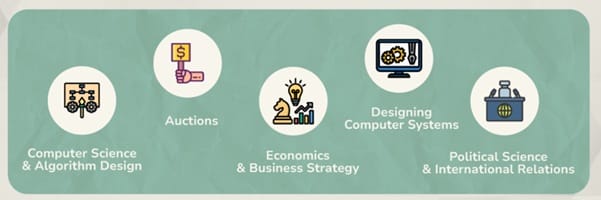
Applications of game theory
Source: Geeksforgeeks
Conclusion: Your Life as a Strategic Game
Life is a series of interconnected “games” – so, mastering the principles of game theory can help an individual navigate them more effectively. By understanding incentives, anticipating moves, and planning strategically, anyone can – improve relationships, make smarter decisions, and achieve better outcomes. Although game theory doesn’t guarantee a perfect life – but it does give a framework to play smarter, not harder. The objective is to turn everyday challenges into opportunities to win.
If this article triggers curiosity about how strategic thinking can improve your everyday decisions, relationships, and career then AIU offers a list of Mini courses, Blogs, News articles and many more on related topics that one can access such as:
AIU also offers a comprehensive array of recorded live classes spanning various subjects. If any topic piques your interest, you can explore related live classes. Furthermore, our expansive online library houses a wealth of knowledge, comprising thousands of e-books, thereby serving as a valuable supplementary resource.
Reference
Reminder to our Dear Students,
Please ensure you are logged in as a student on the AIU platform and logged into the AIU Online
Library before accessing course links. This step is crucial for uninterrupted access to your learning
resources.